'Home run' study on spread of disease published
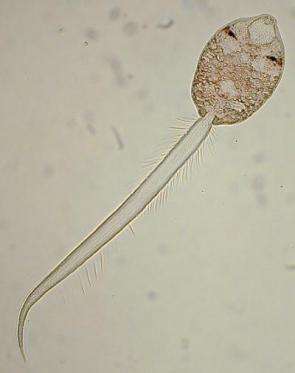
A paper that authors are calling a "home run" study on the spread of disease is published in this week’s issue of the Proceedings of the National Academy of Sciences.
The study traces -- through genetic analysis -- the accidental introduction of invasive snails with parasitic flatworms. The invaders were probably transported with Japanese seed oysters imported into the waters of the Pacific Northwest over a century ago. It is the first comprehensive genetic analysis of an invasive marine host and its parasites. The study points to broad implications for identifying and mitigating spreading disease in a globalized economy.
Understanding the invasion pathways of disease-causing organisms and their hosts is key in limiting future disease outbreaks — in humans, in agriculture, and in wildlife.
Co-author Armand Kuris, professor of zoology in the Department of Ecology, Evolution and Marine Biology at the University of California, Santa Barbara, is one of a handful of experts who have been studying the ecology of parasites since the 1960s, an area of research that Kuris reports is understudied because parasites are so often invisible. He calls this PNAS paper a home run because it describes a complete picture of biological invasions. He explained that the imported snail has wiped out the native snails, changing the ecosystems of the Northwest.
"Little did the American oystermen of the early 1900s know that their activities could impact local fisheries one hundred years later," said Kuris. "Oyster aquaculture brought in many exotic species, including clams, worms, and snails. Importation was done in a crude and sloppy manner; there was little government regulation of these things at the time."
Invasive North American populations of Asian mud snails, Batillaria attramentaria, probably arrived with Pacific oysters, Crassostrea gigas, imported from northern Japan in the early 1900s, according to the scientists. Genetic research has now confirmed this. The team included first author Osamu Miura, a scientist with Tohoku University in Sendai, Japan; colleagues from the Smithsonian Tropical Research Institute in Panama (STRI); and, scientists from UC Santa Barbara.
"We saw a lot of genetic variation among snail populations in Japan but the North American snails are genetically most similar to those from northern Japan, the source of the imported oysters," Miura reports.
"Using genetics we have shown how the pest snail was introduced and that it came with a parasite that infects fishes and birds," said Mark Torchin, a biologist with STRI. Later, a second parasite came that was spread by migratory birds that ate the infected fish in Japan. The process shows that establishment of an invasive pest can lead to later establishment of disease organisms.
Ryan F. Hechinger, a doctoral student at UCSB, explained how the parasitic flatworm, or trematode, castrates the snail, replacing the gonads with its own mass. "The infected snail will never again make snail babies," said Hechinger. "It is now a parasite making machine. It’s basically a robot driven by the parasite."
Hechinger explained that this is the first time that scientists have examined an invasion of a host and a parasite. Migrating birds are bringing one of the trematode parasites; they ingest them when they eat infected fish. The host is a particular snail –- only one species is vulnerable –– and it is used as an intermediate host. The trematode moves on from the snail to burrow into fish. The trematode has permeated the ecosystem’s fish.
Of the eight species of trematode parasites that plague the snails in Japan, only the most common, Cercaria batillariae, has arrived in America. Gene sequencing showed that this single species actually consisted of several cryptic, or similar looking but genetically distinct, species in its home range in Japan. In North America, they commonly found two of the species. One parasite shows much less genetic diversity in America than in Japan, whereas the other parasite is equally diverse in both regions.
"Genetic evidence suggests that while one cryptic parasite species experienced a bottleneck and probably came with the snails, the other was probably historically dispersed by migratory birds and could only establish in North America after the snail hosts arrived," added Torchin. "This is because these trematode parasites have complex life cycles, using snails as first intermediate hosts, fishes as second intermediate hosts and birds as final hosts. As we homogenize biotas as a result of repeated species invasions through global trade, we increase the chances of reuniting infectious agents with suitable hosts."
Parasites which may have historically gone unnoticed as "tourists" in some regions may become pervasive residents after invasion of their missing hosts.
Source: University of California - Santa Barbara


