Europe looks forward to COROT launch
December 19, 2006 Europe looks forward to COROT launch

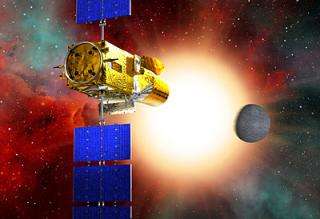
This artist's view shows the COROT satellite, consisting of a 30-centimetre space telescope to be launched in late 2006. COROT will use its telescope to monitor closely the changes in a star’s brightness that comes from a planet crossing in front of it. While it is looking at a star, COROT will also be able to detect ‘starquakes’, acoustical waves generated deep inside a star that send ripples across a star’s surface, altering its brightness. The exact nature of the ripples allows astronomers to calculate the star's precise mass, age and chemical composition. Credits: CNES 2006 - D. Ducros

On 27 December, COROT is to be launched into space on a unique astronomy mission: its twin goals are to detect exoplanets orbiting around other stars and to probe the mysteries of stellar interiors as never before. COROT is a French national space agency (CNES)-led mission to which the European Space Agency and European partners are adding a particularly strong international flavour.

While CNES is completing preparations for the launch from Baikonur/Kazakhstan, ESA and a large number of European scientists involved in the mission are eagerly awaiting this event and the first scientific results to come through.

What is COROT?

COROT stands for 'Convection Rotation and planetary Transits'. The name describes the mission's scientific goals. 'Convection and rotation' refer to the satellite's capability to probe stellar interiors, studying the acoustic waves that ripple across the surface of stars, a technique called asteroseismology. 'Transit' refers to the technique whereby the presence of a planet orbiting a star can be inferred from the dimming starlight caused when the planet passes in front of it. To achieve its twin scientific objectives, COROT will monitor some 120,000 stars with its 30-centimetre telescope.

COROT will lead a bold new search for planets around other stars. In the decade since the first discovery in 1995 of an exoplanet (51 Pegasi b), more than 200 other such planets outside our solar system have been detected using ground-based observatories. The COROT space telescope promises to find many more during its two-and-a-half-year mission, expanding the frontiers of our knowledge towards ever-smaller planets.

Many of the planets COROT will detect are expected to be 'hot Jupiters', gaseous worlds. An unknown percentage of those detected are expected to be rocky planets, maybe just a few times larger than the Earth (or smaller, even). If COROT finds such planets, they will constitute a new class of planet altogether.

While it is looking at a star, COROT will also be able to detect 'starquakes', acoustic waves generated deep inside a star that send ripples across its surface, altering its brightness. The exact nature of the ripples allows astronomers to calculate the star's precise mass, age and chemical composition.

COROT's European dimension

The COROT mission was first proposed by CNES back in 1996. A call for potential European partners was issued in 1999. CNES gave the green light to build the spacecraft in 2000 and is now leading the mission. Its international partners are ESA, Austria, Belgium, Germany, Spain and Brazil.

CNES is responsible for the overall system and for the launch contract with Franco-Russian company Starsem, which is providing the Soyuz launch service.

The contributions of the other international partners range from the provision of hardware items to ground stations, complementary ground-based observation of targets to be studied by COROT and analysis of the scientific data to come.

ESA is playing a crucial role in the mission. It has contributed the optics for the telescope positioned at the heart of the spacecraft and has carried out payload testing. The telescope's baffle was developed by a team at ESA's technical centre ESTEC. ESA has also provided the onboard data processing units. And under this truly collaborative effort, a number of scientists from various European countries - Denmark, Switzerland, the United Kingdom and Portugal - have been selected as Co-Investigators following open competition. As a result of ESA's participation, scientists from its Member States will also be given access to COROT data.

Source: European Space Agency


print this article email this article download pdf blog this article bookmark this article     Stumble it Digg this share on Facebook retweet share on Reddit add to delicious
Rate this story - 2.7 /5 (3 votes)


December 19, 2006 all stories

Comments: 0

2.7 /5 (3 votes)
  • Stumble this up

  • Digg this

  • share this

  • hide
  • Related Stories

  • Young active star resembles the young Sun
    created Dec 23, 2008 | popularity not rated yet | comments 0
  • CoRoT discovery challenges the definition of extra-solar planets
    created Oct 07, 2008 | popularity not rated yet | comments 0
  • COROT discovery stirs exoplanet classification rethink
    created Oct 07, 2008 | popularity not rated yet | comments 0
  • COROT's new find orbits Sun-like star
    created Jul 24, 2008 | popularity not rated yet | comments 0
  • Solar flares set the Sun quaking
    created Apr 18, 2008 | popularity not rated yet | comments 0


  • hide
  • Relevant PhysicsForums posts

  • Gravity on Mars
    created 10 hours ago
  • Question about the orbit between Mars and Earth
    created 18 hours ago
  • SIMBAD/NED help
    created 21 hours ago
  • Black hole confusion
    created Nov 14, 2009
  • More from Physics Forums - General Astronomy

Other News

Close-up movie shows hidden details in the birth of super-suns

Close-up movie shows hidden details in the birth of super-suns (w/ Video)

Space & Earth / Astronomy

created 8 hours ago | popularity 4.8 / 5 (4) | comments 0

(PhysOrg.com) -- The constellation of Orion is a hotbed of massive star formation, most prominently in the Great Nebula that sits in Orion's sword. The glowing gas of the Nebula is powered by a group of young ...


NASA 'Drops' Next Generation Robotic Lander During Autonomous Tests

NASA 'Drops' Next Generation Robotic Lander During Autonomous Tests

Space & Earth / Space Exploration

created 5 hours ago | popularity 4.7 / 5 (3) | comments 1

(PhysOrg.com) -- NASA has successfully completed a series of autonomous "drop" tests of a robotic lander test article - in a record 10 months - to demonstrate the ability to perform a controlled landing on ...


Ghostly 'Spokes' Puff Out From Saturn's Ring's

Ghostly 'Spokes' Puff Out From Saturn's Ring's (w/ Video)

Space & Earth / Space Exploration

created 5 hours ago | popularity 5 / 5 (1) | comments 0

(PhysOrg.com) -- Massive, bright clouds of tiny ice particles hover above the darkened rings of Saturn in an image captured by the Cassini spacecraft on Sept. 22, 2009, around the time of Saturn's equinox. ...


Space shuttle Atlantis lifts off on supply mission (AP)

Space shuttle Atlantis lifts off on supply mission

Space & Earth / Space Exploration

created 5 hours ago | popularity 3.5 / 5 (2) | comments 0

(AP) -- With 100 Internet-savvy NASA fans cheering on the shuttle and churning out constant Twitter updates, Atlantis sailed smoothly into orbit Monday with six astronauts and a full load of spare parts for ...


Volatile gas could turn Rwandan lake into a freshwater time bomb

Space & Earth / Earth Sciences

created 7 hours ago | popularity 5 / 5 (2) | comments 3

A dangerous level of carbon dioxide and methane gas haunts Lake Kivu, the freshwater lake system bordering Rwanda and the Republic of Congo.