Study finds the air rich with bacteria
Want biodiversity? Look no further than the air around you. It could be teeming with more than 1,800 types of bacteria, according to a first-of-its-kind census of airborne microbes recently conducted by scientists from the U.S. Department of Energy's Lawrence Berkeley National Laboratory.
The team used an innovative DNA test to catalog the bacteria in air samples taken from the Texas cities of San Antonio and Austin. Surprisingly, they found a widely varied bacterial population that rivals the diversity found in soil. They also found naturally occurring relatives of microbes that could be used in bioterrorist attacks -- although many of these relatives are harmless.
"Before this study, no one had a sense of the diversity of the microbes in the air," says lead author Gary Andersen of Berkeley Lab's Earth Sciences Division.
The research, which will be published this week in the online early edition of the Proceedings of the National Academy of Sciences, serves two purposes. It paves the way for regional bacterial censuses that will help a Department of Homeland Security bioterrorism surveillance program differentiate between normal and suspicious fluctuations in airborne pathogens. It will also help scientists establish a baseline of airborne microbes, which they can use to track how climate change affects bacterial populations.
"We want to determine the background levels of airborne pathogens and other microbes because only very limited work has been conducted on cataloging organisms in the air," says Andersen. "This work underscores how much we don't know about airborne bacterial populations, or where the bacteria come from."
In the past, scientists relied on bacterial cultures to determine what microbes are present in an air sample. In this method, the culture media is exposed to the sample, and whatever grows is counted. Unfortunately, this approach leaves out all of the organisms that can't survive in the culture, which in some cases is as much as 99 percent of the bacteria in a sample.
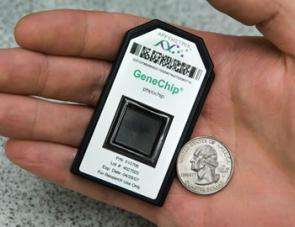
In this census, however, Andersen and colleagues used a vastly more comprehensive test developed by Todd DeSantis, who is also with Berkeley Lab's Earth Sciences Division. Their DNA microarray probes air samples for a gene involved in making proteins, called 16S rRNA, which is found in all bacteria. The square-shaped microarray, which is called PhyloChip and is roughly the size of a quarter, can detect up to 9,000 different types of this gene, each unique to a different type of bacteria. The microarray is sensitive enough to differentiate among these thousands of gene sequences, meaning it can analyze an air sample and list every type of organism present.
To conduct the study, daily air samples were taken at several locations in San Antonio and Austin over a 17-week period. The samples were sent to Berkeley Lab where they were analyzed by the microarray. It found 1,800 types of bacteria, including some pathogens, wafting in the air over the two cities. This diverse population matches the complexity of soil populations, which is considered to be one of the richest habitats for microbes.
The scientists also sought to determine whether background levels of airborne bacteria change from city to city, or are generally the same throughout a region. To explore this question, they chose Austin and San Antonio because the two cities have similar population densities, elevation and topography, and they are only about 100 kilometers apart. After taking into account these similarities, they determined that the two cities shared a similar microbial composition.
"This gives us hope that we can eventually develop a regional airborne microbial census, perhaps even a nationwide or global census," says Andersen. "This will also help us determine the sources of airborne bacteria. Does it come from nearby farms and water treatment plants, or is it imported by the wind from another state or country?"
The team also determined that location was not as strong a source of microbial variation as time and weather. Specifically, the time of the year during the 17-week testing period was the most significant source of variation, followed by atmospheric conditions. For example, warmer and dryer conditions led to increased amounts of spore-forming bacteria.
"This information may help explain temporal spikes, which is important in bioterror surveillance," adds Eoin Brodie, also with Berkeley Lab's Earth Sciences Division. "A spike may not be due to a biological attack, but to normal weather fluctuations that draw bacteria up from their natural reservoir."
In this way, bacterial censuses can help explain whether a pathogen's presence is natural or indicative of a biological attack. In one example, the team detected relatives of Francisella tularensis, a naturally occurring bacterium that causes tularemia, also known as rabbit fever. This especially potent bacterium is a possible candidate as a bioterror weapon. But it's also very common. Tularemia has been reported in all U.S. states except Hawaii. This natural background can confound the detection of a terrorist attack and trigger false alarms. The trick is to determine whether the amount of F. tularensis detected in an air sample is in synch with normal levels, or if it's suspicious.
"Almost all of the bacterial bioterror pathogens are in the environment and in the air naturally, so we need to find their natural backgrounds," says Andersen.
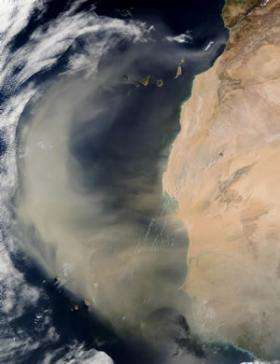
An airborne bacterial census will also enable scientists to track how climate change impacts the microbial composition of the atmosphere. This process is already occurring. Wind-blown dust and biomass from Africa's expanding Sahara desert are reaching North America in significant quantities. Recent research links this dust to an increase in asthma cases in the Caribbean.
"We need to determine what's in the air, so we can determine how climate change affects microbial diversity," says Andersen. "We found that there are a lot of airborne bacteria, including pathogens, which we did not know are out there."
Source: Lawrence Berkeley National Laboratory


