Synchrotrons Help Reveal the Nature of Comets
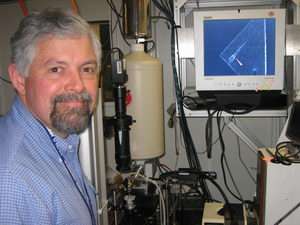
Cometary particles returned to Earth by the Stardust spacecraft are yielding precious information about the origin of the solar system, thanks in part to a collaboration that includes the Stanford Synchrotron Radiation Laboratory (SSRL) and several other of the world's synchrotron light-source facilities.
Although the particles are tiny, the x-ray beams available at synchrotrons can be even smaller, enabling researchers to illuminate the cometary material and in some cases determine the distribution of elements within the particles without damaging them. These results describe the overall chemistry of the samples returned by Stardust, and are published as part of a special series of papers in the Dec. 15, 2006, edition of the journal Science.
"Information from this comet is important because it should be close to the starting material from the beginning of the solar system," said SSRL researcher Sean Brennan. These materials, which have spent most of their time in the distant reaches beyond the orbit of Jupiter, have remained unaltered by the intense environment of the inner Solar System. "As soon as you turn on the nuclear reaction called the Sun, you start changing the material close to it," he says.
Stardust Looks Into the Past
Our Solar System is about 4.5 billion years old, and the details of its origin are still a mystery to researchers. Scientists theorize that large, interstellar dust clouds give rise to new stars and planetary systems. As these dust clouds collapse, a central star forms, surrounded by a rotating disk of dense gas. The planets of our Solar System likely coalesced from one of these disks.
Wild 2 is believed to have originated within a cloud of comets just beyond the orbit of Neptune called the Kuiper Belt. Because Kuiper Belt objects spend most of their time far away from the Sun, researchers suspect they remain unchanged by radiation, heating and aqueous alteration and therefore are likely to carry intact material from the earliest ages of the Solar System.
Scientists compared the samples of the Stardust mission to the chemistry of the most primitive meteorites found on Earth, which are believed to be samples left over from the formation of the Solar System. The samples contain a wide variety of minerals and organic materials that look similar to those seen in the primitive meteorites. But the samples also revealed the presence of new materials as well. The chemical analysis of the Stardust samples could therefore improve our understanding of the chemistry of the early Solar System.
The researchers also discovered that the samples contained minerals similar to compounds in meteorites known to have formed at high temperatures. These compounds, called Calcium Aluminum-rich inclusions (CAIs), are believed to have formed in the innermost part of the solar nebula, well inside the orbit of Mercury. This discovery could challenge the belief that comets formed only beyond the orbit of Jupiter, suggesting that these cometary materials must have somehow been transported to the edge of the solar system where Wild 2 formed. The results also suggest that the materials that formed our Solar System underwent considerable mixing as the sun and planets formed.
A Pinch of Dust Holds The Answer
"We have taken a pinch of comet dust and are learning incredible things," said Stardust principal investigator Donald Brownlee, a professor at the University of Washington and lead author of an overview technical paper, one of seven reports in Science about the mission's initial findings.
The cometary samples were collected from the comet Wild 2 by the Stardust spacecraft, which travelled 2.88 billion miles during its seven-year odyssey before returning to Earth. The spacecraft used a cometary catcher's mitt—a tennis-racket-shaped particle catcher—as it flew through the comet's tail at nearly 14,000 miles per hour. The collection area contained a material called aerogel, often referred to as "fluffy glass." Made of pure silicon dioxide, aerogel is 99.8 percent empty space and is a thousand times less dense than ordinary glass. This high-tech material had enough give to slow and catch the particles without altering them radically as they burrowed tracks into the aerogel.
Stardust returned about one microgram of cometary dust, the largest of which are about 10 microns—approximately a tenth the diameter of a human hair. During preliminary examination, over 200 samples from approximately 35 impact tracks were distributed to the 175 members of the Preliminary Examination Team around the world. The samples represent only a small fraction of the total collected material returned by the Stardust spacecraft. The rest will be preserved for future study by scientists as tools and methods improve.
The diverse techniques needed to study the returned cometary material required the use of six synchrotron facilities around the world. The minute size of the samples and their entrapment deep within slices of aerogel, called keystones, made the brilliant X-ray radiation produced by synchrotron light sources ideal for peering into the particles. Due to the penetrating nature of the X-ray beams, the elemental distribution along the tracks can be mapped without removing the particles from the aerogel. Thus, crucial information can be obtained which will be of use to subsequent researchers who wish to study the same particles.
Participating institutions included the European Synchrotron Radiation Facility in Grenoble, France; the Advanced Photon Source at Argonne National Laboratory, USA; the Stanford Synchrotron Radiation Laboratory at the Stanford Linear Accelerator Center, USA; the Advanced Light Source at Lawrence Berkeley National Laboratory, USA; the National Synchrotron Light Source at Brookhaven National Laboratory, USA; and Spring8 at the Japan Synchrotron Radiation Research Institute.
Source: by Brad Plummer, SLAC


