Celestial Season's Greetings from Hubble
December 19, 2006 Celestial Season's Greetings from Hubble

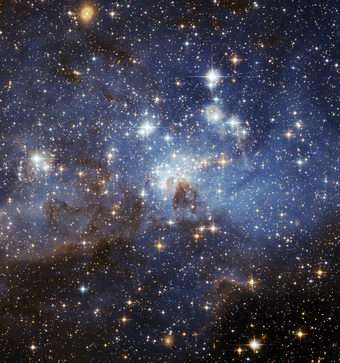
This image of star-formation region LH 95 was taken in March 2006 with Hubble´s Advanced Camera for Surveys. Credit: NASA, ESA, and the Hubble Heritage Team (STScI/AURA)-ESA/Hubble Collaboration Acknowledgment: D. Gouliermis (Max Planck Institute for Astronomy, Heidelberg)

Swirls of gas and dust reside in this ethereal-looking region of star formation imaged by NASA's Hubble Space Telescope. This majestic view, located in the Large Magellanic Cloud (LMC), reveals a region where low-mass, infant stars and their much more massive stellar neighbors reside. A shroud of blue haze gently lingers amid the stars.

Known as LH 95, this is just one of the hundreds of star-forming systems, called associations, located in the LMC some 160,000 light-years distant. Earlier ground-based observations of such systems had only allowed astronomers to study the bright blue giant stars present in these regions. With Hubble's resolution, the low-mass stars can now be analyzed, which will allow for a more accurate calculation of their ages and masses.

This detailed view of the star-forming association LH 95 was taken with Hubble's Advanced Camera for Surveys and provides an extraordinarily rich sample of newly formed low-mass stars. The LMC is a galaxy with relatively small amounts of elements heavier than hydrogen, giving astronomers an insight into star formation in environments different than our Milky Way.

The largest stars within LH 95 - those with at least three times the mass of the Sun - generate strong stellar winds and high levels of ultraviolet radiation that heat the surrounding interstellar gas. The result is a bluish nebula of glowing hydrogen that continues to expand out into the molecular cloud that originally collapsed to form these massive stars.

Some dense parts of this star-forming region are intact despite the stellar winds, and can still be seen as dark dusty filaments in the picture. Such dust lanes absorb parts of the blue light from the stars behind them, making them appear redder. Other parts of the molecular cloud have already contracted to turn into glowing groups of infant stars, the fainter of which have a high tendency to cluster. This deep Hubble image also reveals several large spiral and distant galaxies decorating the background of LH 95.

This image of LH 95 is a composite of two filters that localize visible (V) and infrared (I) light. Because of the color assignments chosen, doubly ionized hydrogen, which is visible within the V filter, appears bluish. The choice of color assignment helps to distinguish hot bright blue stars from cooler, less luminous red stars.

Source: Space Telescope Science Institute


print this article email this article download pdf blog this article bookmark this article     Stumble it Digg this share on Facebook retweet share on Reddit add to delicious
Rate this story - 3.3 /5 (9 votes)


December 19, 2006 all stories

Comments: 0

3.3 /5 (9 votes)
  • Stumble this up

  • Digg this

  • share this

  • hide
  • Related Stories


  • hide
  • Relevant PhysicsForums posts

  • Are there green, purple and pink stars?
    created 2 hours ago
  • Sideral question
    created Nov 21, 2009
  • Doppler shifted blackbody spectrum
    created Nov 21, 2009
  • Earth v. Moon
    created Nov 21, 2009
  • More from Physics Forums - General Astronomy

Other News

The shore of Deception Island in Antarctica, in 2008

Antarctic ice loss vaster, faster than thought: study

Space & Earth / Earth Sciences

created 6 hours ago | popularity 2.9 / 5 (10) | comments 7

The East Antarctic icesheet, once seen as largely unaffected by global warming, has lost billions of tonnes of ice since 2006 and could boost sea levels in the future, according to a new study.


Astronaut's baby daughter born as he circles Earth (AP)

Astronaut's baby daughter born as he circles Earth

Space & Earth / Space Exploration

created 6 hours ago | popularity 5 / 5 (1) | comments 0

(AP) -- Astronaut Randolph Bresnik jubilantly welcomed his new daughter into the world Sunday as he floated 220 miles above it.


Denmark: 65 world leaders for UN climate summit (AP)

Denmark: 65 world leaders for UN climate summit

Space & Earth / Environment

created 6 hours ago | popularity 1 / 5 (2) | comments 2

(AP) -- Sixty-five world leaders have said they will attend the Copenhagen climate summit in December, and several more have responded positively to invitations, Danish officials said Sunday.


Commuters wait on the platform shrouded by fog in London

Climate change not man-made, say majority of Britons: poll

Space & Earth / Environment

created Nov 15, 2009 | popularity 3.4 / 5 (16) | comments 46

Less than half of Britons believes that human activity is to blame for global warming, according to a poll carried out for The Times newspaper and published on Saturday.


Mysteriously warm times in Antarctica

Mysteriously warm times in Antarctica

Space & Earth / Earth Sciences

created Nov 18, 2009 | popularity 4.2 / 5 (21) | comments 31

(PhysOrg.com) -- A new study of Antarctica's past climate reveals that temperatures during the warm periods between ice ages (interglacials) may have been higher than previously thought. The latest analysis ...