It Is Too Early To Be Santa's Sleigh, Isn't It?
December 20, 2006
It Is Too Early To Be Santa's Sleigh, Isn't It?

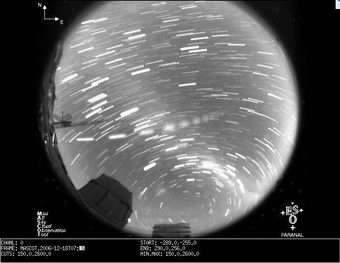
An unusual object was found on ESO Paranal MASCOT images in the morning of 18 December 2006. The whole sequence, seen above, shows how the object then takes the shape of a cloud that vanishes. Credit: ESO

Astronomers at ESO's frontline Paranal Observatory got a surprise on the morning of 18 December when looking at the observatory's all-sky camera, MASCOT. For about 45 minutes in the early morning, an object appeared first as a bright stripe then as a cloud that dissolved.

The discovery was made a little after 4 o'clock in the morning (7:00 GMT) by Christian Esparza, the operator of Antu, the first Unit Telescope (UT1) of ESO's Very Large Telescope who showed it to ESO astronomer Thomas Rivinius. Looking at the Mini All-Sky Cloud Observation Tool (MASCOT), Esparza was surprised by the presence of a nebular object.

MASCOT is the All-Sky Monitor of the Paranal Observatory. It delivers, every three minutes, images of the complete night-time sky, mainly to allow the detection of clouds.

"I went outside to make sure this was not an optical effect," said Rivinius. "At the time I saw it, it had already taken the appearance of a cloud. In fact, it was as large and as bright as the Large Magellanic Cloud."

Having been convinced this was no fault on the camera, the astronomers went on a real detective chase to try to find out what the object could be. ESO's comet specialist Emmanuel Jehin quickly established that it could not be a meteor nor a comet. It was moving too slowly for a meteor - a meteor is seen for example on one of the images as a tenuous and fleeting streak - or for the International Space Station. Moreover, no other known satellite was supposed to pass above Cerro Paranal, in the Atacama Desert at that time. And why would the ISS or a satellite suddenly change shape from a bright point to a cloud?

Checking the Night Sky Live web site, the astronomers then found out that the same phenomenon had been observed with the all-sky camera located at the site of Gemini South at Cerro Pachon, also in Chile and 600 km south of Paranal. Using these observations and a simple triangulation technique used, for example, in land surveys, it was then possible to measure the distance of the object. It appeared that the object was about 6000 km high when first seen and about double that in the later images. The object was moving away from Earth at tremendous speed!

Given this close distance, an astronomical object seemed unlikely and the only remaining possibility left to the scientists was to consider if a rocket had been launched. And, eureka!, it was quickly discovered that the same morning, about one hour before the object was seen from Paranal, the Japanese Aerospace Exploration Agency (JAXA) had launched a H-IIA rocket carrying the KIKU No. 8 (ETS-VIII) engineering test satellite, one of the largest geostationary satellites in the world.

The launch took place from the Tanegashima Space Center at 3:32 p.m. on December 18, 2006, Japan Standard Time (that is 3:32 a.m. Chilean time or 6:32 a.m. GMT). The launch vehicle flew smoothly, and, at 27 minutes and 35 seconds after lift-off, the KIKU No. 8 separation was confirmed. The Santiago station (in Chile) started receiving signals from the KIKU No. 8 at 4:27 a.m. Chilean Time.

Finally the mystery was solved: the object was most probably the 2nd stage of the launcher and the cloudy appearance at the end of the sequence most likely a dump of liquid fuel, made to avoid the explosion of the rocket in hundreds of scattered pieces, as a result of leftover fuel inside spent rocket stages. Having cracked the problem with his colleagues, Thomas Rivinius could finally go to sleep!

Source: ESO

2.6 /5 (18 votes)  

Rank 2.6 /5 (18 votes)
Tags

Related Stories
Relevant PhysicsForums posts
  • Never ending outer space.....
    created3 hours ago
  • Neutron Star fragments?
    created5 hours ago
  • stationary or not?
    created9 hours ago
  • Scale of the Universe
    createdFeb 10, 2012
  • Titan's lack of impact craters
    createdFeb 09, 2012
  • Real pictures of black hole eating a star?
    createdFeb 08, 2012
  • More from Physics Forums - General Astronomy

More news stories

Europe stakes billion-dollar bet on new rocket

A pencil-slim rocket is scheduled to lift into space from South America on Monday, carrying a billion-dollar bet that Europe can grab a juicy slice of the market to place satellites in low orbit.

Space & Earth / Space Exploration

created 16 hours ago | popularity 3.5 / 5 (2) | comments 0

Political leaders play key role in how worried Americans are by climate change: study

More than extreme weather events and the work of scientists, it is national political leaders who influence how much Americans worry about the threat of climate change, new research finds.

Space & Earth / Environment

created Feb 06, 2012 | popularity 5 / 5 (6) | comments 72

NASA budget will axe Mars deal with Europe: scientists

US President Barack Obama's budget proposal to be submitted next week for 2013 will cut NASA's budget by 20 percent and eliminate a major partnership with Europe on Mars exploration, scientists said Thursday.

Space & Earth / Space Exploration

created Feb 10, 2012 | popularity 5 / 5 (3) | comments 48

Humans may have helped the decline of African rainforests 3000 years ago

(PhysOrg.com) -- Large areas of rainforests in Central Africa mysteriously disappeared over three thousand years ago, to be replaced by savannas. The prevailing theory has been that the cause was a change ...

Space & Earth / Environment

created Feb 10, 2012 | popularity 4.1 / 5 (14) | comments 19 | with audio podcast report

Could Venus be shifting gear?

(PhysOrg.com) -- ESA’s Venus Express spacecraft has discovered that our cloud-covered neighbour spins a little slower than previously measured. Peering through the dense atmosphere in the infrared, the ...

Space & Earth / Space Exploration

created Feb 10, 2012 | popularity 5 / 5 (8) | comments 10 | with audio podcast


Walney offshore wind farm is world's biggest (for now)

(PhysOrg.com) -- The Walney wind farm on the Irish Sea--characterized by high tides, waves and windy weather--officially opened this week. The farm is treated in the press as a very big deal as the Walney ...

GPS court ruling leaves US phone tracking unclear

A US Supreme Court decision requiring a warrant to place a GPS device on the car of a criminal suspect leaves unresolved the bigger issue of police tracking using mobile phones, legal experts say.

Europeans protest controversial Internet pact

Tens of thousands of people marched in protests in more than a dozen European cities Saturday against a controversial anti-online piracy pact that critics say could curtail Internet freedom.

Study finds that anti-diabetic medication can prevent the long-term effects of maternal obesity

In a study to be presented today at the Society for Maternal-Fetal Medicine's annual meeting, The Pregnancy Meeting, in Dallas, Texas, researchers will report findings that show that short therapy with the anti-diabetic medication ...

Netflix settlement trims 14 pct off 4Q earnings

(AP) -- Netflix pressed the rewind button on its fourth-quarter earnings after settling allegations that the video subscription service violated a consumer-privacy law.

Navy to begin tests on electromagnetic railgun prototype launcher

The Office of Naval Research (ONR)'s Electromagnetic (EM) Railgun program will take an important step forward in the coming weeks when the first industry railgun prototype launcher is tested at a facility ...