Newfound diversity in gamma-ray bursts puzzles astronomers
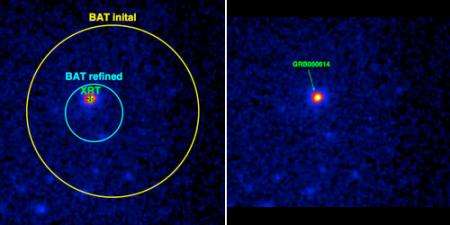
Two brilliant flashes of light from nearby galaxies are puzzling astronomers and could indicate that gamma-ray bursts, which signal the birth of a black hole, are more diverse than once thought.
First seen 40 years ago, gamma-ray bursts are the brightest explosions in the universe. They appear to fall into two distinct categories, short and long, depending on whether they shine for less than or more than about two seconds. Observations accumulated over the last decade led to a consensus that the long variety occurred when a massive star at the end of its life collapses to form a black hole. In addition to making a burst of gamma-rays, the explosion also produces a bright supernova. The short ones, not accompanied by a supernova, are thought to herald the merger of two neutron stars or a neutron star and a black hole, resulting in a bigger black hole.
The two new gamma-ray bursts are of the long variety but, surprisingly, did not show any evidence of supernova activity. This flies in the face of what was an emerging consensus about the origin of long bursts, according to University of California, Berkeley's Joshua Bloom, assistant professor of astronomy. To Bloom, this indicates that there are more than two ways to produce a gamma-ray flash and a black hole.
"Instead of simplicity and clarity, we're seeing a rich diversity emerge - there are more ways than we thought for producing flashes of gamma-rays," Bloom said.
Bloom and 30 colleagues from around the world report observations of two of these peculiar gamma-ray bursts, labeled GRB 060505 and GRB 060614, in the Dec. 21 issue of the British journal Nature. Three other papers in the same issue report details of GRB 060614. Both bursts were detected by NASA's Swift satellite - the first on May 5, 2006, the second on June 14, 2006.
Based solely on GRB 060614, many astronomers remained skeptical about the need to cast away the tidy connection of long bursts to supernovae. Yet, as Bloom stated, "It's easy to explain away one of these anomalous events as a fluke, but two strange events give our claim some oomph. These events are observational threats to the one-to-one association between long bursts and supernovae."
The whole story started with a non-discovery. Daniel Perley, a graduate student in astronomy at UC Berkeley, suggested that he and Bloom use the W. M. Keck Telescope in Hawaii to observe an area of sky where the long burst GRB 060505 had been seen in May. That long burst lasted four seconds and was pinpointed inside a galaxy a little over 1 billion light years away, towards the constellation Piscis Austrinus.
Had this flash been associated with the kind of supernova typically seen at sites of long gamma-ray bursts, or even a relatively weak supernova down to 250 times less powerful, Keck would have detected it, but instead Bloom and Perley observed nothing but the parent galaxy.
"We usually learn a lot about an event when new sources are detected, but in this context, it was much more exciting to detect nothing," Perley said.
At around the same time, a Danish group headed by Johan Peter Uldall Fynbo of the Neils Bohr Institute at the University of Copenhagen had had similar lack of success finding a supernova associated with GRB 060614. That burst lasted almost two minutes and was pinpointed near a galaxy 1.6 billion light years away, towards the constellation Indus. In both cases, the presence of obscuring dust was ruled out.
Fynbo gathered data from an international team, including Bloom and Perley, which argued in the Nature paper that the two supernovae together suggest a "new phenomenological type of massive stellar death."
Most astronomers have concluded that some new process must be at play: either the model of mergers creating second-long "short" bursts needs a major overhaul, or the progenitor star from this peculiar explosion is intrinsically different from the kind that make supernovae and long bursts.
"The paradigm had emerged that all long bursts were associated with the death of massive stars," said Bloom, who last year discovered evidence that convincingly linked short-lived gamma-ray bursts to the explosive merger of old, dead stars. The new observations "do not rule out a massive star origin, but does require that supernovae produced in some explosions are either very weak or non-existent."
Swift, launched in November 2004, is a NASA mission managed by NASA Goddard in partnership with the Italian Space Agency and the Particle Physics and Astronomy Research Council of the United Kingdom.
Source: University of California - Berkeley


