Astronomers Find Neptune-Mass Planet Around Small Star
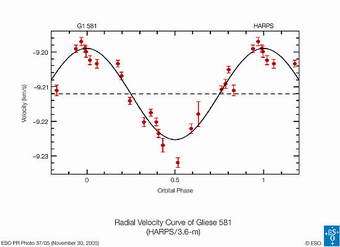
A team of French and Swiss astronomers have discovered one of the lightest exoplanets ever found using the HARPS instrument on ESO's 3.6-m telescope at La Silla (Chile). The new planet orbits a star belonging to the class of red dwarfs. As these stars are very common, this discovery proves crucial in the census of other planetary systems.
Image: The radial velocities of the red dwarf Gl 581 as a function of the orbital phase. The amplitude of the detected variation is 13.2 m/s and the curve is consistent with a circular orbit. The orbital period is 5.366 days.
"Our finding possibly means that planets are rather frequent around the smallest stars," says Xavier Delfosse, from the Laboratoire d'Astrophysique de Grenoble (France) and co-author of the paper relating the work. "It certainly tells us that red dwarfs are ideal targets for the search for exoplanets."
The host star, Gl 581, is located 20.5 light-years away in the Libra constellation (The Scales), and has a mass of only one third the mass of the Sun. Such red dwarfs are at least 50 times fainter than the Sun and are the most common stars in our Galaxy: among the 100 closest stars to the Sun, 80 belong to this class.
Being so numerous in our vicinity, it is thus fundamental to know if such stars also harbour planets. Previous surveys were rather unsuccessful: observations of about 200 red dwarfs revealed only 2 with planets.
"But previous surveys may have missed many planets due to their insufficient precision," says Stéphane Udry, from the Geneva Observatory and co-author of the work. "This is why we decided to make use of the ultra-precise, second generation, HARPS spectrograph. Our new result indicates this was the right strategy."
The newly found planet is about 17 times the Earth's mass, or about the mass of Neptune. It is therefore one of the smallest ever found. It is rather close to its host star and completes a full circle in only 5.4 days: the mean distance is about 6 million kilometres. By comparison, Mercury, the closest planet to the Sun, is at a distance of 58 million kilometres and completes an orbit in 88 days. Being so close, this alien world must be very hot, about 150 degrees.
The planet was revealed by the wobble it induces on the host star. With the HARPS very precise measurements, the astronomers found the star to move back and forth with a maximum velocity of 13 metres/second, or a little bit less than 50 km/h.
The astronomers have published their results in a Letter to the Editor of Astronomy and Astrophysics ("The HARPS search for southern extra-solar planets. VI. A Neptune-mass planet around the nearby M dwarf Gl 518", by X. Bonfils et al., A&A 443, L15, 2005).
Source: European Southern Observatory (ESO)


