Space Physicist finds 'lumpy' ionosphere, glimpses of the subsurface of Mars
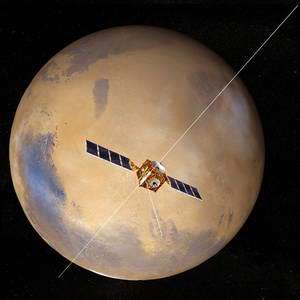
University of Iowa Space Physicist Don Gurnett and his UI colleagues report that a scientific instrument aboard the European Space Agency's (ESA) Mars Express spacecraft is working perfectly and that its data have so far revealed that Mars' ionosphere -- part of the upper atmosphere -- is very lumpy and complex, and that the instrument can "see" hidden craters and thick layers of ice beneath the planet's surface.
Gurnett's findings were scheduled for presentation in the Thursday, Dec. 1 issue of Science Express, an online version of the journal Science, and in talks to be delivered at the Dec. 5-9 fall meeting of the American Geophysical Union in San Francisco.
Called MARSIS (Mars Advanced Radar for Subsurface and Ionospheric Sounding), the joint Italian-U.S. scientific instrument/project includes the Italian Space Agency, the University of Rome, NASA's Jet Propulsion Laboratory and co-investigator Gurnett and colleagues.
In order to learn the shape and height of the ionosphere (which on the Earth reflects AM radio signals back and forth, sometimes for hundreds of miles), Gurnett bounced radar signals off of the ionosphere and measured the time required to detect radar echoes.
"We found that Mars has unexpected bumps, or ridges, in its ionosphere that are related to localized areas of strong magnetic fields," said Gurnett, lead author of the ionosphere paper. "We saw oblique echoes from the ionosphere, kind of like one would get from mountain ridges, above magnetic field lines that are embedded in the crust of Mars."
Previous investigations have shown that Mars does not have a global magnetic field like Earth's. Instead, the magnetic field at Mars is concentrated in small, localized regions, apparently magnetized during a previous era when a strong magnetic field existed at Mars.
A companion paper describes the findings of MARSIS in its probing of the subsurface of Mars. Giovanni Picardi of the University of Rome and Jeffrey Plaut of NASA's Jet Propulsion Laboratory in Pasadena, Calif. were the co-leaders of the study of subsurface echoes, in which they identified a hidden impact crater 250 kilometers in diameter, that is possibly filled with a 1-2 kilometer-thick layer of ice-rich material. Gurnett, who was a co-author of the study, said that the polar-orbiting spacecraft has only just recently entered a period which is more conducive to subsurface exploration.
Said Plaut: "We have also used MARSIS to probe the icy layered deposits that surround the north pole of Mars. The radar waves easily penetrate the material to its base nearly two kilometers deep. This suggests that the layers consist of nearly pure ice."
Gurnett says that MARSIS ultimately will help scientists learn what happened to the water that likely carved the planet's deep canyons, some longer and deeper than the Grand Canyon. Although low atmospheric pressure means that liquid water at the surface would have long ago evaporated, data from NASA's Mars Odyssey craft indicate that water exists just below the surface in the form of permafrost. Also, photographs from NASA's Mars Global Surveyor show that liquid water may periodically emerge from canyon and crater walls.
In addition to Gurnett, UI co-authors and colleagues on MARSIS are: research engineers Don Kirchner and Richard Huff; research investigator David Morgan; research assistant Ann Persoon; senior engineer Terry Averkamp; and graduate assistant Firdevs Duru.
The Mars Express spacecraft was launched aboard a Soyuz rocket from Baikonur, Kazakhstan in June 2003 and arrived at the planet in December of the same year. Concerns about how the deployment of various scientific equipment would affect the integrity of the spacecraft caused researchers to delay some investigations until 2005 and may have indirectly contributed to the current success of the MARSIS project.
Gurnett and his UI colleagues developed the 130-foot-long antenna and related electrical instruments for MARSIS, and Rockwell Collins of Cedar Rapids assisted in the design of the radio transmitter, which is coupled to the antennas. The MARSIS instrument weighs about 26 pounds and is one of eight instruments aboard the spacecraft.
A member of the National Academy of Sciences, Gurnett is a veteran of more than 30 major spacecraft projects, including the Voyager 1 and Voyager 2 flights to the outer planets, the Galileo mission to Jupiter, and the Cassini mission to Saturn. He made the first observations of plasma waves and low-frequency radio emissions in the magnetospheres of Jupiter, Saturn, Uranus and Neptune and discovered lightning in the atmospheres of Jupiter and Neptune. Gurnett and his UI colleagues have over 120 years of spacecraft instrument design and construction experience between them.
Source: University of Iowa


