Squirrels place winning bet in unpredictable world
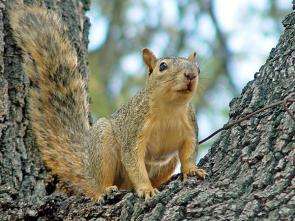
In an evolutionary game of tug-of-war, red squirrels have gained the upper hand over the cunning spruce trees, says new University of Alberta research that suggests the clever animals are staying one step ahead of its food source.
A team of scientists, led by Dr. Stan Boutin from the U of A’s Faculty of Science, has discovered that red squirrels are able to counter the trees’ "swamp and starve" strategy of boom and bust seed production by producing an extra litter of babies in anticipation of a lush season of tree seeds.
In a paper published in "Science," Boutin and his international team of researchers, describe how they have studied the relationship between the American and Eurasian red squirrel and the trees they feast on. Over the 20 years Boutin has spent studying this chess match, he has noticed a surprising pattern. Red squirrels are somehow able to predict years when a bountiful crop is about to occur and remarkably produce a second litter of babies to take advantage of the onslaught of food about to arrive.
The international team of researchers found that the trees have been trying to outwit the squirrels by implementing a "swamp and starve" tactic. This is actually an evolutionary strategy by the trees to thwart the animals that eat its seed. In bust years the trees try to starve their seed predators so that in boom years there are few seed eaters around and they are swamped by all of the seed available. The seed predators can’t respond in time to the increased production because they can’t predict when it is going to occur. The net result is that more seed escapes to germinate in a mast year as compared to a strategy where the trees produce a constant amount of seed each year.
Normally this tactic works. By the time the seed matures in the fall, most seed eaters, like squirrels, have already made their "decisions" about having babies for that year. So when the trees produce a big crop in the fall, it is too late for the seed eaters to take advantage of it and they are forced to wait until the following year.
Except the tree didn’t count on one important factor: a cunning squirrel that seems to have foiled the trees’ plans. Somehow, the squirrel is able to predict the upcoming big crop and devotes energy to producing a second litter, maximizing the number of youngsters available to eat the mature seed available in the fall. The squirrel has "trumped the swamp and starve strategy," says Boutin, by increasing its numbers before the big seed crop rather than in the following year.
"Lots of animals time their reproduction to match predictable increases in resources like the new growth of plants every spring," said Boutin. "But the interesting twist here is that these squirrels have figured out a way to produce this second litter of babies at a time when they have little food and before an ‘unpredictable’ boom in seed production.
"It’s like the squirrels are using a very successful stock market strategy. Most of us invest conservatively when the market is down because our funds are tight and we can’t predict when things will turn around. It’s not until the market has improved and is humming along that we increase our investment. Squirrels do the opposite, investing heavily when they have barely enough to get by but just before the market turns favorable. The result is that their investment —their babies—pay big dividends in the upcoming favorable market, which in this case is lots of seed."
The red squirrels also seemed to have figured their way around an additional evolutionary challenge, says Boutin. To be able to produce a second litter while the female is lactating, and therefore typically not ovulating, surprised the researchers. "These squirrels are doing something special to get over the physiological barriers that are usually in their way," he said.
While the researchers still aren’t certain how the squirrels can predict the trees’ behaviour, they speculate it might be related to the buds which turn into cones and are eaten by the squirrels every summer. "Squirrels could be using a visual cue or a hormonal cue they gain from eating the buds," said Boutin. "These squirrels are very clever because they use reliable cues to invest in extra offspring not when they can but when it makes sense evolutionarily."
Source: University of Alberta


