Researchers identify a 'heartbeat' in Earth's climate
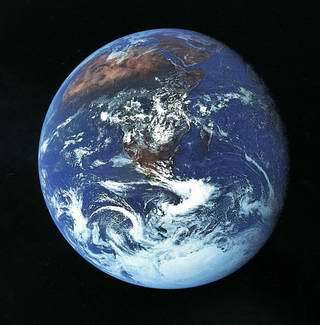
December 21, 2006 Earth from space

A few years ago, an international team of researchers went to the middle of the Pacific Ocean and drilled down five kilometers below sea level in an effort to uncover secrets about the earth's climate history. They exceeded their expectations and have published their findings in the Dec. 22 edition of the journal Science.

The researchers' drilling produced pristine samples of marine microfossils, otherwise known as foraminifera. Analysis of the carbonate shells of these microfossils, which are between 23 million to 34 million years-old, has revealed that the Earth's climate and the formation and recession of glaciation events in the Earth's history have corresponded with variations in the earth's natural orbital patterns and carbon cycles.

The researchers were particularly interested in these microfossils because they came from the Oligocene epoch, a time in Earth's history known for falling temperatures.

"The continuity and length of the data series we gathered and analyzed allowed for unprecedented insights into the complex interactions between external climate forcing, the global carbon cycle and ice sheet oscillations," said Dr. Jens Herrle, co-author of the paper and a micropaleontology professor at the University of Alberta.

The authors also show how simple models of the global carbon cycle, coupled to orbital controls of global temperature and biological activity, are able to reproduce the important changes observed after the world entered an "ice-house" state about 34 million years ago.

In the early half of the 20th century, Serbian physicist Milutin Milankovitch first proposed that cyclical variations in the Earth-Sun geometry can alter the Earth's climate and these changes can be discovered in the Earth's geological archives, which is exactly what this research team, consisting of members from the United Kingdom, the U.S. and Canada, has done.

"This research is not only concerned with the climate many millions-of-years-ago. Researching and understanding 'extreme' climate events from the geological past allows us to better tune climate models to understand present and future events, and the response to major perturbations of Earth's climate and the global carbon cycle, Herrle added.

Source: University of Alberta


print this article email this article download pdf blog this article bookmark this article     Stumble it Digg this share on Facebook retweet share on Reddit add to delicious
Rate this story - 4.1 /5 (82 votes)


December 21, 2006 all stories

Comments: 0

4.1 /5 (82 votes)
  • Stumble this up

  • Digg this

  • share this

  • hide
  • Related Stories

  • The politics of climate fixes
    created Nov 06, 2009 | popularity not rated yet | comments 0
  • Newly drilled ice cores may be the longest taken from the Andes
    created Nov 02, 2009 | popularity not rated yet | comments 0
  • Climate variability impacts the deep sea
    created Nov 02, 2009 | popularity not rated yet | comments 0
  • Green is cool, but US land changes generally are not
    created Nov 02, 2009 | popularity not rated yet | comments 0
  • Iron controls patterns of nitrogen fixation in the Atlantic
    created Nov 02, 2009 | popularity not rated yet | comments 0


  • hide
  • Relevant PhysicsForums posts

  • The Origin of the term 'fossil' fuels
    created Nov 05, 2009
  • co2
    created Nov 03, 2009
  • Early Earths Sulfidic Ocean Conditions
    created Oct 30, 2009
  • vegetation
    created Oct 29, 2009
  • More from Physics Forums - Earth

Other News

Seattle team wins $900,000 in Space Elevator Games (AP)

Seattle team wins $900,000 in Space Elevator Games

Space & Earth / Space Exploration

created 20 hours ago | popularity 5 / 5 (8) | comments 4

(AP) -- A Seattle team has collected a $900,000 prize in a NASA-backed competition to develop the concept of an elevator to space - an idea spurred by science fiction novels.


Russian rocket to launch from French Guiana in 2010

Space & Earth / Space Exploration

created 20 hours ago | popularity 5 / 5 (3) | comments 0

A Russian rocket will next year for the first time blast off from a European launch pad in South America, officials said Saturday, as the first rockets headed for the site on board a ship.


Success in 'space elevator' competition (AP)

Success in 'space elevator' competition (Update 3)

Space & Earth / Space Exploration

created Nov 05, 2009 | popularity 4.3 / 5 (33) | comments 50

(AP) -- A robot powered by a ground-based laser beam climbed a long cable dangling from a helicopter on Wednesday to qualify for prize money in a $2 million competition to test the potential reality of the ...


Space hotel taking bookings for 2012 opening

Space hotel taking bookings for 2012 opening

Space & Earth / Space Exploration

created Nov 05, 2009 | popularity 4.3 / 5 (19) | comments 11

(PhysOrg.com) -- The first orbiting space hotel is on track to open for its first customers in 2012, but hurry, as bookings are filling fast.


'Dropouts' pinpoint earliest galaxies

'Dropouts' pinpoint earliest galaxies

Space & Earth / Astronomy

created Nov 06, 2009 | popularity 4.1 / 5 (9) | comments 11

Astronomers, conducting the broadest survey to date of galaxies from about 800 million years after the Big Bang, have found 22 early galaxies and confirmed the age of one by its characteristic hydrogen signature ...