Engineers discover why toucan beaks are models of lightweight strength
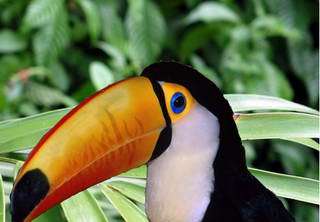
As a boy growing up in Brazil 40 years ago, Marc A. Meyers marveled at the lightweight toughness of toucan beaks that he occasionally found on the forest floor. Now a materials scientist and professor of mechanical and aerospace engineering at UCSD's Jacobs School of Engineering, Meyers said makers of airplanes and automobiles may benefit from the first ever detailed engineering analysis of toucan beaks conducted in his lab.
Image above: UCSD materials scientists discovered that the lightweight strength of the Toco Toucan's beak is due to a matrix of bony fibers and drum-like membranes sandwiched between an outer layer of keratin, the protein that makes up fingernails, hair, and horn.
“Our computer modeling shows that the beak is optimized to an amazing degree for high strength and very little weight,” said Meyers. “It’s almost as if the toucan has a deep knowledge of mechanical engineering.”
In a paper to be published Dec. 1 in Acta Materialia, Meyers and graduate students Yasuaki Seki and Matthew S. Schneider reported that the secret to the toucan beak's lightweight strength is an unusual bio-composite. The interior of the beak is rigid "foam" made of bony fibers and drum-like membranes sandwiched between outer layers of keratin, the protein that makes up fingernails, hair, and horn. Just as the hook-shaped barbs on cockleburs inspired the development of Velcro, Meyers said the avian bio-composite could inspire the design of ultra-light aircraft and vehicle components with synthetic foams made with metals and polymers.
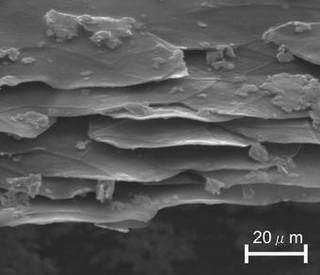
Image: The surface of the toucan beak is made of layers of keratin "tiles" that are glued together.
"The big surprise was our finding that the beak's sandwich structure also behaves as a high energy impact-absorption system," said Meyers. "Panels that mimic toucan beaks may offer better protection to motorists involved in crashes."
Toucans are highly social, noisy residents of rainforests in the Amazon, although the birds live as far north as Mexico. They use their extremely large and often brightly colored beaks for a variety of purposes, from gathering fruit from the tips of tree branches, to defending themselves.
Bird beaks are typically either short and thick or long and thin. The Meyers team decided to prospect for a novel material in toucan beaks because they are both long and thick. Emerald Forest Bird Gardens, a California breeder of exotic birds, provided beaks from toucans that had died from natural causes to Meyers's team. They analyzed the beaks' density, stiffness, hardness, and response to compression and stretching. They also examined the beaks with a scanning electron microscope.
The beak’s interior is a highly organized matrix of stiff cancellous bone fibers that looks as if it was dipped into a soapy solution and dried, generating drum-like membranes that interconnect the fibers. The result is a solid “foam” of air-tight cells that gives the beak additional rigidity.
"The beak is mostly air," said Meyers. "While the inner part of human bone also contains cancellous bone, we don't have the foam interconnections, which produce a much stronger structure with very little additional weight."
Like a house covered by a shingled roof, the foam is covered with overlapping keratin tiles, each about 50 micrometers in diameter and 1 micrometer thick, which are glued together to produce sheets.
The study in Acta Materialia also noted a hollow region extending about half the length of the upper and lower beaks. "When we did the calculations, we discovered that there are only very insignificant mechanical stresses in the center of the beak at the position of the hollow areas," said Meyers. "This is why I jokingly tell my students that toucans have a deep knowledge of mechanics. They don't bother adding structural support in a part of the beak that doesn't really need it."
Source: UCSD


