30-inch carbon nanotube based field emission display
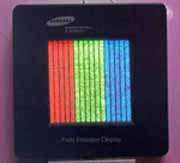
May 12th, 2004 field emission display

Samsung demonstrated a working carbon nanotube display prototype in 1999, and has almost completed the development of a field emission display (FED) with a 30-inch diagonal screen, according to a Korea Times report. The report said that Japan's government-backed New Energy and Industrial Technology Development Organization (NEDO) is likely to spend more than $5 million on FED projects in 2004 in an attempt to wrest leadership of display technology back from South Korea.

As the transition from Cathode-Ray Tube displays to LCD displays accelerates, various technologies are competing to replace LCDs. The current front runner for flat screens appears to be OLED displays, which have the potential to create clearer, sharper, and brighter images than LCDs. However, researchers are making steady progress with using carbon nanotubes to make displays.

The FED is a new type of flat-panel display in which electron emitters, arranged in a grid, function individually to generate colored light. It is touted as a breakthrough technology because it can accommodate a thin panel like liquid crystal display (LCD) and offers a wider field-of-view and higher image quality. Field-emission displays use much less power than plasma displays because they’re intrinsically more efficient.

The nanotube-based cathodes in this case are created using a process proprietary to Samsung in which a combination of multi and single-wall tubes are mixed into a photosensitive resin. The resin is then screen-printed onto the cathode backplane and photoexposed to define the cathode regions. Samsung’s device differs from most field-emission displays using so-called lateral field emitters.

Full story: Korea Times


print this article email this article download pdf blog this article bookmark this article     Digg this Stumble it share on Facebook share on Reddit add to delicious save to Yahoo! bookmarks
3.3/5 after 15 votes


May 12th, 2004 all stories
Nanotechnology /

Comments: 0
Rank: 3.3/5 after 15 votes

  • Stumble this up

  • Digg this

  • Share it:
  • share on Facebook
  • share on MySpace
  • share on Slashdot
  • rss-newsfeed
  • share on Google
  • share on Reddit
  • add to delicious
  • save to Yahoo! bookmarks
  • share on Windows Live
  • Add to Mixx!
Rating: 3.3/5 after 15 votes

  • Related Stories

  • Improved Volumetric Displays May Lead to 3D Computer Monitors
    created Dec 22, 2008 | popularity not rated yet | comments 0
  • Displays of a Different Stripe
    created Jul 24, 2006 | popularity not rated yet | comments 0
  • Holographic movies show promise for medical, military applications
    created Jun 14, 2005 | popularity not rated yet | comments 0
  • Organic light-emitting diode screens ready to go mainstream
    created Jun 24, 2009 | popularity not rated yet | comments 0
  • Big impact from tiny semiconductor lasers (w/Video)
    created Jun 18, 2009 | popularity not rated yet | comments 0

Tags


  • Physicists Demonstrate Quantum Memory with Matter Qubits
    Physicists Demonstrate Quantum Memory with Matter Qubits
    Physics / General Physics
    created Jul 03, 2009 | popularity 4.4 / 5 (17) | comments 1
  • 'Holey' Nanosheets for Wastewater Dye Removal
    Nanotechnology / Nanomaterials
    created Jul 01, 2009 | popularity 5 / 5 (5) | comments 1
  • Jellyfish Robot Swims Like its Biological Counterpart
    Jellyfish Robot Swims Like its Biological Counterpart
    Electronics / Robotics
    created Jun 26, 2009 | popularity 4.4 / 5 (8) | comments 1
  • Could Maxwell's Demon Exist in Nanoscale Systems?
    Could Maxwell's Demon Exist in Nanoscale Systems?
    Physics / General Physics
    created Jun 24, 2009 | popularity 4.4 / 5 (18) | comments 29
  • Living Safely with Robots, Beyond Asimov's Laws
    Living Safely with Robots, Beyond Asimov's Laws
    Electronics / Robotics
    created Jun 22, 2009 | popularity 4.6 / 5 (52) | comments 40
  • Other News

    A 'quantum of sol' -- how nanotechnology could hold the key to a solar-powered future

    A 'quantum of sol' -- how nanotechnology could hold the key to a solar-powered future

    Nanotechnology / Nanomaterials

    created Jun 30, 2009 | popularity 3.9 / 5 (15) | comments 17

    (PhysOrg.com) -- A new generation of 'nano-structured' millimetre-sized solar cells that could convert the sun's energy to electricity more than twice as efficiently as current technology, is the subject of ...


    Australian researchers are set to begin human trials of a tiny nano-cell that acts as a "Trojan horse" against cancer

    Hi-tech 'Trojan horse' can kill cancer cells: researchers

    Nanotechnology / Bio & Medicine

    created Jun 29, 2009 | popularity 4.7 / 5 (12) | comments 7

    Australian researchers are set to begin human trials of a tiny nano-cell that acts as a "Trojan horse" against cancer cells, a breakthrough they say may curb the need for debilitating chemotherapy.


    'Holey' Nanosheets for Wastewater Dye Removal

    Nanotechnology / Nanomaterials

    created Jul 01, 2009 | popularity 5 / 5 (5) | comments 1

    (PhysOrg.com) -- Researchers have discovered that extremely thin sheets of nickel oxide with hexagonally shaped holes can absorb hazardous dyes from wastewater nearly as well as the best traditional methods, but are recyclable. ...


    Harnessing Nanoparticles To Track Cancer Cell Changes

    Nanotechnology / Bio & Medicine

    created Jul 03, 2009 | popularity not rated yet | comments 1

    The more dots there are, the more accurate a picture you get when you connect them. Cancer researchers adopting that philosophy have developed a new imaging technology that could give scientists the ability to simultaneously ...


    Computer-Guided Nanoparticle Therapy Destroys Tumors

    Nanotechnology / Bio & Medicine

    created Jun 29, 2009 | popularity 4.9 / 5 (12) | comments 0

    Gold nanoshells are among the most promising new nanoscale therapeutics being developed to kill tumors, acting as antennas that turn light energy into heat that cooks cancer to death. Now, a multi-institutional research team ...