Nanotech discovery could have radical implications
It has been 20 years since the futurist Eric Drexler daringly predicted a new world where miniaturized robots would build things one molecule at a time. The world of nanotechnology that Drexler envisioned is beginning to come to pass, with scientists conjuring new applications daily.
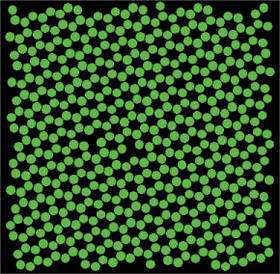
Image above: "Honeycomb Lattice."
Now Salvatore Torquato, a Princeton University scientist, is proposing turning a central concept of nanotechnology on its head. If the theory bears out – and it is in its infancy -- it could have radical implications not just for industries like telecommunications and computers but also for our understanding of the nature of life.
Torquato and colleagues have published a paper in the Nov. 25 issue of Physical Review Letters, the leading physics journal, outlining a mathematical approach that would enable them to produce desired configurations of nanoparticles by manipulating the manner in which the particles interact with one another.
This may not mean much to the man on the street, but to the average scientist it is a fairly astounding proposition.
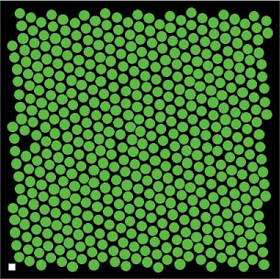
Image: "Triangle Lattice."
"In a sense this would allow you to play God, because the method creates, on the computer, new types of particles whose interactions are tuned precisely so as to yield a desired structure," said Pablo Debenedetti, a professor of chemical engineering at Princeton.
The standard approach in nanotechnology is to come up with new chemical structures through trial and error, by letting constituent parts react with one other as they do in nature and then seeing whether the result is useful.
Nanotechnologists rely on something called "self-assembly." Self-assembly refers to the fact that molecular building blocks do not have to be put together in some kind of miniaturized factory-like fashion. Instead, under the right conditions, they will spontaneously arrange themselves into larger, carefully organized structures.
As the researchers point out in their paper, biology offers many extraordinary examples of self-assembly, including the formation of the DNA double helix.
But Torquato and his colleagues, visiting research collaborator Frank Stillinger and physics graduate student Mikael Rechtsman, have taken an inverse approach to self-assembly.
"We stand the problem of self-assembly on its head," said Torquato, a professor of chemistry who is affiliated with the Princeton Institute for the Science and Technology of Materials, a multidisciplinary research center devoted to materials science.
Instead of employing the traditional trial-and-error method of self-assembly that is used by nanotechnologists and which is found in nature, Torquato and his colleagues start with an exact blueprint of the nanostructure they want to build.
''If one thinks of a nanomaterial as a house, our approach enables a scientist to act as architect, contractor, and day laborer all wrapped up in one," Torquato said. "We design the components of the house, such as the 2-by-4s and cement blocks, so that they will interact with each other in such a way that when you throw them together randomly they self-assemble into the desired house."
To do the same thing using current techniques, by contrast, a scientist would have to conduct endless experiments to come up with the same house. And in the end that researcher may not end up with a house at all but rather – metaphorically speaking -- with a garage or a horse stable or a grain silo.
While Torquato is a theorist rather than a practitioner, his ideas may have implications for nanostructures used in a range of applications in sensors, electronics and aerospace engineering.
"This is a wonderful example of how asking deep theoretical questions can lead to important practical applications," said Debenedetti.
So far Torquato and his colleagues have demonstrated their concept only theoretically, with computer modeling.
They illustrated their technique by considering thin films of particles. If one thinks of the particles as pennies scattered upon a table, the pennies, when laterally compressed, would normally self-assemble into a pattern called a triangular lattice.
But by optimizing the interactions of the "pennies," or particles, Torquato made them self-assemble into an entirely different pattern known as a honeycomb lattice (called that because it very much resembles a honeycomb).
Why is this important? The honeycomb lattice is the two-dimensional analog to the three-dimensional diamond lattice – the creation of which is somewhat of a holy grail in nanotechnology.
Diamonds found in nature self-assemble the way they do because the carbon atoms that are the building blocks of diamonds interact with each other in a specific way that is referred to as covalent bonding. This means that each carbon atom has to bond with exactly four neighboring atoms along specific directions.
One surprising and exciting feature of the Princeton work is that the researchers were able to achieve the honeycomb with non-directional bonding rather than covalent, or directional, bonding.
"Until now, people did not think it was possible to achieve this with non-directional interactions, so we view this as a fundamental theoretical breakthrough in statistical mechanics," Torquato said. Statistical mechanics is a field that bridges the microscopic world of individual atoms with the macroscopic world of materials that we can see and touch.
To create the honeycomb lattice, the researchers employed techniques of optimization, a field that has burgeoned since World War II and which is essentially the science of inventing mathematical methods to make things run efficiently.
Torquato and his colleagues hope that their efforts will be replicated in the laboratory using particles called colloids, which have unique properties that make them ideal candidates to test out the theory. Paul Chaikin, a professor of physics at New York University, said he is planning to do laboratory experiments based on the work.
The paper appearing in Physical Review Letters is a condensed version of a more detailed paper that has been accepted for publication in Physical Review E and which will probably appear sometime before the end of the year.
Torquato said that he and Stillinger initially had trouble attracting research money to support their idea. Colleagues "thought it was so far out in left field in terms of whether we could do what we were claiming that it was difficult to get funding for it," he said. The work was ultimately funded by the Office of Basic Energy Sciences at the U.S. Department of Energy.
"The honeycomb lattice is a simple example but it illustrates the power of our approach," Torquato said. "We envision assembling even more useful and unusual structures in the future."
Publication: Optimized Interactions for Targeted Self-Assembly: Application to a Honeycomb Lattice Mikael C. Rechtsman, Frank H. Stillinger, and Salvatore Torquato Phys. Rev. Lett. 95, 228301 (2005)
Source: Princeton University


