Scientists Predict Big Solar Cycle
December 22, 2006
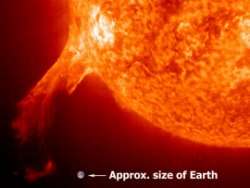
An erupting solar prominence photographed by the Solar and Heliospheric Observatory (SOHO).
Evidence is mounting: the next solar cycle is going to be a big one. Solar cycle 24, due to peak in 2010 or 2011 "looks like its going to be one of the most intense cycles since record-keeping began almost 400 years ago," says solar physicist David Hathaway of the Marshall Space Flight Center. He and colleague Robert Wilson presented this conclusion last week at the American Geophysical Union meeting in San Francisco.
Their forecast is based on historical records of geomagnetic storms.
Hathaway explains: "When a gust of solar wind hits Earth's magnetic field, the impact causes the magnetic field to shake. If it shakes hard enough, we call it a geomagnetic storm." In the extreme, these storms cause power outages and make compass needles swing in the wrong direction. Auroras are a beautiful side-effect.
Hathaway and Wilson looked at records of geomagnetic activity stretching back almost 150 years and noticed something useful:. "The amount of geomagnetic activity now tells us what the solar cycle is going to be like 6 to 8 years in the future," says Hathaway. A picture is worth a thousand words:
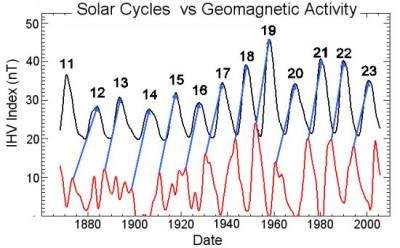
Peaks in geomagnetic activity (red) foretell solar maxima (black) more than six years in advance. Credit: NASA
In the plot, above, black curves are solar cycles; the amplitude is the sunspot number. Red curves are geomagnetic indices, specifically the Inter-hour Variability Index or IHV. "These indices are derived from magnetometer data recorded at two points on opposite sides of Earth: one in England and another in Australia. IHV data have been taken every day since 1868," says Hathaway.
Cross correlating sunspot number vs. IHV, they found that the IHV predicts the amplitude of the solar cycle 6-plus years in advance with a 94% correlation coefficient.
"We don't know why this works," says Hathaway. The underlying physics is a mystery. "But it does work."
According to their analysis, the next Solar Maximum should peak around 2010 with a sunspot number of 160 plus or minus 25. This would make it one of the strongest solar cycles of the past fifty years—which is to say, one of the strongest in recorded history.
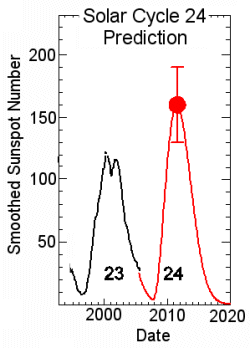
Hathaway and Wilson's prediction for the amplitude of Solar Cycle 24. Credit: NASA
Astronomers have been counting sunspots since the days of Galileo, watching solar activity rise and fall every 11 years. Curiously, four of the five biggest cycles on record have come in the past 50 years. "Cycle 24 should fit right into that pattern," says Hathaway.These results are just the latest signs pointing to a big Cycle 24. Most compelling of all, believes Hathaway, is the work of Mausumi Dikpati and colleagues at the National Center for Atmospheric Research (NCAR) in Boulder, Colorado. "They have combined observations of the sun’s 'Great Conveyor Belt' with a sophisticated computer model of the sun’s inner dynamo to produce a physics-based prediction of the next solar cycle." In short, it's going to be intense.
"It all hangs together," says Hathaway. Stay tuned for solar activity.
Source: by Dr. Tony Phillips, Science@NASA
-
Sunspots could soon disappear for decades: study
Sep 15, 2010 |
4.9 / 5 (55) |
576
-
Study may explain the extended solar minimum
Mar 15, 2010 |
3.8 / 5 (13) |
9
-
Solar Dynamics Observatory: The 'Variable Sun' Mission
Feb 05, 2010 |
4.9 / 5 (18) |
2
-
Are Sunspots Disappearing?
Sep 03, 2009 |
4.8 / 5 (27) |
15
-
How Low Can It Go? Sun Plunges into the Quietest Solar Minimum in a Century
Apr 01, 2009 |
4.6 / 5 (18) |
17
-
Engineers build first sub-10-nm carbon nanotube transistor
Feb 01, 2012 |
4.9 / 5 (29) |
30
-
Something old, something new: Evolution and the structural divergence of duplicate genes
Jan 31, 2012 |
4.6 / 5 (7) |
1
-
The hidden nanoworld of ice crystals: Revealing the dynamic behavior of quasi-liquid layers
Jan 30, 2012 |
5 / 5 (3) |
1
-
Stock market network reveals investor clustering
Jan 27, 2012 |
4 / 5 (22) |
8
-
Of microchemistry and molecules: Electronic microfluidic device synthesizes biocompatible probes
Jan 26, 2012 |
5 / 5 (1) |
0
-
Hypothetical way to travel faster than light, but not technically exceed lightspeed
Feb 06, 2012
-
How do scientists monitor the Sun's activity?
Feb 05, 2012
-
Search patterns in observational studies
Feb 05, 2012
-
Derivation of Pogson's law
Feb 03, 2012
-
Landing on comet by Rosetta probe in 2014 (YouTube)
Feb 02, 2012
-
Star whose pressure support is degenerate electrons.
Feb 01, 2012
- More from Physics Forums - General Astronomy
More news stories
Yangtze river pollution sparks panic in China
A cargo ship spilled acid into China's longest river last week, contaminating tap supplies and sparking a run on bottled water in eastern China, the government and state media said.
19 minutes ago |
not rated yet |
0
Mars-bound NASA rover carries coin for camera checkup
(PhysOrg.com) -- The camera at the end of the robotic arm on NASA's Mars rover Curiosity has its own calibration target, a smartphone-size plaque that looks like an eye chart supplemented with color chips ...
Space & Earth / Space Exploration
10 hours ago |
4 / 5 (4) |
5
|
When worlds collide: Researchers harness supercomputers to understand solar storm, magnetosphere
If the sun is anything, it is reassuring. It rises, sets, and rises again, allowing us to grow crops, get tan, and power homes, just to name a few of humanity's most important life-sustaining functions. No ...
Space & Earth / Space Exploration
21 hours ago |
3 / 5 (1) |
6
|
Mars Express radar gives strong evidence for former Mars ocean
(PhysOrg.com) -- ESA's Mars Express has returned strong evidence for an ocean once covering part of Mars. Using radar, it has detected sediments reminiscent of an ocean floor within the boundaries of previously ...
Space & Earth / Space Exploration
20 hours ago |
4.4 / 5 (5) |
3
|
Russia sets its sights on the moon for 2020
Looks like Republican Presidential hopeful Newt Gingrich might have some competition if he wants to be the first to build a base on the Moon. Last week, the Russian Space Agency Roscosmos announced plans to ...
Space & Earth / Space Exploration
19 hours ago |
5 / 5 (4) |
5
Scared of a younger rival? Not for some male songbirds
When mature male white-crowned sparrows duel to win a mate or a nesting territory, a young bird just doesn't get much respect.
Tiny primate 'talks' in ultrasound
One of the world's smallest primates, the Philippine tarsier, communicates in a range of ultrasound inaudible to predator and prey alike, according to a study published on Wednesday.
Playing school sports affects youths' smoking
Young people's choices about using drugs and alcohol are influenced by peersnot only close friends, but also sports teammates. A new study of middle schoolers and their social networks has found that teammates' smoking ...
New study: Adolescents suffering from depression more likely to be bullied
A new study provides evidence that adolescents who suffer from depression are more likely to develop difficulty in peer relationships including being bullied at school.
Preventing bacteria from falling in with the wrong crowd could help stop gum disease
Stripping some mouth bacteria of their access key to gangs of other pathogenic oral bacteria could help prevent gum disease and tooth loss. The study, published in the journal Microbiology suggests that t ...
New study sheds light on genetics of rice metabolism
A large-scale study analyzing metabolic compounds in rice grains conducted by researchers at the RIKEN Plant Science Center (PSC) and their collaborators has identified 131 rice metabolites and clarified the ...