First Images from Hinode Offer New Clues About Our Violent Sun
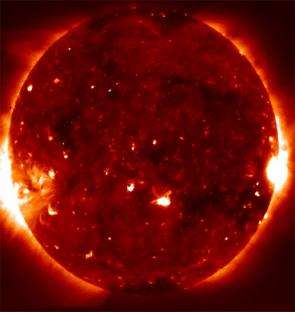
Instruments aboard a Japan Aerospace Exploration Agency satellite named Hinode, or "Sunrise," are returning extraordinary new images of our sun. The international mission to study the forces that drive the violent, explosive power of the sun launched from Japan in September.
Hinode is circling Earth in a polar flight path (a "sun-synchronous" orbit) that allows the spacecraft's instruments to remain in continuous sunlight for nine months each year. An international team of scientists and engineers is performing the calibration and checkout of Hinode's three primary instruments: the Solar Optical Telescope, the X-ray Telescope and the Extreme Ultraviolet Imaging Spectrometer. NASA made significant contributions to the development of these scientific instruments.
"The checkout phase is crucial because it allows controllers to confirm the spacecraft's instruments are working properly," said John M. Davis, NASA project scientist at the Marshall Space Flight Center, Huntsville, Ala. "As part of this checkout, we've been treated to some remarkable images of the sun."
Hinode's X-ray Telescope has captured unprecedented details in solar active region corona, the sun's outer atmosphere. The corona is the spawning ground for explosive solar activity, such as coronal mass ejections. Powered by the sun's magnetic field, these violent atmospheric disturbances of the sun can be of danger to space travelers, disruptive to orbiting satellites and can cause power grid problems on Earth.
Hinode's Solar Optical Telescope has delivered images that show greatly magnified views of the sun's surface. These images are revealing new details about solar convection. Solar convection is the process that drives the rising and falling of gases in the lowest atmospheric region, the photosphere. In addition, the Solar Optical Telescope is the first space-borne instrument to measure the strength and direction of the sun's magnetic field.
The Solar Optical Telescope images and magnetic maps uncover highly dynamic, intermittent nature of the sun's lower atmosphere - chromosphere. It is also providing revolutionary views on various solar phenomena from heating of solar atmosphere to generation of magnetic fields and magnetic reconnection.
Hinode's third primary instrument is the Extreme-Ultraviolet Imaging Spectrometer. The instrument has provided measurements of the speed of solar material, along with information that will help scientists diagnose the temperature and density of solar outer atmosphere. The Extreme-Ultraviolet Imaging Spectrometer provides a crucial link between the other two instruments aboard Hinode since it measures the layers that separate the photosphere from the corona: the chromosphere and the chromosphere-corona transition region.
"These first engineering images have given us a fascinating preview of what's on the horizon once the science phase of the mission begins, sometime in late December," Davis said. "Once we enter that phase, the focus will shift from calibration to using the instruments for making continuous, simultaneous observations of specific solar features."
By performing coordinated measurements with all three instruments, Hinode will help scientists observe how changes in the magnetic field at the sun's surface spread through the outer layers of the solar atmosphere. These first images leave no doubt that Hinode observations will revolutionize the knowledge of our nearest and most important star, the sun.
The Hinode mission, known as "Solar-B" before launch, is led by the Japan Aerospace Exploration Agency (JAXA). The collaborative mission includes the space agencies of Japan, the U.S., Great Britain and Europe. Marshall managed the development of the scientific instrumentation provided by NASA, academia and industry. Hinode's operations center is located at JAXA's facility in Sagamihara, Japan.
Source: NASA


