'Vortex lattices' may help explain material defects
December 22, 2006
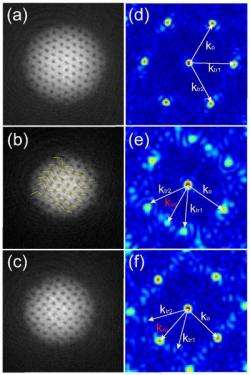
This set of JILA images shows a rotating Bose-Einstein condensate (BEC) "pinned" to a rotating lattice created with lasers as the shape of the combined "vortex lattice" evolves from triangular (top) to square (bottom). The images on the left show the BEC vortex lattice at low, medium and high pinning strengths, or optical intensity levels (top to bottom). The corresponding images on the right are computer processed to reveal the structural relationship between the BEC vortex and optical lattice, with red indicating the symmetry of the physical structures (hexagonal/triangular or square). Credit: Cornell group/JILA
What do you get when you superimpose a rotating pattern of intersecting laser beams on a spinning cloud of ultracold atoms in a thin gas? Pretty pictures, for one thing--but also a new method that could be used to simulate why and how defects arise in superconductors, important materials that are difficult to study directly.
By combining two cutting-edge laboratory creations--optical lattices and atoms in a Bose-Einstein condensate (BEC) spinning in a trap like planets orbiting the sun--physicists at JILA have developed a method of visualizing defects, or disruptions, in rotating patterns.
The experiments, reported in a paper published online Dec. 12 by Physical Review Letters, create the equivalent of "tornadoes in valleys," says group leader Eric Cornell, a Fellow at the National Institute of Standards and Technology (NIST). JILA is a joint institute of NIST and the University of Colorado at Boulder.
A BEC is a unique form of matter, first created by Cornell and colleague Carl Wieman at JILA, in which atoms are chilled to near absolute zero, and a point at which, by the rules of quantum physics, they condense into an amorphous "super atom" in which the individual atoms are indistinguishable. Part of the scientific fascination with BECs is that they share important physical characteristics with seemingly quite different phenomena, such as low-energy paired electrons in superconductors or the "superfluid" helium-4 that flows uphill with zero viscosity. For instance, helium-4, when stirred, doesn't circulate around the container like water in a glass, but rather breaks into an orderly array of quantized vortices, or little tornadoes. BECs behave the same way.
The JILA experiments were performed with 3 million rubidium atoms held in a magnetic trap. A superfluid of vortices was created by spinning the trap. The reddish BEC cloud, about 100 micrometers in diameter, contained about 100 hollow vortices, like a spinning bundle of fibers. Lasers were used to set up optical lattices--grids of light in an arrangement of energy peaks and troughs--in triangular and square patterns and focus them onto the BEC.
The overlapping lattice and vortices, under certain conditions such as when spinning at about the same rates, tend to lock together. The energy peaks of the lattice "pin" the BEC at those spots by reducing the density of the superfluid flowing around the local vortex. The JILA group visualized the structure or repeating patterns of the pinned vortex lattice by taking pictures over time, and then using an image processing technique to show how the vortex lattice structure and orientation were related to the optical lattice structure and orientation. The vortex lattice and peak optical signals evolve into different shapes at various laser intensities and spinning rates. Because BECs and optical lattices can be precisely controlled, the technique may be useful in studying more mysterious patterned superfluids, such as superconductors.
Citation: S. Tung, V. Schweikhard and E.A. Cornell. 2006. Observation of vortex pinning in Bose-Einstein condensates. Physical Review Letters. 97, 240402 (2006) Posted online Dec. 12.
Source: National Institute of Standards and Technology
-
Listening to the stars
Dec 01, 2011 |
5 / 5 (4) |
3
-
New study proves that much-sought exotic quantum state of matter can exist
Aug 15, 2011 |
4.7 / 5 (15) |
4
-
'Critical baby step' taken for spying life on a molecular scale
May 19, 2011 |
5 / 5 (5) |
0
-
Scientists take another step towards quantum computing using flawed diamonds
Mar 29, 2011 |
5 / 5 (5) |
1
-
Physicists discover important step for making light crystals (w/Videos)
Apr 09, 2009 |
4.9 / 5 (13) |
3
-
Engineers build first sub-10-nm carbon nanotube transistor
Feb 01, 2012 |
4.9 / 5 (31) |
30
-
Something old, something new: Evolution and the structural divergence of duplicate genes
Jan 31, 2012 |
4.6 / 5 (7) |
1
-
The hidden nanoworld of ice crystals: Revealing the dynamic behavior of quasi-liquid layers
Jan 30, 2012 |
5 / 5 (3) |
1
-
Stock market network reveals investor clustering
Jan 27, 2012 |
3.9 / 5 (23) |
8
-
Of microchemistry and molecules: Electronic microfluidic device synthesizes biocompatible probes
Jan 26, 2012 |
5 / 5 (1) |
0
-
Weight required to balance a boom stand?
2 hours ago
-
Questions about Equivalence principle & Einstein Elevator?
3 hours ago
-
Kinetic energy of gas
5 hours ago
-
Understanding induced emfs
7 hours ago
-
What is the precise definition of a year?
8 hours ago
-
Universe as a cellular automaton
9 hours ago
- More from Physics Forums - General Physics
More news stories
Explained: Sigma
It's a question that arises with virtually every major new finding in science or medicine: What makes a result reliable enough to be taken seriously? The answer has to do with statistical significance -- but ...
Feb 09, 2012 |
5 / 5 (19) |
66
Quantum physicist explains $100K offer for proof scaled-up quantum computing is impossible
(PhysOrg.com) -- MIT researcher Scott Aaronson has certainly riled the physics community with his offer this past Friday, of $100,000 to anyone who can prove that scaled-up quantum computing is impossible. ...
Diamond light, brighter than the sun
Its the size of five football pitches and generates light 10 billion times brighter than the sun. As the Diamond Light Source celebrates its tenth anniversary this year, Penny Bailey visits one of the ...
Feb 07, 2012 |
4.3 / 5 (7) |
17
|
Physicists 'record' magnetic breakthrough
An international team of scientists has demonstrated a revolutionary new way of magnetic recording which will allow information to be processed hundreds of times faster than by current hard drive technology.
Feb 07, 2012 |
4.5 / 5 (41) |
14
|
Hints of the Higgs - papers are submitted
Back in December 2011, the ATLAS and CMS experiments at CERN presented some exciting results that provided tantalising hints of the Higgs boson.
Feb 08, 2012 |
4.1 / 5 (7) |
10
Walney offshore wind farm is world's biggest (for now)
(PhysOrg.com) -- The Walney wind farm on the Irish Sea--characterized by high tides, waves and windy weather--officially opened this week. The farm is treated in the press as a very big deal as the Walney ...
GPS court ruling leaves US phone tracking unclear
A US Supreme Court decision requiring a warrant to place a GPS device on the car of a criminal suspect leaves unresolved the bigger issue of police tracking using mobile phones, legal experts say.
Europeans protest controversial Internet pact
Tens of thousands of people marched in protests in more than a dozen European cities Saturday against a controversial anti-online piracy pact that critics say could curtail Internet freedom.
Europe stakes billion-dollar bet on new rocket
A pencil-slim rocket is scheduled to lift into space from South America on Monday, carrying a billion-dollar bet that Europe can grab a juicy slice of the market to place satellites in low orbit.
Study finds that anti-diabetic medication can prevent the long-term effects of maternal obesity
In a study to be presented today at the Society for Maternal-Fetal Medicine's annual meeting, The Pregnancy Meeting, in Dallas, Texas, researchers will report findings that show that short therapy with the anti-diabetic medication ...
Netflix settlement trims 14 pct off 4Q earnings
(AP) -- Netflix pressed the rewind button on its fourth-quarter earnings after settling allegations that the video subscription service violated a consumer-privacy law.