NIST laser-based method cleans up grubby nanotubes
December 22, 2006 NIST laser-based method cleans up grubby nanotubes

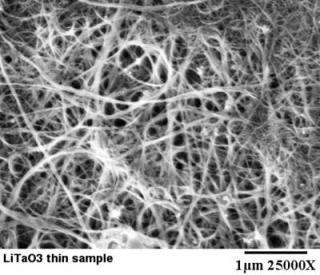
Before and after electron microscope images of a pyroelectric detector coated with single-walled nanotubes (SWNTs) visually demonstrate the effect of the laser cleaning process. In addition, the SWNTs look visibly blacker after laser treatment, suggesting less graphitic material and increased porosity. Credit: NIST

Before carbon nanotubes can fulfill their promise as ultrastrong fibers, electrical wires in molecular devices, or hydrogen storage components for fuel cells, better methods are needed for purifying raw nanotube materials. Researchers at the National Institute of Standards and Technology (NIST) and the National Renewable Energy Laboratory (NREL, Golden, Colo.), have taken a step toward this goal by demonstrating a simple method of cleaning nanotubes by zapping them with carefully calibrated laser pulses.

When carbon nanotubes--the cylindrical form of the fullerene family--are synthesized by any of several processes, a significant amount of contaminants such as soot, graphite and other impurities also is formed. Purifying the product is an important issue for commercial application of nanotubes.
NIST laser-based method cleans up grubby nanotubes

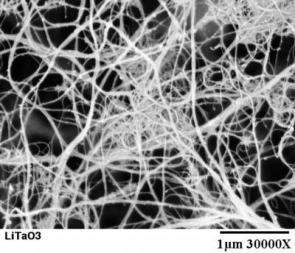
Before and after electron microscope images of a pyroelectric detector coated with single-walled nanotubes (SWNTs) visually demonstrate the effect of the laser cleaning process. In addition, the SWNTs look visibly blacker after laser treatment, suggesting less graphitic material and increased porosity. Credit: NIST

In a forthcoming issue of Chemical Physics Letters, the NIST/NREL team describes how pulses from an excimer laser greatly reduce the amount of carbon impurities in a sample of bulk carbon single-walled nanotubes, without destroying tubes. Both visual examination and quantitative measurements of material structure and composition verify that the resulting sample is "cleaner." The exact cleaning process may need to be slightly modified depending on how the nanotubes are made, the authors note. But the general approach is simpler and less costly than conventional "wet chemistry" processes, which can damage the tubes and also require removal of solvents afterwards.

"Controlling and determining tube type is sort of the holy grail right now with carbon nanotubes. Purity is a key variable," says NIST physicist John Lehman, who leads the research. "Over the last 15 years there's been lots of promise, but when you buy some material you realize that a good percentage of it is not quite what you hoped. Anyone who thinks they're going into business with nanotubes will realize that purification is an important--and expensive--step. There is a lot of work to be done."

The new method is believed to work because, if properly tuned, the laser light transfers energy to the vibrations and rotations in carbon molecules in both the nanotubes and contaminants. The nanotubes, however, are more stable, so most of the energy is transferred to the impurities, which then react readily with oxygen or ozone in the surrounding air and are eliminated. Success was measured by examining the energy profiles of the light scattered by the bulk nanotube sample after exposure to different excimer laser conditions. Each form of carbon produces a different signature.

Changes in the light energy as the sample was exposed to higher laser power indicated a reduction in impurities. Before-and-after electron micrographs visually confirmed the initial presence of impurities (i.e., material that did not appear rope-like) as well as a darkening of the nanotubes post-treatment, suggesting less soot and increased porosity.

The researchers developed the new method while looking for quantitative methods for evaluating laser damage to nanotube coatings for next-generation NIST standards for optical power measurements (see http://www.physorg.com/news2821.html). The responsivity of a prototype NIST standard increased 5 percent after the nanotube coating was cleaned.

Citation: K.E. Hurst, A.C. Dillon, D.A. Keenan and J.H. Lehman. Cleaning of carbon nanotubes near the [pi]-plasmon resonance. Chemical Physics Letters, In Press, Corrected Proof. Available online 15 November 2006.

Source: National Institute of Standards and Technology


print this article email this article download pdf blog this article bookmark this article     Stumble it Digg this share on Facebook retweet share on Reddit add to delicious
Rate this story - 4.1 /5 (16 votes)


December 22, 2006 all stories

Comments: 0

4.1 /5 (16 votes)
  • Stumble this up

  • Digg this

  • share this

  • hide
  • Related Stories

  • Nanoparticles Detect and Purge Metastases in Lymph Nodes
    created Oct 30, 2009 | popularity not rated yet | comments 0
  • Next-generation microcapsules deliver 'chemicals on demand'
    created Oct 28, 2009 | popularity not rated yet | comments 0
  • Race for Superconductors Shrinks to Nanoscale
    created Oct 09, 2009 | popularity not rated yet | comments 0
  • Golden Nanotubes Detect Tumor Cells, Map Sentinel Lymph Nodes
    created Sep 24, 2009 | popularity not rated yet | comments 0
  • Golden Nanotubes Used for Imaging Agent to Detect Tumor Cells, Map Sentinel Lymph Node
    created Aug 26, 2009 | popularity not rated yet | comments 0


  • hide
  • Relevant PhysicsForums posts

  • dynamic hardness measurements
    created 10 hours ago
  • May i know is structure such as bcc, fcc depends on how it process?
    created 16 hours ago
  • Wear patterns
    created Nov 18, 2009
  • What is meant by 'as-cast'?
    created Nov 18, 2009
  • Iron-rich spheres
    created Nov 18, 2009
  • Catalyst External and Internal Mass Transfer
    created Nov 16, 2009
  • More from Physics Forums - Materials & Chemical Engineering

Other News

Using superconducting probes to get a picture of what it's like inside CNTs

Nanotechnology / Nanophysics

created Nov 20, 2009 | popularity 4.9 / 5 (7) | comments 0

(PhysOrg.com) -- "Carbon nanotubes are exciting for fundamental physics, and for potential technological applications," Nadya Mason tells PhysOrg.com. "However, we are generally limited in the way that we can study them. ...


Nanoparticles used in common household items caused genetic damage in mice

Nanotechnology / Bio & Medicine

created Nov 16, 2009 | popularity 4.7 / 5 (22) | comments 11

Titanium dioxide (TiO2) nanoparticles, found in everything from cosmetics to sunscreen to paint to vitamins, caused systemic genetic damage in mice, according to a comprehensive study conducted by researchers at UCLA's Jonsson ...


Nanotube defects equal better energy and storage systems

Nanotube defects equal better energy and storage systems

Nanotechnology / Nanomaterials

created Nov 19, 2009 | popularity 4.4 / 5 (9) | comments 2

(PhysOrg.com) -- Most people would like to be able to charge their cell phones and other personal electronics quickly and not too often. A recent discovery made by UC San Diego engineers could lead to carbon ...


When It Comes to Drug Delivery, Size Matters

Nanotechnology / Bio & Medicine

created Nov 20, 2009 | popularity 5 / 5 (1) | comments 0

(PhysOrg.com) -- One of the great promises of nanotechnologies lies in its ability to create drug-containing nanoparticles decorated with targeting molecules that recognize and bind to cancer cells, providing drug delivery ...


Scientists synthesize graphene-like material: Polymer with honeycomb structure

Scientists synthesize graphene-like material: Polymer with honeycomb structure

Nanotechnology / Nanomaterials

created Nov 19, 2009 | popularity 4.5 / 5 (6) | comments 1

Two-dimensional carbon layers, so-called graphenes, are regarded as a possible substitute for silicon in the semiconductor industry. The electronic properties of these layers can be varied by "building in" ...