Repair Costs of Seismic Test House Could Have Been Prohibitive
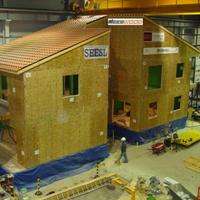
While the group of 200-plus faculty, students and media spectators who gathered at the Structural Engineering and Earthquake Simulation Laboratory (SEESL) at the University at Buffalo on Nov. 14 to watch the world's largest seismic test on a wooden structure probably came away feeling that the house held up very well, a close survey of the damage told a different story.
According to the structural engineers at UB and other institutions who conducted the testing, had this been a real earthquake, the damage sustained by the house would have rendered it uninhabitable and in need of major repairs.
Final data analysis will take several months, but, the engineers say, damage in the test house was so extensive that in a real-world situation, repairs might total as much as the house's original construction cost.
The test, a simulation of the 1994 magnitude 6.7 Northridge earthquake, was part of a four-year, $1.24 million international project called NEESWood, funded by the National Science Foundation's George E. Brown Jr. Network for Earthquake Engineering Simulation (NEES). The 80,000-pound, two-story house was constructed on top of twin, movable shake tables in UB's SEESL, the only laboratory in the U.S. large enough and sophisticated enough to conduct the test.
"In a real earthquake, this house would have been 'yellow tagged,'" stated Andre Filiatrault, Ph.D., UB professor in the Department of Civil, Structural and Environmental Engineering and the lead UB investigator on the NEESWood project. "That means that the owners would have been allowed to go into the house for a brief time to gather some belongings. They would then not be allowed in again until a detailed investigation could be made by structural engineers and repairs had been made."
During the final test, Filiatrault explained, the top of the wall containing the large garage opening underwent a maximum displacement of nearly four inches relative to its base.
"That's about double the expected displacement in a design level earthquake," he said.
The second level of the building experienced a peak acceleration of over 1.5 times gravity, which means that a person standing in one of the second floor bedrooms would have been subjected to a lateral force equivalent to 1.5 times his or her body weight.
"It would have been very difficult to remain standing under such a force," said Filiatrault.
As a result of these high lateral forces, he said, a whole section of the gypsum ceiling failed on the second floor.
Significant uplift and rocking of the foundation were observed in the transverse (short) direction of the building during the test.
This caused the entire foundation wood sill plate all around the perimeter of the building to split and crack.
"Replacement of this sill plate, which would require jacking the entire building, would have been very expensive for the owners," explained Filiatrault.
The test also left the first level of the house as a whole leaning forward on its foundation by about half an inch, enough to pose a potential safety hazard to occupants in the event of aftershocks, he said.
All over the inside of the building, severe cracking of the gypsum wallboard was observed, another significant repair cost; some wood studs in the garage also were damaged.
While the researchers said that repair costs to get the house ready for occupancy again would vary by region, they also said that it would probably equal a substantial amount, perhaps as much as the original construction cost of the building.
"And that doesn't include the costs associated with the replacement of the contents of the building that were severely damaged during this extreme shaking event," added Filiatrault.
The researchers' analysis of data from the 250 sensors installed inside the house and a dozen video cameras stationed inside and outside the house during the test should be complete in about six months.
Demolition of the 1,800-square-foot house took place earlier this month over the course of five days. A time-lapse video of the demolition to the tune of the Nutcracker Suite may be viewed at nees.buffalo.edu/projects/NEESWood/video.asp .
Construction of the house was done by Buffalo area contractors familiar with California construction. The seismic tests were conducted by a dedicated group of UB faculty, staff and students with important contributions from colleagues at the other NEESWood institutions, including Colorado State University, Cornell University, Texas A&M University and Rensselaer Polytechnic Institute.
Led by John van de Lindt, Ph.D., associate professor of civil engineering at Colorado State University, the NEESWood research is based on the premise that if more is known about how wood structures react to earthquakes, then larger and taller wood structures can be built in seismic regions worldwide, providing economic, engineering and societal benefits.
Conducted during last summer and the fall, and culminating with the November 14 event, the UB tests were the first step in moving toward performance-based design for wood frame structures. NEESWood will culminate with the validation of new design processes using a six-story wood frame structure that will be tested on the world's largest shake table in Miki City, Japan, early in 2009.
Source: University at Buffalo


