Winning by a neck -- Giraffes avoid competing with shorter browsers
December 22, 2006 Giraffe

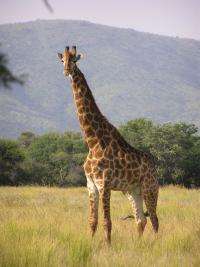
Giraffe in its natural environment. Photographed by Miroslav Duchacek (from Czech Republic) in Africa. Credit: Wikipedia.org

The giraffe's elongated neck has long been used in textbooks as an illustration of evolution by natural selection, but this common example has received very little experimental attention.

In the January issue of the American Naturalist, researchers at the Mammal Research Institute in the Department of Zoology and Entomology at the University of Pretoria tested whether foraging competition with shorter herbivores could explain why giraffes feed mostly on leaves high in trees, despite being able to feed at lower levels as well.

"This [study] provides the first real experimental evidence that the long neck of the giraffe might have evolved as a consequence of competition, which provides support for a previously untested textbook example of natural selection," says Elissa Cameron (University of Pretoria), who coauthored the study with Johan du Toit (University of Pretoria and Utah State University).

Giraffes are well known for their unusual height, and they generally feed high in the tree canopy, above the height other herbivores can reach. Giraffes receive more leaves per bite by foraging high in the tree, but it's unclear whether this is caused by competition -- smaller browsers eating some of the leaves at lower heights -- or if more leaves grow at higher levels.

The researchers built low fences around trees in greater Kruger National Park to stop smaller browsers from eating leaves. After a complete growing season they found that the number of leaves on the fenced trees was roughly the same, revealing that small browsers are responsible for most of the foraging. Therefore, the researchers argue, it is competition from other herbivores, such as kudu, that appears to drive giraffes to eat leaves high in the trees.

Citation: Cameron, Elissa Z. and Johan T. du Toit, "Winning by a neck: tall giraffes avoid competing with shorter browsers." The American Naturalist: January 2007.

Source: University of Chicago


Rate this story - 2.8 /5 (6 votes)


December 22, 2006 all stories

Comments: 0

2.8 /5 (6 votes)

  • hide
  • Related Stories


Other News

Scientists crash test DNA's replication machinery

Biology / Cell & Microbiology

created 1hour ago | popularity 5 / 5 (2) | comments 0 | with audio podcast

(PhysOrg.com) -- Important molecular machines routinely crash into one another while plying their trades on DNA. New research shows that the enzymes that copy DNA before cell division, called replisomes, are the kings of ...


giant oarfish

Bizarre giant oarfish filmed (w/ Video)

Biology / Plants & Animals

created 2 hours ago | popularity 4 / 5 (3) | comments 0 | with audio podcast report

(PhysOrg.com) -- A rare giant oarfish, probably the largest bony fish in the ocean, has been filmed off the Gulf of Mexico. This is possibly the first time the fish has been observed in its natural environment.


Benefits of badger culling not long lasting for reducing cattle TB, says study

Benefits of badger culling not long lasting for reducing cattle TB, says study

Biology / Ecology

created 1hour ago | popularity not rated yet | comments 0

(PhysOrg.com) -- Badger culling is unlikely to be a cost-effective way of helping control cattle TB in Britain, according to research published today in PLoS ONE.


Scientists release Key Largo wood rats in first test of restocking experiment

Biology / Ecology

created 2 hours ago | popularity not rated yet | comments 0

The seven pioneers spent the week preparing for their upcoming ordeal in North Key Largo, sampling berries and other local fare, redecorating homes with sticks, leaves and whatever else they got their little paws on, and ...


Great tits: birds with character

Great tits: birds with character

Biology / Plants & Animals

created 15 hours ago | popularity 5 / 5 (3) | comments 3 | with audio podcast

(PhysOrg.com) -- In humans and animals alike, individuals differ in sets of traits that we usually refer to as personality. An important part of the individual difference in personality is due to variation ...