Adenine ‘Tails’ Make Tailored Anchors for DNA
December 22, 2006 Adenine ‘Tails’ Make Tailored Anchors for DNA

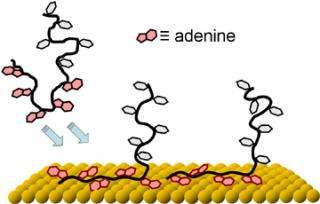
Single-strand DNA can be anchored to a gold substrate for use in biodetectors by attaching a tail of adenine bases. Adenine's strong affinity for gold not only bonds the strands in place but also allows some control over the spacing by adjusting the length of the tail. Credit: NIST

Researchers from the National Institute of Standards and Technology, the Naval Research Laboratory and the University of Maryland have demonstrated a deceptively simple technique for chemically bonding single strands of DNA to gold.

Among other features, they report in a forthcoming issue of the Proceedings of the National Academy of Sciences, the technique offers a convenient way to control the density of the DNA strands on the substrate, which could be important for optimizing DNA sensor arrays.

Short DNA sequences arrayed on substrates like glass, silicon or gold are used in biochemical sensors that can detect specific “target” sequences of DNA or analyze complex sequences. In such arrays, DNA strands are attached to the substrate by one end and stand up like bristles on a brush.

Specific “target” DNA sequences from a test sample can be identified because they will bond (hybridize) only to a complementary sequence on the array—microarray “gene chips” are the best-known example of the technology. The properties of gold are well-known, so it is a practicaland convenient substrate for some sensors. One popular technique for making DNA sensors (developed at NIST) is to use DNA with a sulfur atom attached to one end, which acts as “glue” because sulfur readily reacts with gold.

But a potentially less expensive and even simpler approach, according to the NIST, NRL and UMD team, might be to use a string of adenine nucleotides as an anchor. Of the four nucleotides that comprise DNA molecules, adenine, turns out to have a particularly high affinity for gold. Short strands composed entirely of adenine will adhere to a gold surface even if they have to muscle aside other strands in the process.

As a result, say the researchers, short blocks of adenine at the end of DNA strands can serve as bonding anchors—but even better, they say, these adenine blocks can be used to control the spacing of the DNA strands on the substrate. This is because each adenine tail lies flat on the substrate, taking up space. Within limits, the longer the adenine tail is, the larger is its footprint on the substrate, and the lower the total density of DNA strands.

Controlling the density of DNA “brushes” on a substrate is important for sensor design because an overly dense thicket does not leave enough room for “target” DNA strands from the test sample to bond, while too sparse an array doesn’t produce a strong enough signal.

The authors have applied for a patent on the technique.

Citation: A. Opdahl, D. Petrovykh, H. Kimura-Suda, M.J. Tarlov and L.J. Whitman. Independent control of grafting density and conformation of single-stranded DNA brushes. Proceedings of the National Academy of Sciences, 104:9-14 (2007) (Appears on-line in PNAS Early Edition.)

Source: NIST


print this article email this article download pdf blog this article bookmark this article     Stumble it Digg this share on Facebook retweet share on Reddit add to delicious
Rate this story - 3.5 /5 (4 votes)


December 22, 2006 all stories

Comments: 0

3.5 /5 (4 votes)
  • Stumble this up

  • Digg this

  • share this

  • hide
  • Related Stories

  • Models begin to unravel how single DNA strands combine
    created Oct 05, 2009 | popularity not rated yet | comments 0
  • Professor sequences his entire genome at low cost, with small team
    created Aug 10, 2009 | popularity not rated yet | comments 0
  • Researchers unravel mystery of DNA conformation
    created Jul 13, 2009 | popularity not rated yet | comments 0
  • Backtracking on DNA
    created Jun 23, 2009 | popularity not rated yet | comments 0
  • DNA template could explain evolutionary shifts
    created Jun 21, 2009 | popularity not rated yet | comments 0


Other News

New chemical reaction offers opportunities for drug development

Chemistry / Biochemistry

created 41 minutes ago | popularity not rated yet | comments 0

(PhysOrg.com) -- Scientists at University College Dublin have solved a chemistry problem which has stumped researchers worldwide for more than a decade. The results have earned the group the cover story of the leading scientific ...


Researchers solve structure of NMDA receptor unit that could be drug target for neurological diseases

Chemistry / Biochemistry

created 6 hours ago | popularity not rated yet | comments 0

A team of scientists at Cold Spring Harbor Laboratory reports on Thursday their success in solving the molecular structure of a key portion of a cellular receptor implicated in Alzheimer's, Parkinson's, and other serious ...


Sweet as can be: How E. coli gets ahead

Chemistry / Biochemistry

created 8 hours ago | popularity not rated yet | comments 0

Scientists at the University of York have discovered how certain bacteria such as Escherichia coli have evolved to capture rare sugars from their environment giving them an evolutionary advantage in naturally competitive enviro ...


H1N1 Virus Can Be Killed by Acidic Ozone Water

H1N1 Virus Can Be Killed by Acidic Ozone Water

Chemistry / Biochemistry

created Nov 09, 2009 | popularity 4.8 / 5 (25) | comments 10

(PhysOrg.com) -- Scientists have found that acidic ozone water can deactivate H1N1 viruses very effectively, offering a promising disinfectant for the millions of people trying to avoid the disease. Acidic ...


Toward home-brewed electricity with 'personalized solar energy'

Toward home-brewed electricity with 'personalized solar energy'

Chemistry / Materials Science

created Nov 04, 2009 | popularity 3.4 / 5 (9) | comments 5

New scientific discoveries are moving society toward the era of "personalized solar energy," in which the focus of electricity production shifts from huge central generating stations to individuals in their ...