Physicists coax six atoms into quantum 'cat' state
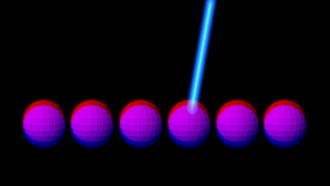
Scientists at the Commerce Department's National Institute of Standards and Technology (NIST) have coaxed six atoms into spinning together in two opposite directions at the same time, a so-called Schrödinger "cat" state that obeys the unusual laws of quantum physics. The ambitious choreography could be useful in applications such as quantum computing and cryptography, as well as ultra-sensitive measurement techniques, all of which rely on exquisite control of nature's smallest particles.
Image: NIST researchers have succeeded in coaxing six ions into an unusual quantum "cat" state in which their nuclei are collectively spinning clockwise and counterclockwise at the same time. Click here for an animation. Image credit: Bill Pietsch, Astronaut 3 Media Group, Inc.
The experiment, which was unusually challenging even for scientists accustomed to crossing the boundary between the macroscopic and quantum worlds, is described in the Dec. 1 issue of Nature. NIST scientists entangled six beryllium ions (charged atoms) so that their nuclei were collectively spinning clockwise and counterclockwise at the same time. Entanglement, which Albert Einstein called "spooky action at a distance," occurs when the quantum properties of two or more particles are correlated. The NIST work, along with a paper by Austrian scientists published in the same issue of Nature, breaks new ground for entanglement of multiple particles in the laboratory. The previous record was five entangled photons, the smallest particles of light.
"It is very difficult to control six ions precisely for a long enough time to do an experiment like this," says physicist Dietrich Leibfried, lead author of the NIST paper.
The ability to exist in two states at once is another peculiar property of quantum physics known as "superposition." The NIST ions were placed in the most extreme superposition of spin states possible with six ions. All six nuclei are spinning in one direction and the opposite direction simultaneously or what physicists call Schrödinger cat states. The name was coined in a famous 1935 essay in which German physicist Erwin Schrödinger described an extreme theoretical case of being in two states simultaneously, namely a cat that is both dead and alive at the same time.
Schrödinger's point was that cats are never observed in such states in the macroscopic "real world," so there seems to be a boundary where the strange properties of quantum mechanics--the rule book for Nature's smallest particles--give way to everyday experience. The NIST work, while a long way from full entanglement of a real cat's roughly 1026 atoms, extends the domain where Schrödinger cat states can exist to at least six atoms. The Austrian team used a different approach to entangle more ions (eight) but in a less sensitive state.
In the NIST experiment, the ions are held a few micrometers apart in an electromagnetic trap. Ultraviolet lasers are used to cool the ions to near absolute zero and manipulate them in three steps. To create and maintain the cat states, the researchers fine-tuned trap conditions to reduce unwanted heating of the ions, improved cooling methods, and automated some of the calibrations and other formerly manual processes. One run of the experiment takes about 1 millisecond; the cat states last about 50 microseconds (about 1/20 as long). The team ran the experiment successfully tens of thousands of times, including numerous runs that entangled four, five, or six ions.
Entanglement and superpositions are being exploited in laboratories around the world in the development of new technologies such as quantum computers. If they can be built, quantum computers could solve certain problems in an exponentially shorter time than conventional computers of a similar size. For example, current supercomputers would require years to break today's best encryption codes, (which are used to keep bank transactions and other important information secret) while quantum computers could quickly decipher the codes. Quantum computers also may be useful for optimizing complex systems such as airline schedules and database searching, developing "fraud-proof" digital signatures, or simulating complex biological systems for use in drug design.
Cat states, because they are superpositions of opposite overall properties that are relatively easy to verify, could be useful in a NIST-proposed design for fault-tolerant quantum computers. In addition, cat states are more sensitive to disturbance than other types of superpositions, a potentially useful feature in certain forms of quantum encryption, a new method for protecting information by making virtually all eavesdropping detectable.
The entangled cat states created by the NIST researchers also might be used to improve precision instruments, such as atomic clocks or interferometers that measure microscopic distances. Six ions entangled in a cat state are about 2½ times more sensitive to external magnetic fields than six unentangled ions, offering the possibility of better magnetic field sensors, or (for fixed external magnetic fields) better frequency sensors, which are components of atomic clocks. In addition, correlations between entangled ions could improve measurement precision, because a measurement of the spin of one of the entangled ions makes it possible to predict the spin of all remaining ions with certainty.
Source: NIST


