In Depth: Tide out on Titan? A soft solid surface for Huygens
November 30, 2005
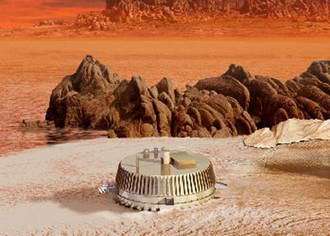
Huygens descent and landing overview. Credits: ESA/C.Carreau

The Surface Science Package (SSP) revealed that Huygens could have hit and cracked an ice ‘pebble’ on landing, and then it slumped into a sandy surface possibly dampened by liquid methane. Had the tide on Titan just gone out?

Image: Huygens descent and landing overview. Credits: ESA/C.Carreau

The SSP comprised nine independent sensors, chosen to cover the wide range of properties that be encountered, from liquids or very soft material to solid, hard ice. Some were designed primarily for landing on a solid surface and others for a liquid landing, with eight also operating during the descent.

Extreme and unexpected motion of Huygens at high altitudes was recorded by the SSP’s two-axis tilt sensor tilt sensor, suggesting strong turbulence whose meteorological origin remains unknown.

Penetrometry and accelerometry measurements on impact revealed that the surface was neither hard (like solid ice) nor very compressible (like a blanket of fluffy aerosol). Huygens landed on a relatively soft surface resembling wet clay, lightly packed snow and either wet or dry sand.

The probe had penetrated about 10 cm into surface, and settling gradually by a few millimetres after landing and tilting by a fraction of a degree. An initial high penetration force is best explained by the probe striking one of the many pebbles seen in the DISR images after landing.

Acoustic sounding with SSP over the last 90 m above the surface revealed a relatively smooth, but not completely flat, surface surrounding the landing site. The probe’s vertical velocity just before landing was determined with high precision as 4.6 m/s and the touchdown location had an undulating topography of around 1 metre over an area of 1000 sq. metres.

Those sensors intended to measure liquid properties (refractometer, permittivity and density sensors) would have performed correctly had the probe landed in liquid. The results from these sensors are still being analysed for indications of trace liquids, since the Huygens GCMS detected evaporating methane after touchdown.

Together with optical, radar and infrared spectrometer images from Cassini and images from the DISR instrument on Huygens, these results indicate a variety of possible processes modifying Titan’s surface.

Fluvial and marine processes appear most prominent at the Huygens landing site, although aeolian (wind-borne) activity cannot be ruled out. The SSP and HASI impact data are consistent with two plausible interpretations for the soft material: solid, granular material having a very small or zero cohesion, or a surface containing liquid.

In the latter case, the surface might be analogous to a wet sand or a textured tar/wet clay. The ‘sand’ could be made of ice grains from impact or fluvial erosion, wetted by liquid methane. Alternatively it might be a collection of photochemical products and fine-grained ice, making a somewhat sticky ‘tar’.

The uncertainties reflect the exotic nature of the materials comprising the solid surface and possible liquids in this extremely cold (–180 °C) environment.

Source: ESA

4.8 /5 (6 votes)  

Rank 4.8 /5 (6 votes)
Tags

Related Stories
Relevant PhysicsForums posts

More news stories

Humans may have helped the decline of African rainforests 3000 years ago

(PhysOrg.com) -- Large areas of rainforests in Central Africa mysteriously disappeared over three thousand years ago, to be replaced by savannas. The prevailing theory has been that the cause was a change ...

Space & Earth / Environment

created 20 hours ago | popularity 4.3 / 5 (12) | comments 12 | with audio podcast report

Could Venus be shifting gear?

(PhysOrg.com) -- ESA’s Venus Express spacecraft has discovered that our cloud-covered neighbour spins a little slower than previously measured. Peering through the dense atmosphere in the infrared, the ...

Space & Earth / Space Exploration

created 16 hours ago | popularity 5 / 5 (7) | comments 7 | with audio podcast

NASA budget will axe Mars deal with Europe: scientists

US President Barack Obama's budget proposal to be submitted next week for 2013 will cut NASA's budget by 20 percent and eliminate a major partnership with Europe on Mars exploration, scientists said Thursday.

Space & Earth / Space Exploration

created 19 hours ago | popularity 5 / 5 (2) | comments 18

Mars Science Laboratory computer issue resolved

(PhysOrg.com) -- Engineers have found the root cause of a computer reset that occurred two months ago on NASA's Mars Science Laboratory and have determined how to correct it.

Space & Earth / Space Exploration

created 17 hours ago | popularity 4.7 / 5 (6) | comments 3 | with audio podcast

Two new moons for Jupiter

Advances in technology have lead to the discovery of new planets outside of our Solar System, and now even new moons in our own backyard.

Space & Earth / Space Exploration

created 16 hours ago | popularity 4 / 5 (1) | comments 7


Anonymous knocks CIA website offline (Update)

The website of the Central Intelligence Agency was inaccessible on Friday after the hacker group Anonymous claimed to have knocked it offline.

Google users warned of threat to smartphone wallets

Users of Google smartphone wallets were being warned on Friday that there is a way to crack pass codes intended to thwart thieves from going on illicit shopping sprees.

New error-correcting codes guarantee the fastest possible rate of data transmission

Error-correcting codes are one of the triumphs of the digital age. They’re a way of encoding information so that it can be transmitted across a communication channel — such as an optical fiber o ...

New power source discovered

(PhysOrg.com) -- Researchers at the Massachusetts Institute of Technology (MIT) and RMIT University have made a breakthrough in energy storage and power generation.

Small modular reactor design could be a 'SUPERSTAR'

(PhysOrg.com) -- Though most of today's nuclear reactors are cooled by water, we've long known that there are alternatives; in fact, the world's first nuclear-powered electricity in 1951 came from a reactor ...

The power of estrogen -- male snakes attract other males

A new study has shown that boosting the estrogen levels of male garter snakes causes them to secrete the same pheromones that females use to attract suitors, and turned the males into just about the sexiest ...