Purdue 'metamaterial' could lead to better optics, communications
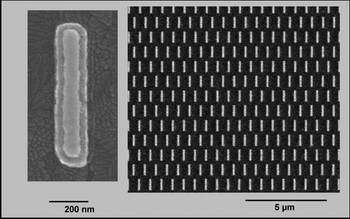
Engineers at Purdue University are the first researchers to create a material that has a "negative index of refraction" in the wavelength of light used for telecommunications, a step that could lead to better communications and imaging technologies.
This image, taken with a field-emission scanning electron microscope, shows tiny parallel "nanorods" of gold that represent the first material that has a "negative index of refraction" in the wavelength of light used for telecommunications, a step that could lead to better communications and imaging technologies. The material, created by Purdue engineers, conducts clouds of electrons called "plasmons" with a frequency of light referred to as the near-infrared, the same wavelength used for fiberoptic communications. Each of the rods is about as wide as 100 nanometers, or 100 billionths of a meter, and 700 nanometers long. (Purdue University School of Electrical and Computer Engineering)
"This work represents a milestone because it demonstrates that it is possible to have a negative refractive index in the optical range, which increases the likelihood of harnessing this phenomenon for optics and communications," said Vladimir Shalaev, the Robert and Anne Burnett Professor of Electrical and Computer Engineering.
The material consists of tiny parallel "nanorods" of gold that conduct clouds of electrons called "plasmons" with a frequency of light referred to as the near-infrared. The wavelength size of this near-infrared light is 1.5 microns, or millionths of a meter, the same wavelength used for fiberoptic communications.
"This is the most important wavelength for communications," Shalaev said.
Findings are detailed in a paper appearing Dec. 15 in the journal Optics Letters, published by the Optical Society of America. The paper was written by Shalaev, his graduate research assistants Wenshan Cai and Uday K. Chettiar, doctoral student Hsiao-Kuan Yuan, senior research scientists Andrey K. Sarychev and Vladimir P. Drachev, and principal research scientist Alexander V. Kildishev.
The nanorods are an example of materials that are able to reverse a phenomenon called refraction, which occurs as electromagnetic waves, including light, bend when passing from one material into another and is caused by a change in the speed of light as it passes from one medium into another. Scientists measure this bending of radiation by its "index of refraction." Refraction causes the bent-stick-in-water effect, which occurs when a stick placed in a glass of water appears bent when viewed from the outside. Each material has its own refraction index, which describes how much light will bend in that particular material and defines how much the speed of light slows down while passing through a material. All natural materials, such as glass, air and water, have positive refractive indices.
In the late 1960s, researchers hypothesized what would happen if a material had a negative refractive index, causing it to bend light in the opposite direction from ordinary materials. In 2000, researcher John Pendry at the Imperial College London theorized that slabs of such material might be used to create a "superlens" that would drastically improve the quality of medical diagnostic imaging and other technologies. Such lenses theoretically could compensate for the loss of a portion of the light transmitting an image as it passes through a lens. Lenses and imaging systems could be improved if this lost light, which scientists call "evanescent light," could be restored. An imaging system that used a combination of positive and negative refraction might restore the lost evanescent light.
Harnessing materials that have a negative index of refraction could make it possible to take optical images of objects that are smaller than the wavelength of visible light, including molecules such as DNA, for research and medical imaging; the development of "photo-nanolithography," which would make it possible to etch smaller electronic devices and circuits, resulting in more powerful computers; new types of antennas, computer components and consumer electronics such as cell phones that use light instead of electricity for carrying signals and processing information, resulting in faster communications.
A major obstacle now hindering development of opto-electronic devices is that wavelengths of light are too large to fit into the tiny features needed for miniature circuits and components. "Plasmonic nanomaterials," however, could make it possible to squeeze light waves into much smaller spaces, Shalaev said.
Various research groups have fabricated "metamaterials" made of tiny metal rings and rods, which have a negative index of refraction. No metamaterials have yet been created that have negative refraction indices for visible light, but now the Purdue researchers have created the first metamaterial with a negative refractive index in the near-infrared portion of the spectrum. This is just beyond the range of visible light, demonstrating the feasibility of applying the concept to communications and computers.
"The challenge was to fabricate a structure that would have not only an electrical response, but also a magnetic response in the near-infrared range," Shalaev said.
The gold nanorods conduct clouds of electrons, all moving in unison as if they were a single object instead of millions of individual electrons. These groups of electrons are known collectively as plasmons. Light from a laser or other source was shined onto the nanorods, inducing an "electro-optical current" in the tiny circuit. Each of the rods is about as wide as 100 nanometers, or 100 billionths of a meter, and 700 nanometers long.
"These rods basically conduct current because they are a metal, producing an effect we call optical inductance, while a material between the rods produces another effect called optical capacitance," Shalaev said. "The result is the formation of a very small electromagnetic circuit, but this circuit works in higher frequencies than normal circuits, in a portion of the spectrum we call optical frequencies, which includes the near-infrared. So we have created a structure that works as kind of an optical circuit and interacts effectively with both of the field components of light: electrical and magnetic."
The research has been funded by the U.S. Army Research Office and the National Science Foundation and is affiliated with Purdue's Birck Nanotechnology Center at Discovery Park, the university's hub for interdisciplinary research.
"Although many researchers are skeptical about developing materials with a negative index of refraction in optical wavelengths and then using them in practical technologies, I think the challenges are mainly engineering problems that could eventually be overcome," Shalaev said. "There is no fundamental law of physics that would prevent this from happening."
Source: Purdue University


