Optical vortex could look directly at extrasolar planets
November 30, 2005
A new optical device might allow astronomers to view extrasolar planets directly without the annoying glare of the parent star. It would do this by "nulling" out the light of the parent star by exploiting its wave nature, leaving the reflected light from the nearby planet to be observed in space-based detectors. The device, called an optical vortex coronagraph, is described in the December 15, 2005 issue of Optics Letters.
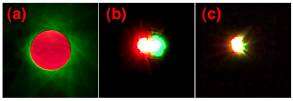
These laboratory images demonstrate how the optical vortex coronograph works. They were obtained with a green "star" and red "planet" (point light sources). (a) shows how the green light is "spun out," while the red light remains unaffected. Images of the point sources are shown when large (b) and small (c) apertures are used to limit the transmission of light from (a). Reported by: Foo et al. in Optics Letters for 1 December 2005
About ten years ago the presence of planets around stars other than our sun was first deduced by the very tiny wobble in the star's spectrum of light imposed by the mutual tug between the star and its satellite. Since then more than 100 extrasolar planets have been detected in this way. Also, in a few cases the slight diminution in the star's radiation caused by the transit of the planet across in front of the star has been observed.
Many astronomers would, however, like to view the planet directly - a difficult thing to do. Seeing the planet next to its bright star has been compared to trying to discern, from a hundred meters away, the light of a match held up next to the glare of an automobile's headlight. The approach taken by Grover Swartzlander and his colleagues at the University of Arizona is to eliminate the star's light by sending it through a special helical-shaped mask, a sort of lens whose geometry resembles that of a spiral staircase turned on its side.
The process works in the following way: light passing through the thicker and central part of the mask is slowed down. Because of the graduated shape of the glass, an "optical vortex" is created: the light coming along the axis of the mask is, in effect, spun out of the image. It is nulled, as if an opaque mask had been place across the image of the star, but leaving the light from the nearby planet unaffected.
The idea of an optical vortex has been around for many years, but it has never been applied to astronomy before. In lab trials of the optical vortex mask, light from mock stars has been reduced by factors of 100 to 1000, while light from a nearby "planet" was unaffected. Attaching their device to a telescope on Mt. Lemon outside Tucson, Arizona, the researchers took pictures of Saturn and its nearby rings to demonstrate the ease of integrating the mask into a telescopic imaging system.
This is, according to Swartzlander, a more practical technique than merely attempting to cover over the star's image, as is done in coronagraphs, devices for observing our sun's corona by masking out the disk of the sun. It could fully come into its own on a project like the Terrestrial Planet Finder, or TPF, a proposed orbiting telescope to be developed over the coming decade and designed to image exoplanets.
Source: American Institute of Physics
-
Electrons in concert: A simple probe for collective motion in ultracold plasmas
Feb 06, 2012 |
4.3 / 5 (6) |
0
-
Colorful solar instrument treks east for a new career
Feb 01, 2012 |
not rated yet |
0
-
New research suggests Fomalhaut B may not be a planet after all
Jan 27, 2012 |
4.7 / 5 (6) |
3
-
NRL's SoloHI instrument selected for flight on solar orbiter mission
Jan 24, 2012 |
not rated yet |
0
-
Professor's research helps restore sight to the blind
Jan 23, 2012 |
5 / 5 (2) |
0
-
Engineers build first sub-10-nm carbon nanotube transistor
Feb 01, 2012 |
4.9 / 5 (31) |
30
-
Something old, something new: Evolution and the structural divergence of duplicate genes
Jan 31, 2012 |
4.6 / 5 (7) |
1
-
The hidden nanoworld of ice crystals: Revealing the dynamic behavior of quasi-liquid layers
Jan 30, 2012 |
5 / 5 (3) |
1
-
Stock market network reveals investor clustering
Jan 27, 2012 |
3.9 / 5 (23) |
8
-
Of microchemistry and molecules: Electronic microfluidic device synthesizes biocompatible probes
Jan 26, 2012 |
5 / 5 (1) |
0
More news stories
Putting the squeeze on planets outside our solar system
(PhysOrg.com) -- Using high-powered lasers, scientists at Lawrence Livermore National Laboratory and collaborators discovered that molten magnesium silicate undergoes a phase change in the liquid state, abruptly ...
21 hours ago |
4.3 / 5 (7) |
0
|
Hovering not hard if you're top-heavy, researchers find
Top-heavy structures are more likely to maintain their balance while hovering in the air than are those that bear a lower center of gravity, researchers at New York University's Courant Institute of Mathematical Sciences ...
22 hours ago |
5 / 5 (3) |
1
|
Explained: Sigma
It's a question that arises with virtually every major new finding in science or medicine: What makes a result reliable enough to be taken seriously? The answer has to do with statistical significance -- but ...
Feb 09, 2012 |
5 / 5 (17) |
54
Quantum physicist explains $100K offer for proof scaled-up quantum computing is impossible
(PhysOrg.com) -- MIT researcher Scott Aaronson has certainly riled the physics community with his offer this past Friday, of $100,000 to anyone who can prove that scaled-up quantum computing is impossible. ...
Diamond light, brighter than the sun
Its the size of five football pitches and generates light 10 billion times brighter than the sun. As the Diamond Light Source celebrates its tenth anniversary this year, Penny Bailey visits one of the ...
Feb 07, 2012 |
4.3 / 5 (7) |
15
|
Walney offshore wind farm is world's biggest (for now)
(PhysOrg.com) -- The Walney wind farm on the Irish Sea--characterized by high tides, waves and windy weather--officially opened this week. The farm is treated in the press as a very big deal as the Walney ...
GPS court ruling leaves US phone tracking unclear
A US Supreme Court decision requiring a warrant to place a GPS device on the car of a criminal suspect leaves unresolved the bigger issue of police tracking using mobile phones, legal experts say.
Study finds that anti-diabetic medication can prevent the long-term effects of maternal obesity
In a study to be presented today at the Society for Maternal-Fetal Medicine's annual meeting, The Pregnancy Meeting, in Dallas, Texas, researchers will report findings that show that short therapy with the anti-diabetic medication ...
Europe stakes billion-dollar bet on new rocket
A pencil-slim rocket is scheduled to lift into space from South America on Monday, carrying a billion-dollar bet that Europe can grab a juicy slice of the market to place satellites in low orbit.
Netflix settlement trims 14 pct off 4Q earnings
(AP) -- Netflix pressed the rewind button on its fourth-quarter earnings after settling allegations that the video subscription service violated a consumer-privacy law.
Anonymous briefly knocks CIA website offline (Update 2)
The website of the Central Intelligence Agency was briefly inaccessible on Friday after the hacker group Anonymous claimed to have knocked it offline.