A Planet With Planets? Spitzer Finds Cosmic Oddball
November 30, 2005
Planets are everywhere these days. They have been spotted around more than 150 stars, and evidence is growing that they also circle "failed," or miniature, stars called brown dwarfs. Now, astronomers using NASA's Spitzer Space Telescope say they have found what may be planets-in-the-making in the strangest of places - around a brown dwarf that itself is the size of a planet.
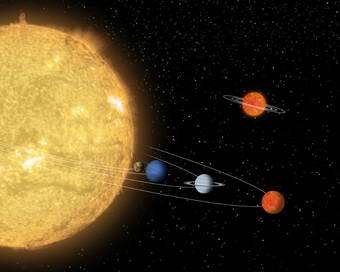
Image: This artist's concept compares a hypothetical solar system centered around a tiny "sun" (top) to a known solar system centered around a star, called 55 Cancri, which is about the same size as our sun. Image credit: NASA/JPL-Caltech
The little brown dwarf, called Cha 110913-773444, is one of the smallest known. At eight times the mass of Jupiter, it is even smaller than several planets around other stars.
Yet, this tiny orb might eventually host a tiny solar system. Spitzer's infrared eyes found, swirling around it, a flat disk made up of dust that is thought to gradually clump together to form planets. Spitzer has previously uncovered similar planet-forming disks around other brown dwarfs, but Cha 110913-773444 is the true dwarf of the bunch.
"Our goal is to determine the smallest 'sun' with evidence for planet formation," said Dr. Kevin Luhman of Pennsylvania State University, University Park, lead author of a new paper describing the findings in the Dec. 10 issue of Astrophysical Journal Letters. "Here, we have a sun that is so small it is the size of a planet."
Brown dwarfs are born like stars, condensing out of thick clouds of gas and dust. But unlike stars, brown dwarfs do not grow large enough to trigger nuclear fusion. They remain relatively cool spheres of gas and dust.
Astronomers have become more confident in recent years that brown dwarfs share another trait in common with stars - planets. The evidence is in the planet-forming disks. Such disks are well-documented around stars, but only recently have they been located in increasing numbers around brown dwarfs. So far, Spitzer has found dozens of disk-sporting brown dwarfs, five of which show the initial stages of the planet-building process. The dust in these five disks is beginning to stick together into what may be the "seeds" of planets (See http://www.nasa.go … 0051020.html).
Last year, Luhman and his colleagues used Spitzer to uncover what was then the smallest of brown dwarfs hugged by a disk. At only 15 times the mass of Jupiter, the brown dwarf, called OTS 44, is comparable to the most massive extrasolar planets (See http://www.nasa.go … -020705.html).
Now, the team has again used Spitzer, this time to detect a disk around Cha 110913-773444, which has only about half the mass of OTS 44. The object itself was discovered by Spitzer with the help of NASA's Hubble Space Telescope, the 4-meter Blanco telescope at the Cerro Tololo Inter-American Observatory in Chile and the Gemini South Observatory, also in Chile. Its cool and dusty disk, however, could be seen by only Spitzer's infrared eyes. The teeny brown dwarf is young at 2 million years old, and lives 500 light-years away in the Chamaeleon constellation.
So, what makes this oddball a brown dwarf and not a planet? "There are two camps when it comes to defining planets versus brown dwarfs," said Dr. Giovanni Fazio, co-author of the new paper from the Harvard-Smithsonian Center for Astrophysics. "Some go by size and others go by how the object formed. For instance, this new object would be called a planet based on its size, but a brown dwarf based on how it formed. The question then becomes what do we call any little bodies that might be born from this disk - planets or moons?"
If one were to call the object a planet, then it would seem Spitzer has discovered its first "moon-forming" disk. But, no matter what the final label may be, one thing is clear: the universe produces some strange solar systems very different from our own.
Source: NASA (by Whitney Clavin/JPL)
-
Tidal forces could squeeze out planetary water
Feb 09, 2012 |
5 / 5 (2) |
2
-
Radio stars: Caltech's astronomy professor searches for cosmic radio waves
Feb 03, 2012 |
not rated yet |
0
-
Scientists discover a Saturn-like ring system eclipsing a sun-like star
Jan 11, 2012 |
5 / 5 (5) |
2
-
Can Earth-sized planets survive their star's expansion?
Dec 21, 2011 |
4.7 / 5 (12) |
18
-
Some nearby young stars may be much older than previously thought
Dec 21, 2011 |
4 / 5 (4) |
3
-
Engineers build first sub-10-nm carbon nanotube transistor
Feb 01, 2012 |
4.9 / 5 (31) |
30
-
Something old, something new: Evolution and the structural divergence of duplicate genes
Jan 31, 2012 |
4.6 / 5 (7) |
1
-
The hidden nanoworld of ice crystals: Revealing the dynamic behavior of quasi-liquid layers
Jan 30, 2012 |
5 / 5 (3) |
1
-
Stock market network reveals investor clustering
Jan 27, 2012 |
3.9 / 5 (23) |
8
-
Of microchemistry and molecules: Electronic microfluidic device synthesizes biocompatible probes
Jan 26, 2012 |
5 / 5 (1) |
0
More news stories
Europe stakes billion-dollar bet on new rocket
A pencil-slim rocket is scheduled to lift into space from South America on Monday, carrying a billion-dollar bet that Europe can grab a juicy slice of the market to place satellites in low orbit.
Space & Earth / Space Exploration
54 minutes ago |
5 / 5 (1) |
0
NASA sees wide-eyed cyclone Jasmine
Cyclone Jasmine's eye has opened wider on NASA satellite imagery, as it moves through the Southern Pacific Ocean.
Space & Earth / Earth Sciences
16 hours ago |
3.5 / 5 (2) |
2
NASA sees Giovanna reach cyclone strength, threaten Madagascar
Tropical Storm 12S built up steam and became a cyclone on February 10, 2012 as NASA's Terra satellite passed overhead. Residents of east-central Madagascar should prepare for this cyclone to make landfall ...
Space & Earth / Earth Sciences
16 hours ago |
not rated yet |
0
Humans may have helped the decline of African rainforests 3000 years ago
(PhysOrg.com) -- Large areas of rainforests in Central Africa mysteriously disappeared over three thousand years ago, to be replaced by savannas. The prevailing theory has been that the cause was a change ...
Political leaders play key role in how worried Americans are by climate change: study
More than extreme weather events and the work of scientists, it is national political leaders who influence how much Americans worry about the threat of climate change, new research finds.
Feb 06, 2012 |
5 / 5 (6) |
68
Walney offshore wind farm is world's biggest (for now)
(PhysOrg.com) -- The Walney wind farm on the Irish Sea--characterized by high tides, waves and windy weather--officially opened this week. The farm is treated in the press as a very big deal as the Walney ...
GPS court ruling leaves US phone tracking unclear
A US Supreme Court decision requiring a warrant to place a GPS device on the car of a criminal suspect leaves unresolved the bigger issue of police tracking using mobile phones, legal experts say.
Netflix settlement trims 14 pct off 4Q earnings
(AP) -- Netflix pressed the rewind button on its fourth-quarter earnings after settling allegations that the video subscription service violated a consumer-privacy law.
Study finds that anti-diabetic medication can prevent the long-term effects of maternal obesity
In a study to be presented today at the Society for Maternal-Fetal Medicine's annual meeting, The Pregnancy Meeting, in Dallas, Texas, researchers will report findings that show that short therapy with the anti-diabetic medication ...
Elbow position not a predictor of injury
Elbow position alone appeared to not affect injury rates and performance in college-level, male pitchers say researchers presenting at the American Orthopaedic Society for Sports Medicine's Specialty Day in San Francisco, ...
New data provides direction for ACL injured knee treatments
Primary Anterior Cruciate Ligament (ACL) reconstruction improves quality of life and sports functionality for athletes, according to research presented today at the American Orthopaedic Society for Sports Medicine's Specialty ...