Poisonous volcanic gas caused world's largest mass extinction, study
The research, published in the journal Geology, reveals vital clues about the mass extinction at the end of the Permian period, 250 million years ago, when mammal-like reptiles known as synapsids roamed the earth. Many scientists had previously thought that an asteroid hitting the earth or a deep-sea methane release had caused the extinction, which obliterated more than two-thirds of reptile and amphibian families.
However, analysis of a unique set of molecules found in rocks taken from the Dolomites in Italy has enabled scientists to build up a picture of what actually happened. The molecules are the remains of polysaccharides, large sugar-based structures common in plants and soil, and they tell the story of the extinction.
The molecules date from the same time as a major volcanic eruption that caused the greatest ever outpouring of basalt lava over vast swathes of land in present day Siberia.
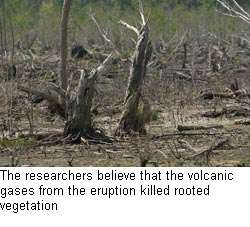
The researchers believe that the volcanic gases from the eruption, which would have depleted earth's protective ozone layer and acidified the land and sea, killed rooted vegetation. This meant that soil was no longer retained and it washed into the surrounding oceans.
The chemistry of the rocks reveals that although the sugar molecules were found in marine sediments, they derived from land, supporting the theory that massive soil erosion caused them to end up in the sea.
Soil materials in the oceans would have blocked out light and soaked up oxygen. Analysis of rock chemistry suggests that after the soil crisis on land, the marine ecosystem succumbed to the stresses of environmental change and oceanic life faltered, completing a global catastrophe.
Dr Mark Sephton, from Imperial College London's Department of Earth Sciences and Engineering and lead author of the research, said: "The cause of the end Permian extinction has been highly controversial. We show that the terrestrial ecosystem was the first to suffer. The continent-wide nature of the event implies that it was caused by something in the atmosphere. The unique chemical data indicates that something fast and catastrophic happened on land."
Prof Henk Visscher of Utrecht University, also part of the research team, commented: "Similar to the 'Dead Zone' nowadays spreading in the Gulf of Mexico, the soil crisis could have caused a worldwide expanse of uninhabitable low-oxygen conditions in shallow marine waters. So what began on land ended in the sea. It seems there was no place to hide at this time of great dying."
Dr Sephton believes that lessons can be learned in the present day from the damage caused by the end Permian extinction: "Land degradation is a worsening global problem thanks to human activity and soil erosion has caused the loss of a third of arable land over the last forty years. 35% of the Earth's land is now soil-free. Identifying the nature of the end Permian soil crisis may help us understand what is in store for us in the years ahead," he said.
The research was carried out by an international team of scientists from the United Kingdom, the Netherlands and the United States.
Source: Imperial College London


