Voyages to the Sun
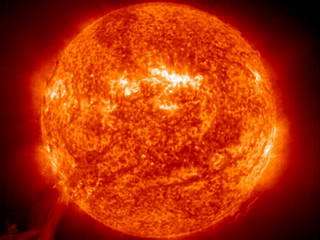
Humanity's epic voyages to the Moon are well known, the stuff of history. But what about voyages to the Sun? Though they do not involve human spacecraft, those voyages are no less epic. And on the occasion of the tenth anniversary of the launch of one of the most successful voyages — is the Solar and Heliospheric Observatory, fondly known as SOHO — it is fitting that we recall those voyages to our life-giving star.
Image Above: An object of worship and awe from the days of ancient civilization, the Sun has been well-studied from the ground. It has been known since the days of Galileo that the Sun rotates, and is speckled with spots, though our knowledge of the nature of the spots (at only 6,000 degrees, cooler parts of the Sun's surface) and the 11-year sunspot cycle, are relatively recent.
The Sun is indeed our nearest star, a mere 8 light minutes away, compared to 4.5 light years for the next star, the Alpha Centauri system. A nuclear furnace generating prodigious amounts of energy, the Sun provides the conditions necessary for life on Earth. It is a matter of practical importance that we know how the Sun works, as well as a matter of theoretical importance, since its proximity gives us the best information on how other Sun-like stars work.
After early observations from sounding rockets, the study of the Sun from space began, naturally enough, from Earth orbit. The Orbiting Solar Observatory (OSO) was a series of eight orbiting observatories that NASA launched between 1962 and 1971. Seven of them were successful, and studied the Sun at ultraviolet and X-ray wavelengths. The OSO spacecraft photographed the million-degree solar corona, made X-ray observations of a solar flare, and enhanced our understanding of the Sun's atmosphere among its many other achievements.
The Apollo Telescope Mount, though inelegantly named, was an innovative program for astronauts to observe the Sun from Skylab, the orbiting space station that made use of hardware in the aftermath of the Apollo program. It was the most important scientific instrument aboard Skylab, which operated for eight months beginning in May, 1973. Unhampered by the limits of telemetry, the astronauts brought solar photographs back to Earth, including x-ray observations of solar flares, coronal holes, and the corona itself. Attempts to observe the Sun beyond Earth orbit are more recent. Ulysses, known before launch as the International Solar Polar Mission, was deployed in October, 1990 from the Space Shuttle Discovery. It was a joint mission of NASA and the European Space Agency designed to gain a new perspective of the Sun by viewing its polar regions.
Remarkably, it uses one of the tricks that space navigators have learned – a gravity assist, whereby it travels first outward to Jupiter before being hurled back toward the Sun. It reached Jupiter in 1992, passed the Sun's south pole in 1994 and its north pole a year later. It repeated these passes in 2000 and 2001, and will do so again in 2006 and 2007. Quite a voyage!
With the first pass of Ulysses, scientists discovered unknown complexities of the Sun and its surroundings, including different speeds of the solar wind. Ulysses – named after Homer's Greek adventurer – did not carry imaging instruments, and focused on the Sun's environment rather than its surface. Fifteen years after launch, the spacecraft remains in good health.
This brings us to SOHO, also a joint American-European project, and another epic solar voyage still underway. Launched Dec 2, 1995, its array of instruments were designed to study the solar wind, as well as the Sun's outer layers and interior structure.
In order to do this, it was placed in an orbit 1.5 million kilometers from Earth, at a point known as the L1 Lagrangian point, where the combined gravity of Earth and Sun keep it in an orbit locked to the Earth-Sun line. Though still far from the Sun, this location, about four times the distance of the Moon in the direction of the Sun, is ideal for long-term uninterrupted observations with the Earth out of the way.
SOHO's scientific findings have been phenomenal. It has imaged the structure of sunspots below the surface, measured the acceleration of the wind from the Sun (streams of protons and electrons traveling at a million miles per hour!), discovered coronal waves and solar tornadoes, and found more than 1000 comets.
Moreover, it has revolutionized our ability to forecast space weather, and provided data on the variability of the Sun's energy, both of which affect us directly on Earth. Some 140 Ph.D. theses have been written using SOHO data, and almost 300 meetings held to discuss its findings.
And what images SOHO has returned during its ten years! Both still images and movies showing the dynamic Sun's prominences, flares, spots, coronal mass ejections, and otherwise lively gyrations fill the SOHO website at sohowww.nascom.nasa.gov
As with most voyages, SOHO has remarkable stories to tell, mostly of what it has seen. But there are other stories: for example, of the day on June 24, 1998 when a ground controller accidentally turned the satellite to face away from Earth. The satellite was feared lost, but a month later the enormous 305-meter radio telescope at Arecibo, Puerto Rico found SOHO.
After a lengthy battery recharge, the satellite was declared recovered on September 18. By the end of the year its gyros had failed, but ground controllers found other ways to control the spacecraft, and it continues to send spectacular images to this day. Designed for a nominal mission of two years, it celebrates it's tenth anniversary this month, and is expected to operate at least until 2007.
With its nine European and three American principal investigators, SOHO is also another example of international cooperation in space. It was built by companies in 14 European countries, and is operated from Goddard Space Flight Center.
So here's to SOHO, its predecessors, and the many other spacecraft, including TRACE, Cluster, Polar, Wind and Geotail, that have contributed to our understanding of Sun-Earth connections. They are connections most of us take for granted every day. But solar scientists know that improved knowledge of the Sun and its effects on Earth can only be a good thing – another of the reasons why we explore.
Source: NASA (by Steven J. Dick)


