Safer cars through touch, sound and smell
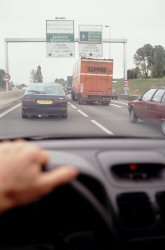
December 2, 2005 Picture: Driver’s view from a car. Vibrating parts of a driver’s body can make them react more quickly to potential dangers when

Oxford researchers have found that using smell, touch and sound may make the car of the future safer.

Picture: Driver’s view from a car. Vibrating parts of a driver’s body can make them react more quickly to potential dangers when driving.

Research by Dr Charles Spence and Cristy Ho at the Department of Experimental Psychology has shown that vibrating parts of a driver’s body as a warning can make them react more quickly to potential road dangers. They found that such multisensory warning signals were particularly effective if they came from the appropriate direction: for example, when your seatbelt vibrates your stomach if the car in front suddenly brakes.

Directional auditory warning icons, such as the sound of a car horn, generated by your car and then projected in the direction of the potential road danger were also found to be very effective. Such warning signals not only alert the driver to a potential hazard but also seem to automatically and intuitively direct the driver’s attention in the appropriate direction.

In a paper published in Transportation Research Part F: Traffic Psychology and Behaviour, the team reported two experiments in which participants were asked to perform attention-demanding driving-like tasks, which involved responding to rapidly-presented visual stimuli. Whilst performing this visual task, they would sometimes feel a vibration on their front or back, at which point they had to check the front windscreen and the rearview mirror, decide if a potential collision was imminent, and brake or accelerate accordingly.

Tactile warnings improved the reaction times of ‘drivers’ by one to two tenths of a second. That difference could be large enough to reduce the most common type of accident, the front-to-rear-end collision (which accounts for a quarter of car accidents), by as much as 10–15 per cent. These findings have now been replicated in collaboration with Dr Nick Reed at the advanced driving simulator in the National Transport Laboratory in Crowthorne, Berkshire.

Dr Spence’s team has also reported recently in Neuroscience Letters that peppermint odour (normally referred to as an ‘alerting’ odour) can be used to improve concentration. It might not be long before cars will be pumping out various different smells in order to wake drivers up as they dose off, or to calm stressed drivers down (using lavender, for instance) to reduce the incidence of road rage.

Source: University of Oxford


print this article email this article download pdf blog this article bookmark this article     Stumble it Digg this share on Facebook retweet share on Reddit add to delicious
Rate this story - 3.3 /5 (4 votes)


December 2, 2005 all stories

Comments: 0

3.3 /5 (4 votes)
  • Stumble this up

  • Digg this

  • share this

  • hide
  • Related Stories

  • Embedded electronics -- cars get cooperative
    created Jul 01, 2009 | popularity not rated yet | comments 0
  • Why California should consider Australia's 'prepare, stay and defend' wildfire policy
    created Feb 26, 2009 | popularity not rated yet | comments 0
  • Lured by promise of stem cells, Americans head abroad for medical treatment
    created Feb 09, 2009 | popularity not rated yet | comments 0
  • New car tech: Not just crash protection, but prevention
    created Jan 28, 2009 | popularity not rated yet | comments 0
  • Life without plastic
    created Jan 02, 2009 | popularity not rated yet | comments 0


Other News

Failing the sniff test: Researchers find new way to spot fraud

Other Sciences / Economics

created 19 hours ago | popularity not rated yet | comments 1

Companies that commit fraud can find innovative ways to fudge the numbers, making it hard to tell something is wrong by just looking at their financial statements. But research from North Carolina State University unveils ...


Study: Credit crisis, debt load a double whammy for investment

Other Sciences / Economics

created 10 hours ago | popularity not rated yet | comments 0

Firms with heavy long-term debt that came due amid the nation's recent credit crisis slashed investment more than three times as much as companies whose paybacks ducked the meltdown, a new University of Illinois study found.


Remains of Minoan-style painting discovered during excavations of Canaanite palace

Other Sciences / Archaeology & Fossils

created 15 hours ago | popularity 4.3 / 5 (3) | comments 0

The remains of a Minoan-style wall painting, recognizable by a blue background, the first of its kind to be found in Israel, was discovered in the course of the recent excavation season at Tel Kabri. This fresco joins others ...


National anti-gun violence program largely successful, study finds

Other Sciences / Social Sciences

created 12 hours ago | popularity 5 / 5 (3) | comments 0

Project Safe Neighborhoods - a community-based policing effort launched in 2001 - has been largely successful in its goal of reducing violent crime, according to an analysis by Michigan State University, the national research ...


RIT scholars explore the impact of imaging on our reality

Other Sciences / Social Sciences

created 14 hours ago | popularity not rated yet | comments 0

Imaging is the use of machines to enhance humans' ability to perceive things, often by producing visible phenomena that cannot be seen with the naked eye. But, can imaging technology distort reality and even change what humans ...