Researchers Blaze Optical Trail with Record-Setting Molecules
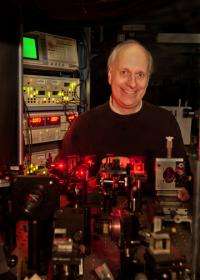
The internet could soon shift into overdrive thanks to a new generation of optical molecules developed and tested by a team of researchers from Washington State University, the University of Leuven in Belgium and the Chinese Academy of Science in China.
The new materials, organic molecules known as chromophores, interact more strongly with light than any molecules ever tested. That makes them, or other molecules designed along the same principles, prime candidates for use in optical technologies such as optical switches, internet connections, optical memory systems and holograms. The molecules were synthesized by chemists in China, evaluated according to theoretical calculations by a physicist at WSU and tested for their actual optical properties by chemists in Belgium.
“To our great excitement, the molecules performed better than any other molecules ever measured,” said WSU physicist Mark Kuzyk.
The team’s findings are published in the January 1 issue of the journal Optics Letters, available online at www.opticsinfobase.org/abstract.cfm?msid=74078 .
Ever since optical technologies became prominent in the 1970s, researchers have tried to improve the materials used to handle light. In 1999, Kuzyk discovered a fundamental limit to how strongly light can interact with matter. He went on to show that all molecules examined at that time fell far short of the limit. Even the best molecules had 30 times less “optical brawn,” as he calls it, than was theoretically possible. The molecules described in the new report break through this long-standing ceiling and are intrinsically 50 percent better than any previously tested, which means they are far more efficient at converting light energy to a useable form.
Earlier this year Kuzyk and two WSU colleagues published theoretical guidelines describing molecular structures that should excel at interacting with light. Koen Clays, a chemist at the University of Leuven in Belgium, had pioneered the use of a test called hyper-Rayleigh scattering to measure the strength of a molecule’s interaction with light. He was in the process of measuring molecules that had been sent to him by chemists from around the world, when he realized that some of his test molecules met the design criteria set forth in Kuzyk’s paper. One series of seven molecules, which had been supplied by chemist Yuxia Zhao at the Chinese Academy of Sciences, looked especially promising. When lead author Xavier Perez-Moreno studied the molecules, he found that two of them showed a more powerful interaction with light than had ever been observed before.
"We found an excellent agreement with Kuzyk's theoretical results,” said Perez-Moreno. “We use the quantum limits to try to get a clearer view of the nonlinear optical interaction and we wish to unveil the unifying principles behind the interaction of light and matter—a very ambitious goal. This summer we set some of the foundations of the quantum limits framework."
Perez-Moreno, a native of Spain, is pursuing a joint Ph.D. degree through Washington State University’s Department of Physics and the University of Leuven’s Department of Chemistry. He will be the first WSU student to receive a doctoral degree in conjunction with a non-U.S. institution.
The new design parameters call for a molecular structure that increases a property known as the “intrinsic hyperpolarizability,” which reflects how readily electrons in the molecule deform when the molecule mediates the merger of two photons into one, an action which is the basis of an optical switch.
Other researchers in the field hailed the breakthrough.
“This is a great lead,” said Geoff Lindsay of the U.S. Navy Research Department. “I would say this is the greatest advance in organic dye hyperpolarizability theory since the field began.”
According to physicist Ivan Biaggio of Lehigh University, the work “is a very important contribution that may help the community to finally deliver the all-optical switching performances that are needed for tomorrow’s all-optical data-processing networks, an aim that has eluded researchers for 20 years.”
In the new designs, each molecule has a component at one end that donates an electron and a component at the other end that accepts an electron. In between is the “bridge” portion of the molecule. Previous efforts to boost the interaction with light focused on “smoothing out” the bridge to allow electrons to flow more easily from donor to acceptor end. Kuzyk’s calculations showed that a more “bumpy” structure actually enhanced the interaction with light; and Clays recognized that Zhao’s structures filled the bill – which was confirmed by measurements made by his group. Quantum mechanics explains the behavior of electrons in this situation, Kuzyk said.
“When you’re looking at something like an electron, you can’t really think of it as a classical little ball that’s moving around,” Kuzyk said. “In reality what ends up happening is that the electron is in a lot of places at the same time. When the electron is all spread out, it can be interfering with itself. By inserting these speed bumps, you’re causing it to bunch up in certain places, and preventing it from interfering with itself.”
The molecules described in the current report have just one “speed bump;’ now that researchers have confirmed that the theoretical designs work, they are synthesizing molecules with more bumps.
“The calculations show that the more bumps, the better,” said Kuzyk.
He said that for use in optical switches or other products, the molecules would probably be embedded in a clear polymer that would provide structural assets such as the ability to be formed into a thin film or into fibers, molded into other shapes or used to coat circuits or chips.
Kuzyk is Boeing Distinguished Professor and associate chair in the Department of Physics and Astronomy at Washington State University. Clays is professor in the Department of Chemistry at the University of Leuven and an adjunct professor in the Department of Physics and Astronomy at WSU. Perez-Moreno is a graduate student jointly enrolled at WSU and the University of Leuven. Zhao is associate professor at the Technical Institute of Physics and Chemistry of the Chinese Academy of Sciences in Beijing. Their research was supported by the University of Leuven, the Belgian government, the Fund for Scientific Research in Flanders, the National Science Foundation and Wright-Paterson Air Force Base.
Source: Washington State University


