Researchers track movements of ancient Central Americans using satellites, video-game technology
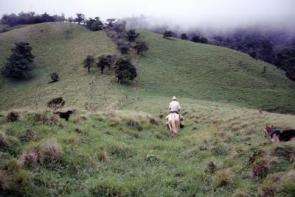
Satellite imagery meshed with video-game technology is allowing University of Colorado at Boulder and NASA researchers to virtually "fly" along footpaths used by Central Americans 2,000 years ago on spiritual pilgrimages to ancestral cemeteries.
The effort has allowed researchers to trace the movements of ancient people in the Arenal region of present-day Costa Rica, who used single-file paths to navigate rugged terrain between small villages and cemeteries over the centuries, said CU-Boulder Professor Payson Sheets. The repeated use of the footpaths caused erosion resulting in narrow trenches in the landscape up to 10 feet deep.
The evidence now indicates people re-used the same processional routes for more than 1,000 years, returning to them despite periodic abandonment of villages caused by recurring violent eruptions of the nearby Arenal Volcano, he said. Sheets gave a presentation on the subject at the 2nd International Conference on Remote Sensing in Archaeology held in Rome from Dec. 4 to Dec. 7.
The researchers have traced one processional path from a village on the Caribbean side of northern Costa Rica over the Continental Divide to a cemetery about 10 miles away using infrared satellite images that indicated characteristic signatures of plant growth, he said. The eroded footpaths -- some virtually invisible to observers on the ground -- collect water that stimulates increased root growth in the vegetation that appears in the images as reddish lines, said Sheets.
"This project has been a huge surprise," said Sheets. "Modern technology has allowed for the discovery and study of 2,000-year-old footpaths in the tropics where the ground is covered by thick vegetation and multiple layers of ash from prehistoric volcanic eruptions."
Software originally developed for video games lets the researchers fly along the footpaths at various altitudes, directions and tilt angles and zoom in on particular landscape features, said Sheets. The team has been able to pinpoint sources of stone used to construct elaborate graves and to confirm springs used for water during ritualistic feasting ceremonies at the cemeteries that lasted for days on end.
"We now know some villages adapted to volcanic eruptions at least four times, retracing the same footpaths to their cemeteries," he said. "We would never have known this without the imagery, and it indicates to me they had a deep need to contact and re-contact spirits of dead ancestors by attempting to access the supernatural."
Sheets has been collaborating with NASA archaeologist Tom Sever -- who earned his doctorate in anthropology at CU-Boulder in 1990 -- as well as a number of CU-Boulder undergraduate and graduate students during the past several years. The project has been supported primarily by the National Science Foundation and NASA.
Images of the footpaths were made by various NASA satellites and aircraft and by a commercial satellite known as IKONOS. Built by Space Imaging of Denver, IKONOS has a resolution of less than one meter and is equipped with infrared sensors that can peer through deep jungle foliage. The team used computer software known as TerraBuilder, a 3-D terrain construction application created by Skyline Software Corp. of Reston, Va., and provided free to the researchers, Sheets said.
The footpaths lead from villages occupied from roughly 500 B.C. to 600 A.D to dozens of small cemeteries in the region, where archaeological evidence indicates visitors cooked, ate, drank, slept and ritually smashed pots on the stone slab-covered graves to commemorate the deceased, he said.
The 3-D visualization project allows users to experience the viewpoint of villagers as they strode out of narrow, subterranean footpaths into the graveyards, a process he likened to "emerging from a tunnel," he said. Subsequently, more complex prehistoric cultures in the region took the concept a step further by developing massive, sunken pathways with entryways wider than soccer fields that connected satellite communities with regional centers as a way to "magnify monumentality," he said.
"Architecture, economics and political structure have traditionally been the brick and mortar of archaeologists," said Sheets. "But here we are using sophisticated technology to probe religion and cosmology of an ancient people, and have found the spiritual aspects of the paths were more important than their practical aspects."
While prehistoric volcanic eruptions in Mesoamerica caused huge social disruption in highly structured societies like the Maya and Aztec, simpler societies like those in the Arenal region were much more resilient, Sheets said. Low population densities, "refuge" areas safe from volcanic activity, a reliance on wild food and a family and village-level political system rather than a highly centralized authority probably helped ensure their survival over the centuries, he said.
The footpaths leading to the cemeteries seem to have been viewed by the ancient villagers as "living entities" and may have been a primary reason they reoccupied the same villages time after time following devastating eruptions of Arenal, said Sheets.
Source: University of Colorado at Boulder


