Scientists discover new class of polymers
They said it couldn't be done. And that's what really motivated UD polymer chemist Chris Snively and Jochen Lauterbach, professor of chemical engineering at UD.
For years, polymer chemistry textbooks have stated that a whole class of little molecules called 1,2-disubstituted ethylenes could not be transformed into polymers--the stuff of which plastics and other materials are made.
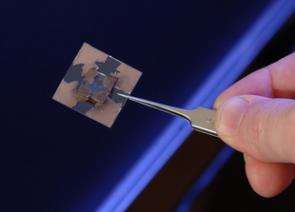
However, the UD scientists were determined to prove the textbooks wrong. As a result of their persistence, the researchers have discovered a new class of ultra-thin polymer films with potential applications ranging from coating tiny microelectronic devices to plastic solar cells.
The discovery was reported as a "communication to the editor" in the Nov. 28 edition of Macromolecules, a scientific journal published by the American Chemical Society.
The research, which also involved doctoral student Seth Washburn, focused on formerly nonpolymerizable ethylenes. Among them are several compounds that are derived from natural sources, such as cinnamon, and and are FDA-approved for use in fragrances and foods. One of the compounds is found in milkshakes, according to the scientists.
"There's been a rule that these molecules wouldn't polymerize," Snively, who is a research associate in Lauterbach's laboratory group, noted. "When I first saw that in a textbook when I was in graduate school, I said to myself, 'Don't tell me I can't do this.'"
And thus, the quest to disprove a widely accepted scientific rule of thumb began.
Polymerization is a chemical reaction in which monomers, which are small molecules with repeating structural units, join together to form a long chain-like molecule--a polymer. Each polymer typically consists of 1,000 or more of these monomer "building blocks."
There are lots of natural polymers in the world, ranging from the DNA in our bodies to chewing gum. Plastics, of course, are one of the most common groups of manmade polymers. These synthetic materials first came on the scene in the mid-1800s and are found today in a wide range of applications, including foam drinking cups, carpet fibers, epoxy and PVC pipes.
Since the late 1990s, Lauterbach and Snively have been developing a method to make extremely thin polymer layers on surfaces. These nanofilms--at least 1,000 times thinner than a human hair--are becoming increasingly important as coatings for optics, solar cells, electrical insulators, advanced sensors and numerous other applications.
Formerly, to make a pound of polymer, scientists would take a monomer and a solvent and subject them to heat or light. Recently, Lauterbach and Snively developed a new polymer-making technique that eliminates the need for a solvent.
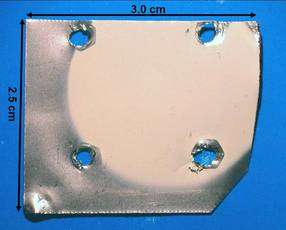
Their deposition-polymerization (DP) process takes place in a vacuum chamber, where the air is pumped out and the pressure is similar to outer space. The material to be coated, such as a piece of metal, is placed in the chamber, and the metal is cooled below the monomer's freezing point, which causes the monomer vapor to condense on the metal. Then the resulting film is exposed to ultraviolet light to initiate polymerization.
The two-step process allows for the formation of uniform, defect-free films with thicknesses that can be controlled to within billionths of a meter.
The process is fairly "green," in that not only are no solvents used, but there also is very low energy consumption using this method, according to Lauterbach.
"You also can do photolithography with it," he said, meaning that the polymer will appear only where the light hits the monomer film.
While their polymerization technique was reported a few years ago, the class of materials the UD scientists have applied it to lately is new and unique.
"We can make nanometer-thick films, but we can't make a gram of the material yet," Snively noted. "We're working on ways to scale up the process."
The scientists also want to find out if the materials may be stronger, tougher or possess unique properties compared to other polymers.
"It's exciting because you don't really know what all their properties are yet," Snively said.
As for all the potential applications, Lauterbach said, "we're kind of in the discovery phase, looking to see where all these materials could be used."
The scientists say their collaboration has been so productive not just because their personalities mesh but because knowledge in each of their respective disciplines is essential to solving the scientific questions they seek to answer.
"We get more done together than either of us could alone," Lauterbach says.
Lauterbach has a doctorate in physical chemistry from the Free University of Berlin and the Fritz-Haber Institute of the Max Planck Society, and a bachelor's degree in physics from the University of Bayreuth, Germany.
Snively, a research assistant professor in the materials science and engineering department, has a doctorate in macromolecular science from Case Western Reserve University.
The two scientists came to UD in 2002 from Purdue University, where Lauterbach won the National Science Foundation's prestigious Faculty Early Career Development Award, as well as Union Carbide's Innovation Recognition Award.
Soon, the UD researchers may be applying the new class of polymers they've discovered to plastic solar cells through collaborative research in UD's new Sustainable Energy from Solar Hydrogen program.
This effort, which focuses on transforming UD graduate students into "energy experts" through interdisciplinary,
problem-based research, is supported by a five-year, $3.1 million grant from the National Science Foundation's Integrative Graduate Education and Research Training (IGERT) program.
UD's program, which began this fall, includes students and faculty from electrical and computer engineering, mechanical engineering, chemical engineering, materials science, chemistry, physics, economics and policy.
"We're looking forward to participating with our students in that program," Lauterbach said.
And until the current polymer textbooks are revised, Lauterbach and Snively also will take great relish when they ask their students to make note of a change in the margins.
"Right now, the excitement for us is that we've proven textbooks wrong," Lauterbach said.
Source: University of Delaware


