Group of galaxies found to bend the light of remote galaxies
January 3, 2007 Galaxy group lens in the CFHTLS-SL2S

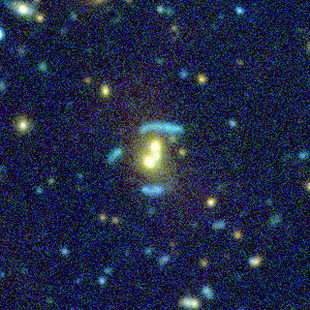
This example of a galaxy group lens in the CFHTLS-SL2S, called SL2SJ021408-053532, shows a very complex arc structure (in blue). Such complex arc geometries allow us to probe the details of the dark matter profiles associated with the group of yellow galaxies in the center of the image. © Canada-France-Hawaii Telescope Corporation 2006

The discovery of a new class of gravitational lenses, the groups of galaxies, by an international team of astronomers using the Canada-France-Hawaii Legacy Survey (CFHTLS), comes 20 years after the publication in January 1987 of the first image of a gravitational arc, made also at CFHT with one of the first CCD cameras in operation at an observatory.

This discovery of gravitational arcs in the center of galaxy groups is an important step in our understanding of the large scale structures of the universe. These new results will allow a better understanding of the distribution of the dark matter and the formation mechanisms of the groups of galaxies, structures intermediate in mass between galaxies and clusters of galaxies.

Twenty years ago at CFHT, French astronomers observed for the first time galaxies distorted in giant arcs at the center of the most massive galaxy clusters. These observations brought to light one of the most spectacular effects of what is called "gravitational lensing".

According to Einstein’s theory of General Relativity, spacetime is curved by the presence of matter. Therefore, the light passing close to an important concentration of mass will be bent. When an observer, a galaxy cluster and a remote galaxy are in nearly perfect alignment, the remote galaxy appears to the observer as one or more luminous arcs resulting from the fusion of images of the remote galaxy distorted and amplified by the galaxy cluster acting as a complex gravitational lens. The shape, brightness and distribution of these gravitational arcs bring invaluable information on the mass distribution of the lensing cluster.

Up to recently, only the most massive galaxy clusters and the massive galaxies were the object of gravitational lensing studies. Intermediate-scale structures like the galaxy groups should however be looked in order to better understand the evolution of the structures in the Universe.

Since the arrival of the MegaCam camera in 2003 on Megaprime, the new CFHT prime focus, astronomers have been able to observe at once a large area of the sky (1 square degree or 4 Full Moon) in 340 MegaPixel digital images with an unprecedented resolution for such a field of view. The Canadian and French communities decided to pull their resources together and to devote 500 nights of telescope time over five years to a large project, the CFHT Legacy Survey, which will cover around 1% of the sky visible from Hawaii.

Thanks to a careful inspection aimed at detecting gravitational arcs in one fourth of the CFHTLS, the team has been able to detect for the first time numerous arcs around galaxy groups. This unexpected discovery provides for the first time direct information on the structure of galaxy groups which are key environments in the formation of structures in the Universe. Scientists will be able to understand the role of dark matter in the evolution of these groups and of the mass concentrations that make the large structures of the Universe.

Source: CFHT


print this article email this article download pdf blog this article bookmark this article     Stumble it Digg this share on Facebook retweet share on Reddit add to delicious
Rate this story - 4.2 /5 (13 votes)


January 3, 2007 all stories

Comments: 0

4.2 /5 (13 votes)
  • Stumble this up

  • Digg this

  • share this

  • hide
  • Related Stories

  • Shedding Light on the Cosmic Skeleton
    created Nov 03, 2009 | popularity not rated yet | comments 0
  • Black Holes Go 'Mano a Mano'
    created Oct 06, 2009 | popularity not rated yet | comments 0
  • Invisible hand in invisible matter
    created Oct 06, 2009 | popularity not rated yet | comments 0
  • Invisible matters: How dwarf galaxies may lose their light
    created Oct 02, 2009 | popularity not rated yet | comments 0
  • The hunt for dark matter
    created Sep 17, 2009 | popularity not rated yet | comments 0


  • hide
  • Relevant PhysicsForums posts

  • Favourite Astronomy Book?
    created 9 hours ago
  • dark energy
    created 9 hours ago
  • The shape of our solar system's orbits.
    created Nov 07, 2009
  • Above or Below the Line of Nodes
    created Nov 07, 2009
  • More from Physics Forums - General Astronomy

Other News

Scripps scientists to develop 'swarms' of miniature robotic ocean explorers

Scientists to develop 'swarms' of miniature robotic ocean explorers (w/ Video)

Space & Earth / Earth Sciences

created 10 minutes ago | popularity not rated yet | comments 0

In an effort to plug gaps of knowledge about key ocean processes, scientists at Scripps Institution of Oceanography at UC San Diego have been awarded nearly $1 million from the National Science Foundation ...


Iowa State scientist develops lab machine to study glacial sliding related to rising sea levels

Scientist develops lab machine to study glacial sliding related to rising sea levels

Space & Earth / Earth Sciences

created 22 minutes ago | popularity not rated yet | comments 0

Neal Iverson opened his laboratory's walk-in freezer and said the one-of-a-kind machine inside could help scientists understand how glaciers slide across their beds. And that could help researchers predict ...


University of Colorado butterfly payload to launch Nov. 16 on space shuttle

Butterfly payload to launch Nov. 16 on space shuttle

Space & Earth / Space Exploration

created 12 minutes ago | popularity not rated yet | comments 0

When NASA's space shuttle Atlantis launches for the International Space Station on Nov. 16 it will carry a University of Colorado at Boulder butterfly experiment that will be monitored by thousands of K-12 ...


Scientists prepare the Mini-Research Module 2 (MRM 2) "Poisk"

Rocket with new module for space station blasts off

Space & Earth / Space Exploration

created 1hour ago | popularity 5 / 5 (1) | comments 0

A Soyuz rocket carrying a new Russian-made module for the International Space Station blasted off on Tuesday from the Baikonur space base in Kazakhstan, television pictures showed.


The Vatican gathered leading scientists to discuss astrobiology

Vatican searches for extra-terrestrial life

Space & Earth / Space Exploration

created 42 minutes ago | popularity not rated yet | comments 0

Is there life on other planets? The Vatican has asked that age-old question over the past five days during a "study week" on astrobiology gathering leading scientists from around the world.