How fish species suffer as a result of warmer waters
January 4, 2007 Eelpout

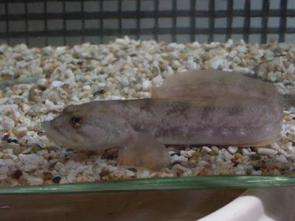
The eelpout (Zoarces vivparus). Credit: Alfred Wegener Institute

Ongoing global climate change causes changes in the species composition of marine ecosystems, especially in shallow coastal oceans. This applies also to fish populations. Previous studies demonstrating a link between global warming and declining fish stocks were based entirely on statistical data. However, in order to estimate future changes, it is essential to develop a deeper understanding of the effect of water temperature on the biology of organisms under question.

A new investigation, just published in the scientific journal Science, reveals that a warming induced deficiency in oxygen uptake and supply to tissues is the key factor limiting the stock size of a fish species under heat stress.

Scientists of the Alfred Wegener Institute for Polar and Marine Research in Bremerhaven investigated the relationship between seasonal water temperature and population density using eelpout (Zoarces viviparus), a fish species from the Southern North Sea.

The goal of the study was to identify those physiological processes exhibiting the most immediate response to warming in the field. Comparing ecological field data with laboratory investigations of the eelpout's physiology, the authors were able, for the first time, to demonstrate a direct link between temperature dependent oxygen limitation experienced by the eelpouts and warming induced changes in their population density.

During evolution, animals have specialised on environmental conditions and are often very limited in their tolerance to environmental change. In this context, fish species from the North Sea which experience large seasonal temperature fluctuations, are more tolerant to higher temperatures and display wider thermal windows than, for instance, fishes from polar regions living at constant low temperatures. The latter are able to grow and reproduce only within a very limited thermal tolerance window.

Investigations at the Alfred Wegener Institute show the key importance of oxygen uptake and distribution – through respiration and blood circulation – in setting the animals' thermal tolerance range, in that these processes are optimised to only a limited temperature window. With increasing temperature, the organism's oxygen supply is the first to deteriorate, followed by other biochemical stress responses. Finally, oxygen supply fails entirely, leaving the organism to perish. These results represent a significant step forward towards understanding the mechanisms involved in climate-induced alterations in marine ecosystems.

The paper 'Climate change affects marine fishes through the oxygen limitation of thermal tolerance' is published on January 5, 2007 in the scientific journal Science.

Source: Alfred Wegener Institute for Polar and Marine Research


print this article email this article download pdf blog this article bookmark this article     Stumble it Digg this share on Facebook retweet share on Reddit add to delicious
Rate this story - 4 /5 (10 votes)


January 4, 2007 all stories

Comments: 0

4 /5 (10 votes)
  • Stumble this up

  • Digg this

  • share this

  • hide
  • Related Stories

  • Robot fish could monitor water quality
    created Nov 02, 2009 | popularity not rated yet | comments 0
  • Scientists study harmful algal blooms in Puget Sound
    created Aug 19, 2009 | popularity not rated yet | comments 0
  • Will a well-mixed, warmer lake doom invasive fish?
    created Jul 30, 2009 | popularity not rated yet | comments 0
  • Humans 'damaging the oceans': research
    created Jul 29, 2009 | popularity not rated yet | comments 0
  • Geologists demonstrate extent of ancient ice age
    created Jun 16, 2009 | popularity not rated yet | comments 0


Other News

Ecologists sound out new solution for monitoring cryptic species

Biology / Ecology

created 44 seconds ago | popularity not rated yet | comments 0

Ecologists have at last worked out a way of using recordings of birdsong to accurately measure the size of bird populations. This is the first time sound recordings from a microphone array have been translated into accurate ...


The six elephants in Sierra Leone were shot and "crudely butchered"

S.Leone elephants 'wiped out' by poachers: official

Biology / Ecology

created 18 hours ago | popularity 5 / 5 (5) | comments 6

Poachers "wiped out" the entire elephant herd in Sierra Leone's only wildlife park, wildlife managers said Thursday after police said they had arrested a gang of 10 poachers.


First-ever blueprint of a minimal cell is more complex than expected

First-ever blueprint of a minimal cell is more complex than expected

Biology / Cell & Microbiology

created 16 hours ago | popularity 5 / 5 (14) | comments 1

What are the bare essentials of life, the indispensable ingredients required to produce a cell that can survive on its own? Can we describe the molecular anatomy of a cell, and understand how an entire organism ...


Ecological speciation by sexual selection on good genes: Is speciation adaptive?

Biology / Ecology

created 16 hours ago | popularity 5 / 5 (1) | comments 0

Darwin suggested that the action of natural selection can produce new species, but 150 years after the publication of his famous book, 'On the Origin of Species', debate still continues on the mechanisms of speciation. New ...


Whiteflies sabotage alarm system of plant in distress

Whiteflies sabotage alarm system of plant in distress

Biology / Plants & Animals

created 20 hours ago | popularity 5 / 5 (2) | comments 0

(PhysOrg.com) -- When spider mites attack a bean plant, the plant responds by producing odours which attract predatory mites. These predatory mites then exterminate the spider mite population, thus acting ...