Saturn dominates the night sky in January
January 4, 2007
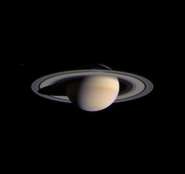
Saturn. Photo by NASA.
The highlight of January will be the planet Saturn, which will rise in the east around 8 p.m. local time at the start of the month and two hours earlier by month's end. The planet with the famous rings will be almost at its biggest and brightest as it crosses the southern sky, remaining visible most of the night.
When Saturn is high in the south on a clear night, there is no better opportunity to view its rings with a telescope. Saturn will remain at almost the same brilliance all month as it dominates the stars of the constellation Leo the Lion. Over the next few weeks Saturn will gradually move away from Leo's brightest star, Regulus.
Saturn's moon Titan, which is larger than the planet Mercury, can be seen with any telescope in a clear dark sky. It will be directly north of Saturn on Jan. 3 and Jan. 19 and directly south of the planet on Jan. 11 and Jan. 27. Wait until the constellation Leo has completely cleared the horizon before you turn a telescope on Saturn, to avoid the turbulence in Earth's atmosphere that will otherwise blur your view of the planet.
While you wait for Saturn to gain altitude in the east, you can enjoy the sight of the planet Venus blazing low in the west-southwest. This "evening star" will appear about a half hour after sunset, shining through the afterglow of twilight.
During the last week of the month, Venus will be joined by much fainter Mercury as the smallest planet climbs out of the twilight into a dark sky. Mercury by itself can be hard to find, and this will be a fine opportunity to see it using Venus as a conspicuous marker. Mercury will be below Venus and slightly to the right (west).
Jupiter will rise in the southeast around 4 a.m. local time in January, easily outshining every other object in the morning sky. The brilliant white planet will pass north of the bright orange star Antares of the constellation Scorpius as the month goes by.
Far below Jupiter will be Mars, which will be close to the southeastern horizon and difficult to see this month.
Meteor shower
The Quadrantid meteor shower will be active for the first week of January, peaking on the night of Jan. 3-4 during the hours before dawn. The moon will be full during the peak, obscuring the fainter meteors, so viewing conditions will not be favorable. Try to find a spot where the moon is blocked by a building or trees. The rate of this shower varies considerably and unpredictably from year to year.
The Quadrantid meteors will appear to come from a point called the radiant near the end of the handle of the Big Dipper, which will rise in the northeast. The radiant is in the constellation Bootes the Herdsman, which contains the bright orange star Arcturus as a conspicuous marker. In the 18th century, this area of the sky was called Quadrans Muralis and gave the Quadrantid meteor shower its name.
Try facing northeast toward the Big Dipper. If you extend the curve formed by the handle's three stars, it forms an "arc to Arcturus." Meteors should be visible in all parts of the sky, but the higher Arcturus is above the eastern horizon, the more meteors there will be. More information about viewing meteor showers, including the Quadrantids, is available from the American Meteor Society at http://www.amsmete … showers.html .
Moon phases
The moon will be full on Jan. 3, at third quarter on Jan. 11, new on Jan. 18 and at first quarter on Jan. 25.
Source: Indiana University
-
Nasa renames earth-observing mission in honor of satellite pioneer
Jan 25, 2012 |
5 / 5 (1) |
0
-
Planets around stars are the rule rather than the exception
Jan 12, 2012 |
4.4 / 5 (9) |
4
-
STAR TRAK for January 2012
Jan 05, 2012 |
not rated yet |
0
-
New Horizons becomes closest spacecraft to approach Pluto
Dec 05, 2011 |
4 / 5 (13) |
9
-
Image: Saturn's Northern storm
Nov 21, 2011 |
5 / 5 (2) |
0
-
Engineers build first sub-10-nm carbon nanotube transistor
Feb 01, 2012 |
4.9 / 5 (31) |
30
-
Something old, something new: Evolution and the structural divergence of duplicate genes
Jan 31, 2012 |
4.6 / 5 (7) |
1
-
The hidden nanoworld of ice crystals: Revealing the dynamic behavior of quasi-liquid layers
Jan 30, 2012 |
5 / 5 (3) |
1
-
Stock market network reveals investor clustering
Jan 27, 2012 |
3.9 / 5 (23) |
8
-
Of microchemistry and molecules: Electronic microfluidic device synthesizes biocompatible probes
Jan 26, 2012 |
5 / 5 (1) |
0
-
Never ending outer space.....
2 hours ago
-
Neutron Star fragments?
4 hours ago
-
stationary or not?
8 hours ago
-
Scale of the Universe
Feb 10, 2012
-
Titan's lack of impact craters
Feb 09, 2012
-
Real pictures of black hole eating a star?
Feb 08, 2012
- More from Physics Forums - General Astronomy
More news stories
Europe stakes billion-dollar bet on new rocket
A pencil-slim rocket is scheduled to lift into space from South America on Monday, carrying a billion-dollar bet that Europe can grab a juicy slice of the market to place satellites in low orbit.
Space & Earth / Space Exploration
15 hours ago |
3.5 / 5 (2) |
0
Political leaders play key role in how worried Americans are by climate change: study
More than extreme weather events and the work of scientists, it is national political leaders who influence how much Americans worry about the threat of climate change, new research finds.
Feb 06, 2012 |
5 / 5 (6) |
72
NASA budget will axe Mars deal with Europe: scientists
US President Barack Obama's budget proposal to be submitted next week for 2013 will cut NASA's budget by 20 percent and eliminate a major partnership with Europe on Mars exploration, scientists said Thursday.
Space & Earth / Space Exploration
Feb 10, 2012 |
5 / 5 (3) |
48
Humans may have helped the decline of African rainforests 3000 years ago
(PhysOrg.com) -- Large areas of rainforests in Central Africa mysteriously disappeared over three thousand years ago, to be replaced by savannas. The prevailing theory has been that the cause was a change ...
Could Venus be shifting gear?
(PhysOrg.com) -- ESAs Venus Express spacecraft has discovered that our cloud-covered neighbour spins a little slower than previously measured. Peering through the dense atmosphere in the infrared, the ...
Space & Earth / Space Exploration
Feb 10, 2012 |
5 / 5 (8) |
10
|
Walney offshore wind farm is world's biggest (for now)
(PhysOrg.com) -- The Walney wind farm on the Irish Sea--characterized by high tides, waves and windy weather--officially opened this week. The farm is treated in the press as a very big deal as the Walney ...
GPS court ruling leaves US phone tracking unclear
A US Supreme Court decision requiring a warrant to place a GPS device on the car of a criminal suspect leaves unresolved the bigger issue of police tracking using mobile phones, legal experts say.
Europeans protest controversial Internet pact
Tens of thousands of people marched in protests in more than a dozen European cities Saturday against a controversial anti-online piracy pact that critics say could curtail Internet freedom.
Study finds that anti-diabetic medication can prevent the long-term effects of maternal obesity
In a study to be presented today at the Society for Maternal-Fetal Medicine's annual meeting, The Pregnancy Meeting, in Dallas, Texas, researchers will report findings that show that short therapy with the anti-diabetic medication ...
Netflix settlement trims 14 pct off 4Q earnings
(AP) -- Netflix pressed the rewind button on its fourth-quarter earnings after settling allegations that the video subscription service violated a consumer-privacy law.
Navy to begin tests on electromagnetic railgun prototype launcher
The Office of Naval Research (ONR)'s Electromagnetic (EM) Railgun program will take an important step forward in the coming weeks when the first industry railgun prototype launcher is tested at a facility ...