Taming 900 vortices gives plasma energy insight
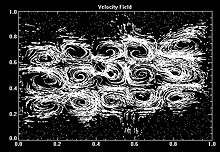
ANU researchers have come closer to understanding how energy is retained in turbulent systems that self-organise - such as the atmosphere, the universe and plasma - after designing a simple experiment in their laboratory which creates 900 vortices in electrolytic fluid.
The researchers watched as the 900 mini-vortices ‘self-organised’ to form one giant vortex. At this high energy state, the fluid developed powerful regions of ‘zonal flow’ which in turn created transport barriers – the key to reducing energy loss from the fluid.
The finding is particularly exciting for the study of turbulence in plasma - a hot, ionised gas - which is known to self-organise to a high energy state. The loss of energy from confined plasma has been one of the main challenges to making it a source of energy.
A better understanding of how this loss occurs has significant implications for the future of plasma energy sources, such as plasma fusion energy reactors, according to Dr Michael Shats, from the Research School of Physical Sciences and Engineering at ANU.
“From this experiment we’ve shown that this process of self-organisation works very similarly in a tank of fluid in the lab and in plasma at temperatures of millions of degrees – it opens up new avenues of discovery.”
In their latest paper published in the journal Physical Review Letters, Dr Shats and colleagues Dr Hua Xia and Dr Horst Punzmann detail how the powerful zonal flows that create the transport barriers, which in turn restrict the loss of energy from the system, are the result of turbulence self-organisation in plasma.
“When the plasma confined by a magnetic field reaches the high energy point of self-organisation, a zonal flow is generated. These zonal flows produce regions in the plasma known as transport barriers, which stop the loss of particles and energy out of the plasma system,” Dr Shats said.
In the natural world, there are already examples of these powerful flows. The turbulent water flow around the Antarctic continent prevents the freezing waters from escaping north, preserving the ice cap on one side and the tropical water on the other. “This is very similar to the transport barrier that we find in plasma,” Dr Shats said.
“Another example is the zonal flows in the atmospheres of most of the planets in the Solar System. High energy winds around Saturn exceed 1500 kilometres an hour. On Venus, zonal winds measure up to 400 kilometres an hour, which is much faster than the planet’s rotation velocity.
“These phenomena have common physics principles which can be studied in the lab, through experiments like ours, opening up a new research direction which will contribute to several fields ranging from improvement in the plasma confinement in a fusion reactor to a better understanding of atmospheric physics,” Dr Shats said.
Source: Australian National University


