Satellites Capture First-Ever Gravity Map Of Tides Under Antarctic Ice
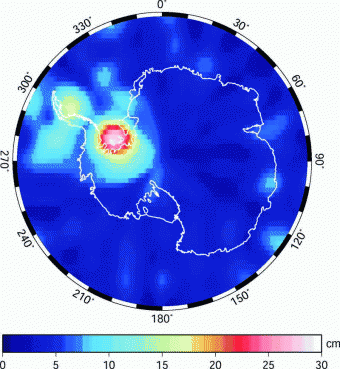
Ohio State University scientists have used minute fluctuations in gravity to produce the best map yet of ocean tides that flow beneath two large Antarctic ice shelves. They did it using the twin satellites of the Gravity Recovery and Climate Experiment (GRACE), a joint project of NASA and the German Aerospace Center.
Image: GRACE-measured gravity fluctuations from twice-daily tides caused by the moon. Courtesy of Ohio State University.
Large tides flow along the ocean floor beneath the Larsen and Filchner-Ronne Ice Shelves. Though scientists have long known of these tides, they have not yet been modeled accurately, said C.K. Shum, professor of civil and environmental engineering and geodetic science at Ohio State. Yet the tides play a major role in scientists’ efforts to measure how much the ice sheets are melting or freezing, and how the melting ice will affect global sea levels.
While the tides cause only minute fluctuations in Earth’s overall gravity, they are actually composed of massive amounts of water, he explained.
The ice is a mile thick in parts, and the tides are so large that they can lift the shelves – with a combined area bigger than the state of California – as high as 15 feet.
Scientists believe that these unseen tides can carve into the ice from underneath and eventually cause pieces to break off, as part of the Larsen Ice Shelf broke off in 1995.
The tides also make the job of measuring changes in the ice more difficult. Large portions of these two ice shelves float on the water, so the rise and fall of the ice with the tides prevents scientists from making precise measurements of ice thickness.
The GRACE satellites offer a good way to track the tides, Shum said. Ocean currents slightly nudge the force of gravity higher or lower in some places around the world every day. GRACE can detect those changes.
Shin-Chan Han, a research scientist in the School of Earth Sciences at Ohio State, presented the study Wednesday in a poster session at the meeting of the American Geophysical Union in San Francisco.
Other research groups have tried to measure these tides terrestrially with sensors called tide gauges. But doing so in Antarctica means first drilling through the ice to plant the sensors on the ocean floor, and then retrieving the sensors later to download the data. Because of the equipment expense and the harsh conditions on the frozen continent, scientists have been able to plant only a handful of these sensors there.
“There were measurements of these tides before, but they were confined to very few spots,” Shum said. “To get really accurate measurements – and make really accurate models of how the tides are interacting with the ice – you’d need to put tide gauges or other equipment all over the ocean bottom underneath an ice shelf, and that’s not practical.”
The twin GRACE satellites have circled the globe in tandem since 2002, effectively drawing a picture of the Earth's gravity field at least once a month. On-board instruments measure very precisely any minute tugs the Earth exerts on the satellites while they're in orbit.
To get a handle on the extent of the Antarctic tides, Shum and his team used GRACE to measure the change in local gravity as water flowed beneath the two ice shelves between August 2002 and June 2004.
Shum and his team, including Han and Koji Matsumoto of the National Astronomical Observatory of Japan, used the gravity variations to calculate expected tide height beneath a number of key points on the two ice shelves.
The researchers compared their data to two Antarctic tide models created by other groups. The two models – which were based on sparse data collected from tide gauges on the continent – agreed with the GRACE data to within 20 percent.
“We have reason to believe that GRACE data is more accurate because the other models are based on substantially less data,” Shum said. “So we think that people who incorporate our GRACE data into their own data are going to get better results. We also hope to help glaciologists measure changes in the ice flow much more accurately.”
Not knowing precisely where the tides are – and how big they are – creates two kinds of errors in scientists’ measurements, he said.
As an ice sheet rises with the tide, part of the grounded portion that normally rests on the ocean floor raises up. Researchers call the point of contact between the ice and the rock the grounding line, and the rise of the ice effectively moves the grounding line inland. That means that while the tide is high, more of the ice bottom is contacting the water than when the tide is low.
Scientists need to know where the grounding line is in order to determine what portion of the ice shelf is being affected by direct contact with the water. Based on the data from GRACE, Shum suspects that previous estimates of where the grounding line is located on these two ice shelves could be off by hundreds of meters (thousands of feet) in different locations.
Meanwhile, the rise and fall of the ice can make the surface appear to be higher or lower than it really is when satellites measure the ice sheets’ topography. Depending on the time of day they record their elevation measurements, scientists who use that data to calculate the mass of an ice sheet can get totally different answers.
While people have studied the tides at Earth’s middle latitudes for centuries, tides at the poles have presented scientists with serious obstacles, Shum said. Where harsh conditions prevent detailed study, the terrain of the ocean bottom is not well known. The interaction between the water and polar ice sheets isn’t fully understood, either.
Source: Ohio State University


