New HIV test may predict drug resistance
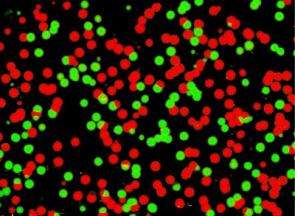
Researchers at Duke University Medical Center have developed a highly sensitive test for identifying which drug-resistant strains of HIV are harbored in a patient's bloodstream.
The test may provide physicians with a tool to guide patient treatment by predicting if a patient is likely to become resistant to a particular HIV drug, said one of its developers, Feng Gao, M.D., associate professor of medicine. Drug resistance is one of the most common reasons why therapy for HIV, the virus that causes AIDS, fails.
The test, which detects genetic changes, or mutations, in HIV, also may help scientists understand how the constantly evolving virus develops drug resistance, Gao said. He said such knowledge ultimately may result in the development of new treatments designed to evade resistance.
The findings will appear online on Sunday, Jan. 7, 2007, in the journal Nature Methods, as well as in the journal's February 2007 print edition. The work was supported by the National Institutes of Health and the Duke Center for AIDS Research.
Duke has filed for a provisional patent on the technology, and the researchers are considering ways to establish a new company to pursue its development or to license the technology to an existing company, Gao said.
Because HIV genes mutate so easily and the virus reproduces so rapidly, most people who are infected have many different forms of the virus in their bodies. In some cases, mutated strains take on new properties that make them more resistant to the drugs used in antiretroviral therapy, the primary means of treatment for HIV infection.
During antiretroviral therapy that does not fully suppress the virus, a strain that develops drug resistance will grow more quickly than strains lacking such resistance, and the resistant strain will replicate to become the most prominent virus in the person's body.
"The viral populations found in the blood of one patient can be very different from the populations present in another," Gao said. "Which resistant viruses are at hand can have important implications for the successful treatment of that patient."
More than 20 drugs currently are available for treating HIV infection. All but one of the drugs target two of the genes that serve as blueprints for vital protein components of HIV: reverse transcriptase and protease.
The Duke test examines the genes of HIV strains for mutations at certain positions that are known to be linked to drug resistance. For example, a change at a specific spot along the genetic code -- position 46 -- of the protease gene results in resistance to the drug indinavir.
To assess the test, the researchers analyzed blood samples from three different groups of HIV patients: those who had never received antiretroviral treatment, those who had received treatment but were not currently being treated and those who were receiving treatment but the treatment was not completely successful.
After processing the blood samples and isolating the genetic material in each of them, the researchers added tiny fluorescent tags designed to stick to HIV genes in particular ways. Tags designed to stick to mutated gene locations known to produce drug resistance were labeled to appear green, while tags designed to stick to the same gene locations but where the genes had not mutated were labeled to appear red.
The researchers used a sophisticated computer program to count the number of molecules with green or red fluorescent tags in each sample. The test proved sensitive enough to detect a single mutated virus out of 10,000 nonmutated viruses in the patient samples, Gao said.
"This level of sensitivity makes the assay about 1,000 times more sensitive than the most widely used assays on the market for detecting drug-resistant HIV viruses" Gao said. "Thus, the assay may permit more accurate prediction of treatment outcomes."
The test also can detect when a virus molecule has more than one mutation, a capability that no commercially available test has achieved, Gao said. This capability may prove critical for detecting HIV strains that have become resistant to multiple drugs, a condition that occurs often as many patients are treated with many drugs at the same time.
The test may find broader medical application as well, Gao said. He said it has the potential to detect mutations that confer drug resistance in infectious agents that cause other diseases besides HIV, such as hepatitis B, hepatitis C and tuberculosis.
Source: Duke University


