Gas giants jump into planet formation early
January 8, 2007 Gas giants jump into planet formation early

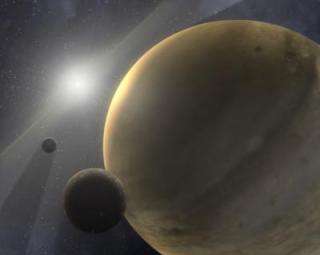
This is an artist's concept of a hypothetical 10-million-year-old star system. The bright blur at the center is a star much like our sun. The other orb in the image is a gas-giant planet like Jupiter. Wisps of white throughout the image represent traces of gas. Astronomers using NASA's Spitzer Space Telescope have found evidence showing that gas-giant planets either form within the first 10 million years of a sun-like star's life, or not at all. The lifespan for sun-like stars is about 10 billion years. The scientists came to this conclusion after searching for traces of gas around 15 different sun-like stars, most with ages ranging from 3 million to 30 million years. With the help of Spitzer's Infrared Spectrometer instrument, they were able to search for relatively warm gas in the inner regions of these star systems, an area comparable to the zone between Earth and Jupiter in our own solar system. They also used ground-based radio telescopes to search for cooler gas in the outer regions of these systems, an area comparable to the zone around Saturn and beyond. Credit: Image credit: NASA/JPL-Caltech/T. Pyle (SSC)

Gas-giant planets like Jupiter and Saturn form soon after their stars do, according to new research.

Observations from NASA's Spitzer Space Telescope show that gas giants either form within the first 10 million years of a sun-like star's life, or not at all. The study offers new evidence that gas-giant planets must form early in a star's history. The lifespan of sun-like stars is about 10 billion years.

Ilaria Pascucci of the University of Arizona Steward Observatory in Tucson led a team of astronomers who conducted the most comprehensive search for gas around 15 different sun-like stars, most with ages ranging from 3 million to 30 million years.

The scientists used Spitzer's heat-seeking infrared eyes to search for warm gas in the inner portions of star systems, an area comparable to the zone between Earth and Jupiter in our own solar system.

In addition, Pascucci, team member Michael Meyer of the UA Steward Observatory and their colleagues probed for cold gas in the outer regions of these star systems with the Arizona Radio Observatory's 10-meter Submillimeter Telescope (SMT) on Mount Graham, Ariz. The outer zones of these star systems are analogous to the region around Saturn's orbit and beyond in our own solar system.

All of the stars in the study – including those as young as a few million years – have less than 10 percent of Jupiter's mass in gas swirling around them, Pascucci said.

"This indicates that gas giant planets like Jupiter and Saturn have already formed in these young solar system analogs, or they never will," Meyer said.

Astronomers suspect that gas around a star may also be important for sending terrestrial, or rocky, planets like Earth into relatively circular orbits as they form. If Earth had a highly elliptical orbit rather than relatively circular one, its temperature swings would be so extreme that humans and other complex organisms might not have evolved.

Many of the sun-like star systems in the study don't currently contain enough gas to send developing rocky planets into circular orbit, Pascucci said. One possibility is that terrestrial planets around these stars have highly elliptical orbits that hinder the development of complex life. Another possibility is that some mechanism other than gas moves the terrestrial planets into circular orbits once they are fully formed. "Our observations tested only the effect of gas," Pascucci said.

Pascucci's paper was published in the Astrophysical Journal in November 2006. The astronomers are presenting a poster of their findings today at the 209th meeting of the American Astronomical Society in Seattle, Wash. The observations were part of the Spitzer Legacy Science Program "Formation and Evolution of Planetary Systems" (FEPS). Meyer, a co-author of the paper, is the principal investigator of the FEPS program.

Source: University of Arizona


print this article email this article download pdf blog this article bookmark this article     Stumble it Digg this share on Facebook retweet share on Reddit add to delicious
Rate this story - 3.2 /5 (6 votes)


January 8, 2007 all stories

Comments: 0

3.2 /5 (6 votes)
  • Stumble this up

  • Digg this

  • share this

  • hide
  • Related Stories


  • hide
  • Relevant PhysicsForums posts

  • Planet Formation Question
    created 1hour ago
  • Gravity on Mars
    created 14 hours ago
  • Question about the orbit between Mars and Earth
    created 22 hours ago
  • SIMBAD/NED help
    created Nov 16, 2009
  • More from Physics Forums - General Astronomy

Other News

Close-up movie shows hidden details in the birth of super-suns

Close-up movie shows hidden details in the birth of super-suns (w/ Video)

Space & Earth / Astronomy

created 13 hours ago | popularity 4.8 / 5 (5) | comments 0

(PhysOrg.com) -- The constellation of Orion is a hotbed of massive star formation, most prominently in the Great Nebula that sits in Orion's sword. The glowing gas of the Nebula is powered by a group of young ...


Volatile gas could turn Rwandan lake into a freshwater time bomb

Space & Earth / Earth Sciences

created 11 hours ago | popularity 4.5 / 5 (8) | comments 3

A dangerous level of carbon dioxide and methane gas haunts Lake Kivu, the freshwater lake system bordering Rwanda and the Republic of Congo.


Ghostly 'Spokes' Puff Out From Saturn's Ring's

Ghostly 'Spokes' Puff Out From Saturn's Ring's (w/ Video)

Space & Earth / Space Exploration

created 9 hours ago | popularity 4.7 / 5 (3) | comments 0

(PhysOrg.com) -- Massive, bright clouds of tiny ice particles hover above the darkened rings of Saturn in an image captured by the Cassini spacecraft on Sept. 22, 2009, around the time of Saturn's equinox. ...


NASA 'Drops' Next Generation Robotic Lander During Autonomous Tests

NASA 'Drops' Next Generation Robotic Lander During Autonomous Tests

Space & Earth / Space Exploration

created 9 hours ago | popularity 4.3 / 5 (4) | comments 1

(PhysOrg.com) -- NASA has successfully completed a series of autonomous "drop" tests of a robotic lander test article - in a record 10 months - to demonstrate the ability to perform a controlled landing on ...


Space shuttle Atlantis lifts off on supply mission (AP)

Space shuttle Atlantis lifts off on supply mission

Space & Earth / Space Exploration

created 9 hours ago | popularity 3.5 / 5 (2) | comments 0

(AP) -- With 100 Internet-savvy NASA fans cheering on the shuttle and churning out constant Twitter updates, Atlantis sailed smoothly into orbit Monday with six astronauts and a full load of spare parts for ...