Hybrid Structures Combine Strengths of Carbon Nanotubes and Nanowires
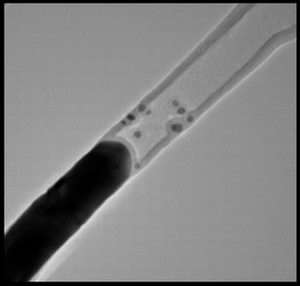
January 8th, 2007 Junction between a gold nanowire and a carbon nanotube

Junction between a gold nanowire (top) and a carbon nanotube. Credit: Rensselaer/Fung Suong Ou

A team of researchers at Rensselaer Polytechnic Institute has created hybrid structures that combine the best properties of carbon nanotubes and metal nanowires. The new structures, which are described in a recent issue of Applied Physics Letters, could help overcome some of the key hurdles to using carbon nanotubes in computer chips, displays, sensors, and many other electronic devices.

The impressive conductivity of carbon nanotubes makes them promising materials for a wide variety of electronic applications, but techniques to attach individual nanotubes to metal contacts have proven challenging. The new approach allows the precise attachment of carbon nanotubes to individual metal pins, offering a practical solution to the problem of using carbon nanotubes as interconnects and devices in computer chips.
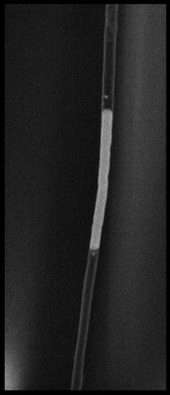
Hybrid Structures Combine Strengths of Carbon Nanotubes and Nanowires

An electron microscope image of a hybrid structure made from a gold nanowire (middle) and carbon nanotubes. Credit: Rensselaer/Fung Suong Ou

“This technique allows us to bridge different pieces of the nanoelectronics puzzle, taking us a step closer to the realization of nanotube-based electronics,” said Fung Suong Ou, the paper’s corresponding author and a graduate student in materials science and electrical engineering at Rensselaer.

As chip designers seek to continually increase computing power, they are looking to shrink the dimensions of chip components to the nanometer scale, or about 1-100 billionths of a meter. Carbon nanotubes and nanowires that became available in the 1990s are promising candidates to act as connections at this scale, according to Ou, because they both possess interesting properties.

For example, carbon nanotubes display amazing mechanical strength, and they are excellent conductors of electricity, with the capacity to produce interconnects that are many times faster than current interconnects based on copper. Gold nanowires also have very interesting optical and electrical properties, and they are compatible with biological applications, Ou said.

“In order to take full advantage of these materials, we demonstrate the idea of combining them to make the next generation of hybrid nanomaterials,” he said. “This approach is a good method to marry the strengths of the two materials.”

The metal nanowires in this technique are made using an alumina template that can be designed to have pore sizes in the nanometer range. Copper or gold wires are deposited inside the pores, and then the entire assembly is placed in a furnace, where a carbon-rich compound is present. When the furnace is heated to high temperatures, the carbon atoms arrange themselves along the channel wall of the template and the carbon nanotubes grow directly on top of the copper wires.

“It’s a really easy technique, and it could be applied to a lot of other materials,” Ou said. “The most exciting aspect is that it allows you to manipulate and control the junctions between nanotubes and nanowires over several hundred microns of length. The alumina templates are already mass-produced for use in the filter industry, and the technique can be easily scaled up for industrial use.”

To date the team has made hybrid nanowires that combine carbon nanotubes with both copper and gold. But they also are currently working to connect carbon nanotubes to a semiconductor material, which could be used as a diode, according to Ou.

The research was performed under the guidance of Pulickel Ajayan, the Henry Burlage Professor of Materials Science and Engineering at Rensselaer and a world-renowned expert in fabricating nanotube-based materials. Other Rensselaer researchers involved with the project were Robert Vajtai, Derek Benicewicz, Lijie Ci, and M.M. Shaijumon.

Source: Rensselaer Polytechnic Institute


print this article email this article download pdf blog this article bookmark this article     Digg this Stumble it share on Facebook share on Reddit add to delicious save to Yahoo! bookmarks
4.1/5 after 16 votes


January 8th, 2007 all stories
Nanotechnology / Nanophysics

Comments: 0
Rank: 4.1/5 after 16 votes

  • Stumble this up

  • Digg this

  • Share it:
  • share on Facebook
  • share on MySpace
  • share on Slashdot
  • rss-newsfeed
  • share on Google
  • share on Reddit
  • add to delicious
  • save to Yahoo! bookmarks
  • share on Windows Live
  • Add to Mixx!
Rating: 4.1/5 after 16 votes


Tags


  • Physicists Demonstrate Quantum Memory with Matter Qubits
    Physicists Demonstrate Quantum Memory with Matter Qubits
    Physics / General Physics
    created Jul 03, 2009 | popularity 4.4 / 5 (17) | comments 1
  • 'Holey' Nanosheets for Wastewater Dye Removal
    Nanotechnology / Nanomaterials
    created Jul 01, 2009 | popularity 5 / 5 (5) | comments 1
  • Jellyfish Robot Swims Like its Biological Counterpart
    Jellyfish Robot Swims Like its Biological Counterpart
    Electronics / Robotics
    created Jun 26, 2009 | popularity 4.4 / 5 (8) | comments 1
  • Could Maxwell's Demon Exist in Nanoscale Systems?
    Could Maxwell's Demon Exist in Nanoscale Systems?
    Physics / General Physics
    created Jun 24, 2009 | popularity 4.4 / 5 (18) | comments 29
  • Living Safely with Robots, Beyond Asimov's Laws
    Living Safely with Robots, Beyond Asimov's Laws
    Electronics / Robotics
    created Jun 22, 2009 | popularity 4.6 / 5 (52) | comments 40
  • Other News

    A 'quantum of sol' -- how nanotechnology could hold the key to a solar-powered future

    A 'quantum of sol' -- how nanotechnology could hold the key to a solar-powered future

    Nanotechnology / Nanomaterials

    created Jun 30, 2009 | popularity 3.9 / 5 (15) | comments 17

    (PhysOrg.com) -- A new generation of 'nano-structured' millimetre-sized solar cells that could convert the sun's energy to electricity more than twice as efficiently as current technology, is the subject of ...


    Australian researchers are set to begin human trials of a tiny nano-cell that acts as a "Trojan horse" against cancer

    Hi-tech 'Trojan horse' can kill cancer cells: researchers

    Nanotechnology / Bio & Medicine

    created Jun 29, 2009 | popularity 4.7 / 5 (12) | comments 7

    Australian researchers are set to begin human trials of a tiny nano-cell that acts as a "Trojan horse" against cancer cells, a breakthrough they say may curb the need for debilitating chemotherapy.


    'Holey' Nanosheets for Wastewater Dye Removal

    Nanotechnology / Nanomaterials

    created Jul 01, 2009 | popularity 5 / 5 (5) | comments 1

    (PhysOrg.com) -- Researchers have discovered that extremely thin sheets of nickel oxide with hexagonally shaped holes can absorb hazardous dyes from wastewater nearly as well as the best traditional methods, but are recyclable. ...


    Harnessing Nanoparticles To Track Cancer Cell Changes

    Nanotechnology / Bio & Medicine

    created Jul 03, 2009 | popularity not rated yet | comments 1

    The more dots there are, the more accurate a picture you get when you connect them. Cancer researchers adopting that philosophy have developed a new imaging technology that could give scientists the ability to simultaneously ...


    Computer-Guided Nanoparticle Therapy Destroys Tumors

    Nanotechnology / Bio & Medicine

    created Jun 29, 2009 | popularity 4.9 / 5 (12) | comments 0

    Gold nanoshells are among the most promising new nanoscale therapeutics being developed to kill tumors, acting as antennas that turn light energy into heat that cooks cancer to death. Now, a multi-institutional research team ...