Precision measurement of W-boson mass suggests a lighter Higgs particle
January 8, 2007 Precision measurement of W-boson mass suggests a lighter Higgs particle

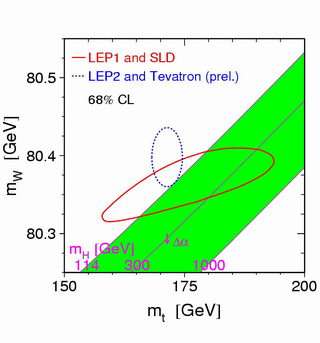
In the Standard Model of particles and forces, the masses of the W boson, the top quark and the Higgs boson are connected. If one knows the mass of any two of the three particles, then the mass of the third particle can be calculated. This plot illustrates that relationship. It depicts the mass of the Higgs boson as a function of top quark and W-boson mass. Each diagonal line represents a single Higgs boson mass; examples chosen are MH = 114, 300 and 1000 GeV/c2. Based on theoretical constraints and direct experimental searches, scientists expect the mass of the Higgs boson to lie somewhere in the green-banded region. The new CDF measurement of the W-boson mass (see this press release) indicates that the W-boson mass is heavier than previously measured (worldwide average). Since the top quark mass did not change, a heavier W-boson mass indicates a lighter Higgs Boson. The blue ellipse shows the most likely values for the top quark and W-boson masses, based on all available experimental information, including the CDF result, at the 68 percent confidence level. The intersection of this ellipse with the green band indicates the most likely Higgs boson mass. This result can be compared to an older result (red ellipse), which did little to constrain the Higgs boson mass. Credit: Fermi Lab

Scientists of the CDF collaboration at the Department of Energy's Fermi National Accelerator Laboratory announced today the world's most precise measurement by a single experiment of the mass of the W boson, the carrier of the weak nuclear force and a key parameter of the Standard Model of particles and forces.

The new W-mass value leads to an estimate for the mass of the yet-undiscovered Higgs boson that is lighter than previously predicted, in principle making observation of this elusive particle more likely by experiments at the Tevatron particle collider at Fermilab.

Scientists working at the Collider Detector at Fermilab measured the mass of the W boson to be 80,413 +/- 48 MeV/c2, determining the particle's mass with a precision of 0.06 percent. Calculations based on the Standard Model intricately link the masses of the W boson and the top quark, a particle discovered at Fermilab in 1995, to the mass of the Higgs boson. By measuring the W-boson and top-quark masses with ever greater precision, physicists can restrict the allowable mass range of the Higgs boson, the missing keystone of the Standard Model.
Precision measurement of W-boson mass suggests a lighter Higgs particle

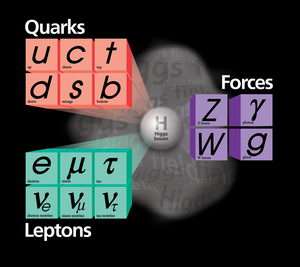
According to the Standard Model of particles and forces, the Higgs mechanism gives mass to particles. Measuring the mass of the top quark and the mass of the W boson, scientists can restrict the allowable mass range of the not-yet-observed Higgs boson. Credit: Fermi Lab

"This new precision determination of the W boson mass by CDF is one of the most challenging and most important measurements from the Tevatron," said Associate Director for High Energy Physics at DOE's Office of Science Dr. Robin Staffin. "Together, the W-boson and top-quark masses allow us to triangulate the location of the elusive Higgs boson."

The CDF result is now the most precise single measurement to date of the W boson mass. Combining the CDF result with other measurements worldwide leads to an average value of the W-boson mass of 80,398 +/- 25 MeV/c2.

Prior to the announcement of the CDF result, ALEPH, an experiment at CERN, the European Center for Nuclear Research, held the record for the most precise W mass measurement. ALEPH and its three sister experiments at CERN, which operated until 2001, made significant contributions to the measurement of the W's mass. The experiments relied on electron-positron collisions produced by the LEP collider at CERN. In contrast, CDF experimenters are analyzing proton-antiproton collisions produced by Fermilab's Tevatron, the world's most powerful particle collider.

"Compared to the electron-positron collisions at LEP, the proton-antiproton collisions at the Tevatron result in a 'dirty' environment experimentally," said Jacobo Konigsberg, University of Florida physicist and CDF cospokesperson. "Every collision produces hundreds of particles along with the W boson that need to be properly accounted for. That's why our analysis is so challenging."

Now, having gained a much better understanding of their detector and the processes it records, CDF scientists are optimistic that they can further improve the precision of their W-mass result by a factor of two in the next couple of years.

"You have to sweat every detail of the analysis," said Fermilab physicist and cospokesperson Robert Roser. "Our scientists cannot take anything for granted in an environment in which composite particles such as protons and antiprotons collide. We need to understand the many different subatomic processes and take into account the capabilities of our detector for identifying the various particles."

In a talk at Fermilab on Friday, January 5, Ashutosh Kotwal, CDF collaborator and Professor of Physics at Duke University, presented the W-mass result to the scientific community. The result will be submitted in a paper to Physical Review Letters.

This W mass measurement is yet another major result of Tevatron Run II announced by scientists in the last year, indicating the progress that experimenters have made with both the CDF and the DZero experiments at Fermilab. As the two collaborations continue to take data, collaborators press the search for the Higgs boson as well as for signs of dark matter particles and extra dimensions.

"The CDF and DZero experiments have much more data to analyze, and they are observing more and more collisions at a faster and faster rate," said Fermilab Director Pier Oddone. "Our experimenters are now in a position to look for some of the rarest and most amazing phenomena that theorists have predicted, as well as to find the completely unexpected. This is a very exciting time."

Source: Fermi National Accelerator Laboratory


Rate this story - 4.3 /5 (24 votes)


January 8, 2007 all stories

Comments: 0

4.3 /5 (24 votes)

  • hide
  • Related Stories

  • Particle oddball surprises physicists
    created Mar 18, 2009 | popularity not rated yet | comments 0
  • New experiments constrain Higgs mass (w/Videos)
    created Mar 13, 2009 | popularity not rated yet | comments 0
  • The hunt for the Higgs steps up a gear
    created Aug 28, 2008 | popularity not rated yet | comments 0
  • Physicists 'See' Single Top Quarks at the Tevatron
    created Aug 22, 2008 | popularity not rated yet | comments 0
  • Tevatron experiments double-team Higgs boson
    created Aug 04, 2008 | popularity not rated yet | comments 0


  • hide
  • Relevant PhysicsForums posts

  • Interception angle
    created 1hour ago
  • Pressure created by clamping base and cover
    created 2 hours ago
  • How to find static friction
    created 8 hours ago
  • Calculating decible increases
    created 15 hours ago
  • Coefficients of friction
    created 15 hours ago
  • Deduction of centripetal force
    created 16 hours ago
  • More from Physics Forums - General Physics

Other News

Extra large carbon

Extra large carbon

Physics / General Physics

created 15 hours ago | popularity 4.7 / 5 (12) | comments 7 | with audio podcast

An exotic form of carbon has been found to have an extra large nucleus, dwarfing even the nuclei of much heavier elements like copper and zinc, in experiments performed in a particle accelerator in Japan. ...


Scientist explore future of high-energy physics

Scientist explore future of high-energy physics

Physics / General Physics

created 21 hours ago | popularity 4.9 / 5 (12) | comments 8 | with audio podcast

In a 1954 speech to the American Physical Society, the University of Chicago's Enrico Fermi fancifully envisioned a particle accelerator that encircled the globe. Such would be the ultimate theoretical outcome, ...


Leaf veins inspire a new model for distribution networks (w/ Video)

Physics / General Physics

created 18 hours ago | popularity 5 / 5 (3) | comments 0 | with audio podcast

(PhysOrg.com) -- Following the straight and narrow may be good moral advice, but it’s not a great design principle for a distribution network. In new research, a team of biophysicists describe a complex netting of interconnected ...


New magnetic tuning method enhances data storage

New magnetic tuning method enhances data storage

Physics / General Physics

created 21 hours ago | popularity 4.2 / 5 (5) | comments 0 | with audio podcast

Researchers in Chicago and London have developed a method for controlling the properties of magnets that could be used to improve the storage capacity of next-generation computer hard drives.


High-performance microring resonator developed by INRS researchers

Physics / Optics & Photonics

created 13 hours ago | popularity 1.5 / 5 (2) | comments 0

A new, more efficient low-cost microring resonator for high speed telecommunications systems has been developed and tested by Professor Roberto Morandotti's INRS team in collaboration with Canadian, American, and Australian ...