Superstrings could add gravitational cacophony to universe's chorus
January 8th, 2007 Cosmic Superstring

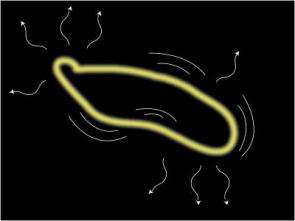
Cosmic superstring loops wiggle and oscillate, producing gravitational waves, then slowly shrink as they lose energy until they disappear. Credit: Matt DePies/UW

Albert Einstein theorized long ago that moving matter would warp the fabric of four-dimensional space-time, sending out ripples of gravity called gravitational waves. No one has observed such a phenomenon so far, but University of Washington researchers believe it is possible to detect such waves coming from strange wispy structures called cosmic superstrings.

Many physicists consider a complex and sometimes-controversial premise called string theory to be a leading candidate to unify their understanding of the four basic forces of nature – gravity, electromagnetic, weak and strong. String theory is sometimes criticized for being untestable or even unscientific, but some versions now predict an exotic behavior with observable effects: the formation of cosmic superstrings, narrow tubes of energy left from the beginning of the universe that have been stretched to enormous lengths by the expansion of the universe, said UW cosmologist Craig Hogan.

If the theories are correct, there are countless cosmic superstrings stretched like a galactic-sized rubber band. They resemble ultra-thin tubes with some of the vacuum of the early universe preserved inside, Hogan said. The strings can form into loops that "flop around" and emit gravitational waves as they decay and eventually disappear.

"They're so light that they can't have any effect on cosmic structure, but they create this bath of gravitational waves just by decaying," he said.

Theory holds that every time something moves it emits a gravitational wave. Colliding black holes send out more waves than anything else, typically a million times more power than is produced by all the galaxies in the universe. While some gravitational waves could occur at frequencies high enough that a human theoretically could hear them, many more of the sources have very low frequencies, 10 to 20 octaves below the range of human hearing, Hogan said.

"Big masses tend to take a long time to move about, so there are more sources at lower frequencies," he said. "Sensing these vibrations would add the soundtrack to the beautiful imagery of astronomy that we are used to seeing. All this time, we have been watching a silent movie."

A proposed orbiting observatory called the Laser Interferometer Space Antenna, being developed by the National Aeronautics and Space Administration, could provide the first measurements of very low frequency gravitational waves, perhaps the first such measurements at any frequency, Hogan said. In addition to the expected wave sources, such as binary stars and black holes, these signals also might include the first direct evidence of cosmic superstrings.

"If we see some of this background, we will have real physical evidence that these strings exist," he said.

Calculations for gravitational waves generated by cosmic strings, as well as the larger rationale for the space antenna mission, are being presented today at the American Astronomical Society national meeting in Seattle in a poster by Hogan and Matt DePies, a UW physics doctoral student and visiting physics lecturer.

An Earth-based project called the Laser Interferometer Gravitational-Wave Observatory also is attempting to observe gravitational waves, but it is searching in higher frequencies where Hogan believes waves from superstrings would be much harder to detect. That's because the background noise would make it difficult to identify the waves emitted by strings.

"The strings, if they exist, are part of that noise, but we want to listen in at lower frequencies and try to detect them," he said.

Source: University of Washington


print this article email this article download pdf blog this article bookmark this article     Digg this Stumble it share on Facebook share on Reddit add to delicious save to Yahoo! bookmarks
3.8/5 after 36 votes


January 8th, 2007 all stories
Physics / General Physics

Comments: 0
Rank: 3.8/5 after 36 votes

  • Stumble this up

  • Digg this

  • Share it:
  • share on Facebook
  • share on MySpace
  • share on Slashdot
  • rss-newsfeed
  • share on Google
  • share on Reddit
  • add to delicious
  • save to Yahoo! bookmarks
  • share on Windows Live
  • Add to Mixx!
Rating: 3.8/5 after 36 votes

  • Related Stories

  • QUIET team to deploy new gravity-wave probe in June
    created May 15, 2009 | popularity not rated yet | comments 0
  • Super-Sensors to Measure 'Signature' of Inflationary Universe (w/Video)
    created May 03, 2009 | popularity not rated yet | comments 0
  • Cosmologists aim to observe first moments of universe
    created Feb 16, 2009 | popularity not rated yet | comments 0
  • Who cares about the fourth dimension?
    created Feb 03, 2009 | popularity not rated yet | comments 0
  • Most Distant Water in the Universe Found
    created Dec 17, 2008 | popularity not rated yet | comments 0

Tags


  • Physicists Demonstrate Quantum Memory with Matter Qubits
    Physicists Demonstrate Quantum Memory with Matter Qubits
    Physics / General Physics
    created Jul 03, 2009 | popularity 4.4 / 5 (16) | comments 1
  • 'Holey' Nanosheets for Wastewater Dye Removal
    Nanotechnology / Nanomaterials
    created Jul 01, 2009 | popularity 5 / 5 (5) | comments 1
  • Jellyfish Robot Swims Like its Biological Counterpart
    Jellyfish Robot Swims Like its Biological Counterpart
    Electronics / Robotics
    created Jun 26, 2009 | popularity 4.4 / 5 (7) | comments 1
  • Could Maxwell's Demon Exist in Nanoscale Systems?
    Could Maxwell's Demon Exist in Nanoscale Systems?
    Physics / General Physics
    created Jun 24, 2009 | popularity 4.4 / 5 (18) | comments 29
  • Living Safely with Robots, Beyond Asimov's Laws
    Living Safely with Robots, Beyond Asimov's Laws
    Electronics / Robotics
    created Jun 22, 2009 | popularity 4.6 / 5 (52) | comments 40
  • Other News

    Science journals

    How to Spot an Influential Paper Based on its Citations

    Physics / General Physics

    created 18 hours ago | popularity 4 / 5 (7) | comments 5

    (PhysOrg.com) -- At first it may seem that the number of citations received by a published scientific paper is directly related to that paper's quality of content. The higher the quality, the more people read ...


    Scientists create first electronic quantum processor

    Scientists create first electronic quantum processor

    Physics / General Physics

    created Jun 28, 2009 | popularity 4.8 / 5 (50) | comments 39

    A team led by Yale University researchers has created the first rudimentary solid-state quantum processor, taking another step toward the ultimate dream of building a quantum computer.


    Fermilab's CDF observes Omega-sub-b baryon

    Fermilab's CDF observes Omega-sub-b baryon

    Physics / General Physics

    created Jun 29, 2009 | popularity 4.7 / 5 (16) | comments 7

    (PhysOrg.com) -- At a recent physics seminar at the Department of Energy’s Fermi National Accelerator Laboratory, Fermilab physicist Pat Lukens of the CDF experiment announced the observation of a new particle, ...


    New insights, and a new angle, on high-temperature superconductivity

    New insights, and a new angle, on high-temperature superconductivity

    Physics / Superconductivity

    created Jun 29, 2009 | popularity 4.8 / 5 (13) | comments 6

    (PhysOrg.com) -- A Princeton-led research team has revealed surprising information about how electron behavior influences the conduction of electricity in a class of high-temperature superconductors. An increased ...


    The art of invisibility and the perfect cat's eye

    The art of invisibility and the perfect cat's eye

    Physics / Optics & Photonics

    created Jun 30, 2009 | popularity 4 / 5 (8) | comments 6

    (PhysOrg.com) -- In recent years scientists have explored the impossible by developing invisibility or 'cloaking' devices, but can the same technology also help make things more visible?