Mathematician's insight helps unravel knotty problem
The latest insight from Rice University assistant professor Shelly Harvey is the kind of idea that comes along rarely for a theorist in any discipline: It's an idea that is both simple and capable of explaining much.
The elegance of the idea and the breadth of its descriptive power are most readily apparent to mathematicians within Harvey's chosen discipline of topology. Harvey discovered an underlying structure - which went unnoticed for more than 100 years - within the mathematical descriptions that topologists most often use to characterize complex knots. The work was described in a paper that recently appeared in the journal Geometry and Topology.
"If someone comes up with a new mathematical theory that's 300 pages long with a lot of complex calculations, then you might suppose that the reason it hadn't been done previously was that it was too difficult," said fellow knot theorist and mathematics professor Tim Cochran. "However, real truth should be simpler and more beautiful than that, and this idea of Shelly's has the ring of truth to it. The moment I heard it, I knew she had hit upon something quite special."
Harvey's discovery applies to a longstanding problem within knot theory, but it can best be understood within the larger context of topology. Topology is a branch of math that's sometimes called "rubber sheet geometry" because topologists study objects that retain their spatial properties even when they are twisted into odd shapes. A classic example is the topological equivalence of a donut and a coffee cup. The donut can be stretched into the shape of the cup, where the hole in the center of the donut becomes the handle on the side of the cup. Thus the property of "having one hole" is preserved.
One of the underlying insights of topology is that some geometric problems depend not on the precise shape of objects but only on the way they are connected. In the classic example, 18 th century mathematician Leonhard Euler proved that it was impossible to find a route through the Russian city of Königsberg that crossed each of the cities seven bridges just once. Topologically, the problem derives from the way the bridges connect the major islands of the city, so the result would be the same even if the primary shape of the town were - in the rubber-sheet analogy - twisted into a complex three-dimensional shape.
In knot theory, topologists are concerned with the spatial arrangements of unbroken lines that are folded in knots - not unlike a tangled kite string or fishing line. While the study of knots may sound esoteric, it does apply to real-world problems. DNA, for example, are long, unbroken strings of amino acids that fold naturally into complex, knotted clumps. The knotting and linking of strands of DNA is a biproduct of natural cellular processes and their unknotting is necessary for the cell to survive. It is known that enzymes dubbed topoisomerases have the job of unknotting those clumps, and topologists have been collaborating with cancer researchers in recent years to attempt to find novel cancer treatments that capitalize on that.
Topologists are keen to find ways to prove that two shapes, which may look very different, are truly inequivalent. One of the overarching goals in knot theory is to find a method that can determine equivalency in every case. Great attention has been paid to finding mathematical measures of a knot's complexity that can then be used to describe similarities and differences between knotted shapes. Sometimes these measures are actual numbers, like the so-called "unknotting number of a knot", and sometimes they are more sophisticated algebraic objects such as matrices or polynomials. One such measure developed 100 years ago by the Frenchman Henri Poincaré, which is reminiscent of Euler's Königsberg bridges problem, uses algebra to measure all possible paths that can be navigated in the space surrounding the knot, without ever touching the string itself. This collection of data is called the "fundamental group of the knot".
"I realized that there's an algebraic structure within the fundamental group of a knot. Some of these paths are more robust than others," Harvey said. "What Tim and I subsequently determined is that this structure remains unchanged as you try to unravel the knots. It even survives in four dimensions, which turns out to be a particularly handy tool for knot theorists because four-dimensional problems - like the jiggling of a DNA strand within a cell - happen to be some of the most difficult topological problems to understand."
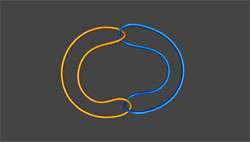
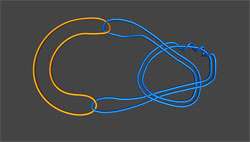
The configurations of knots shown in the two accompanying figures are inequivalent even in 4-dimensions, a fact first shown using the work of Harvey and Cochran. Since Harvey's observation is so fundamental, it pertains as well to the study of many other topological objects, and these applications form part of her on-going research program at Rice.
Source: Rice University, Images: Credit: Shelly Harvey/Rice University


