Metric Moon

January 9, 2007
Metric Moon

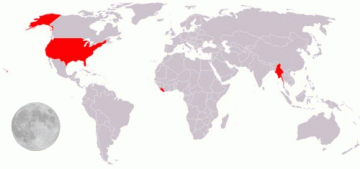
In this map, gray areas denote metric territory. English units are used primarily in red zones. The Moon is shown to scale. Credit: From Wikipedia, the free encyclopedia (www.wikipedia.org)

If you think in pounds and miles instead of kilograms and kilometers, you're in the minority. Only the United States, Liberia, and Burma still primarily use English units -- the rest of the world is metric. And now the Moon will be metric too.

NASA has decided to use metric units for all operations on the lunar surface when it returns to the Moon. The Vision for Space Exploration calls for returning astronauts to the Moon by 2020 and eventually setting up a manned lunar outpost.

The decision is a victory not only for the metric system itself, which by this decision increases its land area in the solar system by 27%, but also for the spirit of international cooperation in exploring the Moon. The decision arose from a series of meetings that brought together representatives from NASA and 13 other space agencies to discuss ways to cooperate and coordinate their lunar exploration programs. Standardizing on the metric system was an obvious step in the right direction.

"When we made the announcement at the meeting, the reps for the other space agencies all gave a little cheer," says Jeff Volosin, strategy development lead for NASA's Exploration Systems Mission Directorate. "I think NASA has been seen as maybe a bit stubborn by other space agencies in the past, so this was important as a gesture of our willingness to be cooperative when it comes to the Moon."

The meetings, which began in April 2006, included representatives from the Australian, Canadian, Chinese, European, French, German, British, Indian, Italian, Japanese, Russian, South Korean and Ukrainian space agencies, all of which are either planning or considering some form of lunar exploration. "Of course there's some competitiveness and national pride involved," Volosin says, "but we want to find areas where our goals overlap and see if cooperating in certain areas would be best for everyone."

Going metric was one of those areas. Agreeing to use a single measurement system will make the human habitats and vehicles placed on the Moon by different space agencies more compatible with each other. That could come in handy if, say, one agency's moonbase needs emergency spare parts from another agency's base. No need to worry about trying to fit a 15 millimeter nut onto a 5/8 inch bolt.

Emergencies aside, a metric standard will make it easier for countries to form new partnerships and collaborations after their lunar operations are already in place. All data will be in compatible units, whether it's scientific data or operational data -- such as how far a rover must travel to reach the edge of a crater. A single measurement system will make sharing this data and merging operations more seamless.

Although NASA has ostensibly used the metric system since about 1990, English units linger on in much of the U.S. aerospace industry. In practice, this has meant that many missions continue to use English units, and some missions end up using both English and metric units. The confusion that can arise from using mixed units was highlighted by the loss of the Mars Climate Orbiter robotic probe in 1999, which occurred because a contractor provided thruster firing data in English units while NASA was using metric.

NASA is considering adopting other standards for its lunar operations as well. For example, another idea that has been discussed informally by the space agencies is using the same type of internet protocols that we all use here on Earth today for communications systems developed for the Moon. "That way, if some smaller space agency or some private company wants to get involved in something we're doing on the Moon, they can say, hey, we already know how to do internet communications," Volosin says. "It lowers the barrier to entry."

In all, this push toward standards and cooperation gives the return to the Moon a very different feel than the Cold War space race of the 1950s and '60s. This time around, competition may help motivate nations to reach for the Moon, but cooperation will help to get them there.

Source: by Patrick L. Barry, Science@NASA

3.8 /5 (9 votes)  

Rank 3.8 /5 (9 votes)
Tags

Related Stories
Relevant PhysicsForums posts
  • Never ending outer space.....
    created3 hours ago
  • Neutron Star fragments?
    created5 hours ago
  • stationary or not?
    created9 hours ago
  • Scale of the Universe
    createdFeb 10, 2012
  • Titan's lack of impact craters
    createdFeb 09, 2012
  • Real pictures of black hole eating a star?
    createdFeb 08, 2012
  • More from Physics Forums - General Astronomy

More news stories

Europe stakes billion-dollar bet on new rocket

A pencil-slim rocket is scheduled to lift into space from South America on Monday, carrying a billion-dollar bet that Europe can grab a juicy slice of the market to place satellites in low orbit.

Space & Earth / Space Exploration

created 15 hours ago | popularity 3.5 / 5 (2) | comments 0

Political leaders play key role in how worried Americans are by climate change: study

More than extreme weather events and the work of scientists, it is national political leaders who influence how much Americans worry about the threat of climate change, new research finds.

Space & Earth / Environment

created Feb 06, 2012 | popularity 5 / 5 (6) | comments 72

NASA budget will axe Mars deal with Europe: scientists

US President Barack Obama's budget proposal to be submitted next week for 2013 will cut NASA's budget by 20 percent and eliminate a major partnership with Europe on Mars exploration, scientists said Thursday.

Space & Earth / Space Exploration

created Feb 10, 2012 | popularity 5 / 5 (3) | comments 48

Humans may have helped the decline of African rainforests 3000 years ago

(PhysOrg.com) -- Large areas of rainforests in Central Africa mysteriously disappeared over three thousand years ago, to be replaced by savannas. The prevailing theory has been that the cause was a change ...

Space & Earth / Environment

created Feb 10, 2012 | popularity 4.1 / 5 (14) | comments 19 | with audio podcast report

Could Venus be shifting gear?

(PhysOrg.com) -- ESA’s Venus Express spacecraft has discovered that our cloud-covered neighbour spins a little slower than previously measured. Peering through the dense atmosphere in the infrared, the ...

Space & Earth / Space Exploration

created Feb 10, 2012 | popularity 5 / 5 (8) | comments 10 | with audio podcast


Walney offshore wind farm is world's biggest (for now)

(PhysOrg.com) -- The Walney wind farm on the Irish Sea--characterized by high tides, waves and windy weather--officially opened this week. The farm is treated in the press as a very big deal as the Walney ...

GPS court ruling leaves US phone tracking unclear

A US Supreme Court decision requiring a warrant to place a GPS device on the car of a criminal suspect leaves unresolved the bigger issue of police tracking using mobile phones, legal experts say.

Europeans protest controversial Internet pact

Tens of thousands of people marched in protests in more than a dozen European cities Saturday against a controversial anti-online piracy pact that critics say could curtail Internet freedom.

Study finds that anti-diabetic medication can prevent the long-term effects of maternal obesity

In a study to be presented today at the Society for Maternal-Fetal Medicine's annual meeting, The Pregnancy Meeting, in Dallas, Texas, researchers will report findings that show that short therapy with the anti-diabetic medication ...

Netflix settlement trims 14 pct off 4Q earnings

(AP) -- Netflix pressed the rewind button on its fourth-quarter earnings after settling allegations that the video subscription service violated a consumer-privacy law.

Navy to begin tests on electromagnetic railgun prototype launcher

The Office of Naval Research (ONR)'s Electromagnetic (EM) Railgun program will take an important step forward in the coming weeks when the first industry railgun prototype launcher is tested at a facility ...