Rethinking last century's closest, brightest supernova
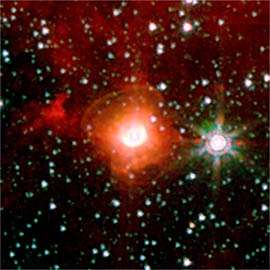
Twenty years ago next month, the closest and brightest supernova in four centuries lit up the southern sky, wowing astronomers and the public alike.
Ongoing observations of the exploded star, called supernova 1987A, provided important tests for theories of how stars die, but it also raised some new questions. Principal among these was how a bizarre, triple-ring nebula surrounding the supernova - ejected by the star a few thousand years before it exploded - originated. Astronomers devised a complicated theory that, within a relatively short period of time, the original star, a red supergiant, merged with a companion and started spinning rapidly, then underwent a transition to a blue supergiant, and finally exploded.
University of California, Berkeley, astronomer Nathan Smith has proposed a different theory for the origin of the nebula, arguing instead that SN1987A's progenitor star may have been in a class of unstable blue supergiant stars, called luminous blue variables, which eject material from their surfaces in recurring, volcano-like eruptions before they finally die in a supernova explosion.
Smith recently discovered two such blue supergiant stars with nebulae closely resembling the peculiarly shaped cloud of dust and gas around SN1987A. A third such nebula was already known.
"Taken together, the three closest analogs of SN1987A in our galaxy are all around blue supergiants; two of them have not gone through a red supergiant phase at all, and one was ejected as a luminous blue variable," said Smith, a UC Berkeley postdoctoral researcher. "This makes a pretty solid case that we should rethink models for how the rings around SN1987A were formed.
"If these other stars with rings are likely to explode, it may hint that LBVs and blue supergiants can explode even before becoming red supergiants, which would be a bit of a shock to our understanding of stellar evolution."
Smith will present his findings today (Tuesday, Jan. 9) at a press conference and an all-day poster session during the American Astronomical Society (AAS) meeting in Seattle.
The proximity of SN1987A, only 168,000 light years away in the Large Magellanic Cloud, and the availability of pre-existing data provided the first chance for astronomers to posthumously identify the star that exploded. Astronomers were surprised to find that it had been a hot blue supergiant - not a cooler red supergiant, as most theories predicted at the time.
Adding to the mystery, images taken in the early 1990s by instruments like NASA's Hubble Space Telescope revealed a bizarre, triple-ring nebula. The origin of this nebula and its shaping mechanism are still difficult to understand. The merger theory with conversion from red supergiant to blue supergiant before exploding has become the prevailing view because it accounts for both the blue supergiant and the shape of the nebula.
The surprise, Smith said, is that analysis of these new objects in our galaxy that resemble SN1987A provide good reasons to suspect that they ejected and shaped their nebulae while they were still blue supergiants, and not in the transition from red to blue as has been proposed for SN1987A. Furthermore, none of the three stars is spinning rapidly, as one might expect if it had recently merged with a close orbiting companion star. A merger and the subsequent red-to-blue transition are the key ingredients in the prevailing explanation for the nebula around SN1987A, but the three stars discussed by Smith apparently formed similar nebulae without either mechanism.
"We are seeing these nebulae before the stars blow up, and they look quite similar to the nebula around SN1987A," said Smith. "The trouble is, they may contradict how we think the nebula around SN1987A was formed."
According to Smith, the unusual nebula around SN1987A, looking like a figure 8, was originally interpreted to mean that the star had recently been a red supergiant that had shed its outer envelope in an expanding shell, but then turned into a blue supergiant before exploding. The blue supergiant generated a faster wind that overtook the earlier wind and became distorted.
"In that picture, the equatorial ring formed because the slow wind of the red supergiant had more material in the equator, so the waist of the blue supergiant wind was pinched," Smith said. "The fly in the ointment is that in order to get the enhanced density in the equator of the red supergiant, you need it to be spinning rapidly - but red supergiant stars don't do that because they are so big. So the only solution would be if the progenitor of SN1987A swallowed a companion star and the two merged, while the added angular momentum made the red supergiant spin to make a disk."
"This requires that the nearest and best observed supernova in modern history just happens to also be a freak, resulting from a coincidental merger event," he added.
While looking through images taken by NASA's Infrared Array Camera on the Spitzer Space Telescope, however, Smith noticed a similarly weird nebula around a nearby star designated HD168625. This star is a luminous blue variable (or LBV), an unstable massive star that burps from time to time and ejects a bipolar nebula as a blue supergiant, not a red supergiant. A well-known LBV is Eta Carinae, the brightest and most massive star in our Milky Way galaxy, weighing in at more than 100 solar masses.
"This new twin of the SN1987A nebula around an LBV gives us an alternative to the binary merger hypothesis for how these form," Smith said. "It hints that SN1987A may have ejected the nebula as a blue supergiant or an LBV, and not as a red supergiant."
Later, Smith identified a second ring nebula, identical in size to the equatorial ring around SN1987A but surrounding another blue supergiant in our galaxy. He found this in the Carina Nebula in the southern Milky Way in data taken by the 4-meter Blanco telescope at Chile's Cerro Tololo Inter-American Observatory, part of the National Optical Astronomy Observatory, and in images taken by one of two 6.5-meter Magellan telescopes in Chile.
The second star, called SBW1, has almost the same spectral type as the progenitor of SN1987A, but the chemical abundances in the nebula imply that it has not yet been a red supergiant. This directly contradicts the old picture for how the rings around SN1987A were formed, he said. A third similar object in our galaxy, called Sher 25, was already known, and it has chemical abundances that also suggest it has not yet been a red supergiant.
Source: UC Berkeley


