The cold truth about climate change and snow
What would the Earth be like if one fine day all the snow melted away?
Obviously, it would be a much warmer place. But what's interesting is how much warmer, says Stephen Vavrus, an associate scientist at the Center for Climatic Research at the University of Wisconsin-Madison.
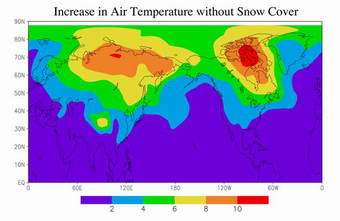
Image: If all the planet's snow were to melt away, Earth would on average be around eight-tenths of a degree Celsius warmer, according to Stephen Vavrus, an associate scientist at the Center for Climatic Research at the University of Wisconsin-Madison. Vavrus generated computer simulations of a snow-free world to assess snow's impact on several climatic variables such as temperature and atmospheric circulation. This map illustrates the effects across the globe. Graphic: Stephen Vavrus, Center for Climatic Research
Working with computer-generated simulations, Vavrus found that in the absence of snow cover, global temperatures would likely spike by about eight-tenths of a degree Celsius. That increase represents as much as a third of the warming that climate change experts have predicted, should levels of heat-trapping greenhouse gases double.
"This was not just a what-if question," says Vavrus, whose work comes amidst mounting reports on the steady melt of Arctic ice. "I wanted to quantify the influence of global snow cover on the present-day climate because that has relevance for the type of climate changes we are expecting in the future." Vavrus will discuss his findings today during the fall meeting of the American Geophysical Union (Dec. 5-9, 2005).
Vavrus, a climate modeling specialist, digitally simulated a snow-free world, and measured the impact of missing snow cover on a range of climatic variables including soil temperatures, cloud cover, atmospheric circulation patterns and soil moisture levels.
Aside from his temperature-related projections, Vavrus also made the counterintuitive finding that in the absence of snow, total regions of permafrost-the permanently frozen soil of the cold north-are likely to expand in area. Without the insulating effect of snow, in other words, soils in colder regions of the world are in fact likely to get much colder. The surprising result has implications for the health of permafrost-associated ecosystems, and may influence decisions in the field of construction.
Already, permafrost changes have triggered structural problems in Alaskan buildings and roadways, says Vavrus, and "there's every reason to think we'll see even stronger effects in the future," he adds.
In forthcoming simulations, Vavrus plans to continue exploring the effects of both nearby and faraway snow cover on local climate conditions.
Source: University of Wisconsin


