A beneficial suicide
January 10, 2007 Neutrophil Granulocytes

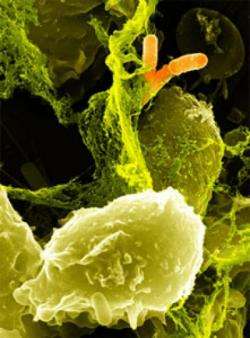
Neutrophil granulocytes have trapped Shigella bacteria in NETs. Credit: Dr. Volker Brinkmann, Max Planck Institute for Infection Biology

They are the largest group of white blood cells: neutrophil granulocytes kill microorganisms. Neutrophils catch microbes with extracellular structures nicknamed Neutrophil Extracellular Traps (NETs) that are composed of nucleic acid and aggressive enzymes.

A group of scientists lead by Arturo Zychlinsky at the Max-Planck-Institute for Infectious Biology in Berlin, Germany discovered, how the neutrophils form this snaring network (Journal of Cell Biology, online, January 8, 2007).

Once triggered, the cells undergo a novel program leading to their death. While they perish, the cells release the content of their nuclei. The nucleic acid, mingled with bactericidal enzymes, forms a lethal network outside the cell. Invading bacteria and pathogenic fungi get caught and killed in the NETs.

Every minute, several million neutrophils leave the bone marrow and are ready to defend the body of invading germs. They are the immune systemâ€TMs first line of defence against harmful bacteria and migrate into the tissue at the site of infection to combat pathogens. For more than hundred years it was known that neutrophil granulocytes kill bacteria very efficiently by devouring them. After eating the germs neutrophils kill tehm with antimicrobial proteins.

The group of scientists lead by Arturo Zychlinsky at the Max-Planck-Institute for Infectious Biology discovered a second killing mechanism: neutrophil granulocytes can form web-like structures outside the cells composed of nucleic acid and enzymes which catch bacteria and kill them. The scientists were able to generate impressive micrographs of these nets. But it remained a mystery how the granulocytes could mobilise the contents of their nuclei and catapult it out of the cells.

Only after lengthy live cell imaging and biochemical studies it became clear how neutrophils make NETs. The cells get activated by bacteria and modify the structure of their nuclei and granules, small enzyme deposits in the cytoplasm. "The nuclear membrane disintegrates, the granules dissolve, and thus the NET components can mingle inside the cells", explains Volker Brinkmann, head of the microscopy group. At the end of this process, the cell contracts until the cell membrane bursts open and quickly releases the highly active melange. Once outside the cell, it unfolds and forms the NETs which then can trap bacteria.

Surprisingly, this process is as effective as devouring bacteria: "NETs formed by dying granulocytes kill as many bacteria as are eaten up by living blood cells", says Arturo Zychlinsky. Thus, neutrophils fulfil their role in the defence battle even after their deaths.

Citation: Tobias A. Fuchs, Ulrike Abed, Christian Goosmann, Robert Hurwitz, Ilka Schulze, Volker Wahn, Yvette Weinrauch, Volker Brinkmann and Arturo Zychlinsky, Novel Cell Death Program Leads to Neutrophil Extracellular Traps, Journal of Cell Biology, online published, January 8, 2007

Source: Max-Planck-Gesellschaft


print this article email this article download pdf blog this article bookmark this article     Stumble it Digg this share on Facebook retweet share on Reddit add to delicious
Rate this story - 3.7 /5 (6 votes)


January 10, 2007 all stories

Comments: 0

3.7 /5 (6 votes)
  • Stumble this up

  • Digg this

  • share this

  • hide
  • Related Stories

  • First-ever blueprint of a minimal cell is more complex than expected
    created 23 hours ago | popularity not rated yet | comments 0
  • Knockouts in human cells point to pathogenic targets
    created Nov 26, 2009 | popularity not rated yet | comments 0
  • Plasma produces KO cocktail for MRSA
    created Nov 26, 2009 | popularity not rated yet | comments 0
  • Cells defend themselves from viruses, bacteria with armor of protein errors
    created Nov 25, 2009 | popularity not rated yet | comments 0
  • Researchers discover biological basis of 'bacterial immune system'
    created Nov 25, 2009 | popularity not rated yet | comments 0


Other News

Hammerhead shark

Wide heads give hammerheads exceptional stereo view

Biology / Plants & Animals

created 6 hours ago | popularity 4.3 / 5 (4) | comments 3

Hammerhead sharks are some of the Ocean's most distinctive residents. 'Everyone wants to understand why they have this strange head shape,' says Michelle McComb from Florida Atlantic University. One possible ...


Tough yet stiff deer antler is materials scientist's dream

Biology / Plants & Animals

created 6 hours ago | popularity not rated yet | comments 1

Prized for their impressive antlers, red deer have been caught in the hunters' sights for generations. But a deer's antlers are much more than decorative. They are lethal weapons that stags crash together when duelling. John ...


Indonesia rejects Bali plan for turtle sacrifices (AP)

Indonesia rejects Bali plan for turtle sacrifices

Biology / Ecology

created 4 hours ago | popularity not rated yet | comments 0

(AP) -- Indonesia has rejected a push by the resort island of Bali for rare turtles to be legally slain in Hindu ceremonies, siding with conservationists of the protected reptiles against religious advocates, ...


Ecologists sound out new solution for monitoring cryptic species

Biology / Ecology

created 6 hours ago | popularity not rated yet | comments 0

Ecologists have at last worked out a way of using recordings of birdsong to accurately measure the size of bird populations. This is the first time sound recordings from a microphone array have been translated into accurate ...


First-ever blueprint of a minimal cell is more complex than expected

First-ever blueprint of a minimal cell is more complex than expected

Biology / Cell & Microbiology

created 23 hours ago | popularity 5 / 5 (17) | comments 4

What are the bare essentials of life, the indispensable ingredients required to produce a cell that can survive on its own? Can we describe the molecular anatomy of a cell, and understand how an entire organism ...