UW Scientists Research DNA, RNA Mysteries
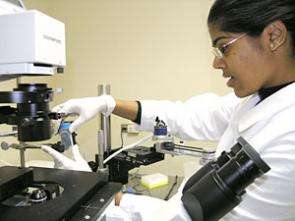
About 19.7 million Web pages in a Google search seek to explain DNA transcription and RNA translation in the cell at the mysterious molecular level. University of Wyoming College of Agriculture Professor Jordanka Zlatanova only needs to use an 18-inch piece of cable television wire to educate the molecular biology illiterate. She twists and untwists the wire and drags it through her fingers to show how protein machines pull and unlock like a zipper the double helix of DNA.
It gets a little more technical after that.
Unraveling the intricacies of DNA transcription and RNA translation could help millions. There are more than 2,000 genetic diseases caused by factors that create mutations (changes) in the DNA, and hence changes in the encoded proteins. Understanding those processes could correct genetic problems.
“This is not easy to do. Perhaps 50 years from now, but not yet,” says Zlatanova, head of the Department of Molecular Biology. “It’s not only a question of figuring out defects in the DNA. In breast cancer, a specific gene is changed and transferred from mother to daughter. If you figure out what changed in the genetic information and you have a normal copy of the DNA, then how do you get rid of the defective gene&?rdquo;
The unknown tickles her curiosity. Research that provides understanding is good, but it also allows the applied side in which we can understand and treat diseases, she says. “It’s a combination of just natural curiosity plus the realization that what you do one day may have direct application.”
Evanescent field fluorescent microscopes and magnetic tweezers that allow researchers to peer at and manipulate the stuff of life -- Zlatanova loves this. She’s been a researcher since she received her master’s degree 39 years ago.
“I can’t imagine how I could live without doing this,” says Zlatanova, who recently gave the keynote address at an international chromatin research conference in Japan. “You uncover the secrets of nature. Nature keeps its secrets. Nothing is more fascinating than living matter.”
Chromatin structure and dynamics fascinate Zlatanova. Chromatin is a DNA/protein complex that organizes the entire DNA of the nucleus in animal and plant cells.
Information is passed from the DNA to the RNA through transcription. Then information is passed from RNA to the proteins through translation.
Scientists want to know how that is done.
“That is life!” exclaims Zlatanova. “If you don’t have those two processes, nothing will happen.”
It happens in bacteria. It happens in plants. It happens in us.
DNA is tightly wrapped around the protein complex but at certain times a portion of the DNA is accessible.
“The amount of DNA is huge,” she notes. “About one and a half meters of DNA are compacted into the tiny nucleus. How does that work? All the protein molecules must have access to the DNA.”
Scientists want to know what makes the DNA spontaneously open and provide access to the protein machinery.
There’s a lot of interest in this area of research now, says Zlatanova. Roger Kornberg of Stanford in October won the Nobel Prize for Chemistry for research into transcription in chromatin.
Zlatanova’s team of six uses single molecule techniques to study the chromatin mysteries. A fluorescent microscope enables single molecules to be viewed. Magnetic tweezers unravel the DNA using an external magnetic field to twist or untwist the DNA double helix.
“Very few labs in the world have this equipment,” notes Zlatanova, who credits the university for the funds.
Her research team includes post-doctorate associates Miroslav Tomschik, Amit Thakar and Satoru Fujimoto, graduate students Pooja Gupta and Kayoko Hayashihira, and Corrine Seebart, technician. The equipment enables researchers to study the processes close to cell environment.
“The poor DNA in the cell undergoes all kinds of pushing and pulling all the time,” Zlatanova says. “The nucleotide sequence in the gene has to be copied into the protein. How."
Source: University of Wyoming


