Interactive binary stars show signs of induced hyperactivity
Astronomers studying highly energetic binary stars called polars have obtained the first observational evidence that the intense magnetic fields produced by the white dwarf half of the interacting pair can induce flares, sunspots and other explosive activity in its otherwise low-wattage, low-mass partner.
"Like Dr. Frankenstein zapping an inert corpse, the white dwarfs in these systems produce very strong electrical currents inside the bodies of their partner star, which can create violent eruptions where there otherwise would be very little if any," said Stella Kafka, an astronomer at the National Optical Astronomy Observatory and lead author of one of two related research papers presented Jan. 7 in Seattle at the meeting of the American Astronomical Society. "These transitory phenomena occur on human time scales, lasting from minutes to years."
Decades ago, astronomers found evidence that other sun-like stars show large optical flares, star-spots, X-ray emission and other energetic activity cycles, especially when they are part of binary systems. In binaries, fast rotation rates and tidal interactions between the two stellar components are the primary contributors to the observed activity.
By contrast, the low-mass partners in polars (also known as magnetic cataclysmic variables) can be as small as the planet Jupiter, and range in mass from about 20 percent of the sun down to brown-dwarf-like objects with 5 percent or less of a solar mass. The masses of these companions are theoretically too low for conventional sun-like internal dynamos to be possible.
Thus, the surface activity detected by these studies is likely greatly enhanced by the white dwarf's strong magnetic field passing through the secondary low-mass star, causing large-scale electric currents in its interior. This flow of charged particles creates an effective dynamo mechanism.
"This discovery points to a new mechanism for the generation of stellar activity by forces outside of the star itself, a phenomenon that we have dubbed 'hyperactivity,'" said co-author Steve B. Howell of NOAO and the WIYN observatory.
Over the past two years, a team of astronomers consisting of Kafka, Howell, Kent Honeycutt (Indiana University), Fred Walter (State University of New York), Thomas Harrison (New Mexico State University) and Jeff Robertson (Arkansas Tech University) have carefully observed four polars (in particular, EF Eridanus and ST Leo Minor) using the 2.1-meter, 4-meter and WIYN 3.5-meter telescopes at Kitt Peak National Observatory, the Magellan 6.5-meter telescope and the ESO Very Large Telescope in Chile, for more than 20 nights of observing.
"Careful analysis of the resulting data shows strong evidence for the formation and structure of starspots and gigantic prominences and loops in the low-mass partner in these polars," Kafka said.
This is the first time that astronomers have strong observational evidence that strong magnetic-field interactions between the stars in a close binary system may be the primary ingredient for the formation of large starspots and flares.
Polars are binaries consisting of a white dwarf (an old star with a mass of one-half to one times that of the sun but a diameter approximately equal to Earth's), and a very cool, red, low-mass stellar object. The two stars are trapped in a close orbit about each other (separated by less than the diameter of the sun), completing a full circle in only 80 to 180 minutes.
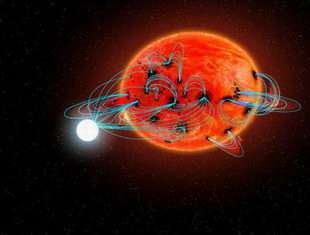
"The interaction between the two stars creates a spaghetti-like pattern of magnetic field lines between the two stars," Howell said. "These magnetic fields confine gas around and between the two components and are responsible for triggering the enhanced activity on the low-mass star."
The artist's concept (see above) visualizes such an effect: it shows a cool low-mass red star with a highly magnetic white dwarf locked in a tight orbit by gravity. The interacting magnetic field lines (blue) produce large coronal loops on the low-mass red star, allowing for high-temperature material to flow along them as well as become trapped in them, similar to large loop-like prominences observed on the sun.
These systems can be looked at as scaled-up versions of exoplanet systems consisting of a sun-like star and a massive Jupiter-like planet in close orbit. As the planet orbits around its parent star, the outer atmosphere of the star responds to the passage of the planet.
Observations suggest that the magnetic field of the star permeates the planet and allows magnetic loops to reconnect by using the planet as a conductor. As a result, energetic activity would be induced in the planet's atmosphere, resulting in small flares and events similar to an aurora on Earth. The similar (though higher-level) phenomenon in magnetic cataclysmic variables is easier to study and therefore can provide more detailed information about such interactions, eventually leading to a comprehensive model.
Source: Indiana University


