Scientists discover new life forms in the Arctic Ocean
January 12, 2007 Phycobiliphyta

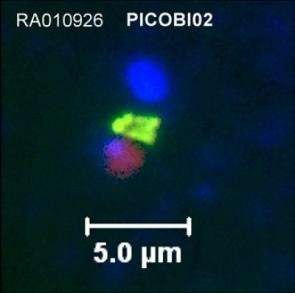
The picture shows a phycobiliphyta cell in fluorescence microscope. The cell nucleus is colored in blue, the cytoplasma in green. The red fluorescence comes from a plastide with phycobiliproteins, pigments that usually occur in red algae, cyanobacteria and cryptophyceae. The cell measures 2x5 µm (1µm = 1/1000 millimeter). Credit: Fabrice Not/Station Biologique de Roscoff

An international group of researchers has succeeded in identifying a previously unknown group of algae. As currently reported in the scientific journal Science, the newly discovered algae are found among the smallest members of photosynthetic plankton - the picoplankton.

On account of the minute size of the organisms (no more than a few thousandth of a millimetre) and the appearance of phycobili-proteins, researchers have termed the new group Picobiliphyta.

Approximately 50 percent of global photosynthesis is conducted in the world's oceans where it is dominated by microscopic algae, the so-called phytoplankton. Scientists estimate that up to 90 percent of phytoplanktonic species are currently unidentified. In the present study, scientists used molecular techniques to investigate the smallest members of the plankton, the picoplankton. Because picoplankton algae are so extremely small, they are almost impossible to study by means of microscopy.

Researchers investigated gene sequences of the 18S gene, common to all cells. The identity of new organisms can be deduced from a comparison of familiar and unfamiliar gene sequences. "The gene sequences found in these algae could not be associated with any previously known group of organisms", explain Dr Klaus Valentin and Dr. Linda Medlin, co-authors of the study and molecularbiologists at the Alfred Wegener Institute in Bremerhaven.

The algae in this study were found in plankton samples originating from various regions of the North Atlantic and the Mediterranean. The scientists have discovered a group of organisms which, despite being completely new to science, have a wide distribution.

"This is a good indication for how much there is still to discover in the oceans, especially using molecular tools", says Valentin. Apart from the unfamiliar gene sequences, the researchers also extracted phycobili-proteins from the algae. In red algae, for example, these proteins occur as colour pigments. However, in the newly discovered algal group, the phycobili-proteins are found at the sites for photosynthesis, i.e. in the plastids.

This location of pigment proteins represents a novelty in that it has not been reported for any other algal species. Hence, it provides a clear indication that the researchers are dealing with a previously unidentified species of algae. Referring to their small size and the presence of phycobili proteins, the researchers named the new group Picobiliphytes.

Source: Alfred Wegener Institute for Polar and Marine Research


print this article email this article download pdf blog this article bookmark this article     Stumble it Digg this share on Facebook retweet share on Reddit add to delicious
Rate this story - 4.2 /5 (36 votes)


January 12, 2007 all stories

Comments: 0

4.2 /5 (36 votes)
  • Stumble this up

  • Digg this

  • share this

  • hide
  • Related Stories

  • Photoswitches shed light on spontaneous free swimming in zebrafish (w/ Video)
    created Sep 16, 2009 | popularity not rated yet | comments 0
  • Professor hatches century-old eggs to study evolution
    created Jul 17, 2009 | popularity not rated yet | comments 0
  • Midget plant gets makeover
    created Jun 22, 2009 | popularity not rated yet | comments 0
  • Researchers predict large 2009 Gulf of Mexico 'dead zone'
    created Jun 18, 2009 | popularity not rated yet | comments 0
  • Studies shed light on collapse of coral reefs (w/Video)
    created May 28, 2009 | popularity not rated yet | comments 0


Other News

Indian engineer invents device to stop rampaging elephants

Biology / Plants & Animals

created 11 minutes ago | popularity not rated yet | comments 0

An Indian inventor has created a device to stop rampaging elephants in their tracks, amid concern about human injuries and deaths when they run amok, his company said Monday.


It's a gas: New discovery may lead to heartier, high-yielding plants

Biology / Biotechnology

created 11 minutes ago | popularity 5 / 5 (1) | comments 0

In a research report published in the November 2009 issue of the journal Genetics, scientists show how a family of genes (1-aminocyclopropane-1-carboxylate synthase, or ACS genes) are responsible for production of ethyle ...


Measuring and modeling blood flow in malaria

Biology / Cell & Microbiology

created 3 hours ago | popularity not rated yet | comments 0

When people have malaria, they are infected with Plasmodium parasites, which enter the body from the saliva of a mosquito, infect cells in the liver, and then spread to red blood cells. Inside the blood cells, the parasites ...


Bioengineers succeed in producing plastic without the use of fossil fuels

Biology / Biotechnology

created 2 hours ago | popularity not rated yet | comments 0

A team of pioneering South Korean scientists have succeeded in producing the polymers used for everyday plastics through bioengineering, rather than through the use of fossil fuel based chemicals. This groundbreaking research, ...


Beyond sunlight: Explorers census 17,650 ocean species between edge of darkness and black abyss

Beyond sunlight: Explorers census 17,650 ocean species between edge of darkness and black abyss (w/ Video)

Biology / Plants & Animals

created 19 hours ago | popularity 4.9 / 5 (12) | comments 0

Census of Marine Life scientists have inventoried an astonishing abundance, diversity and distribution of deep sea species that have never known sunlight - creatures that somehow manage a living in a frigid ...